
Mesa presents workforce development strategy; emphasizes partnerships, data dashboards and Mesa College Promise
Get AI-powered insights, summaries, and transcripts
Sign Up Free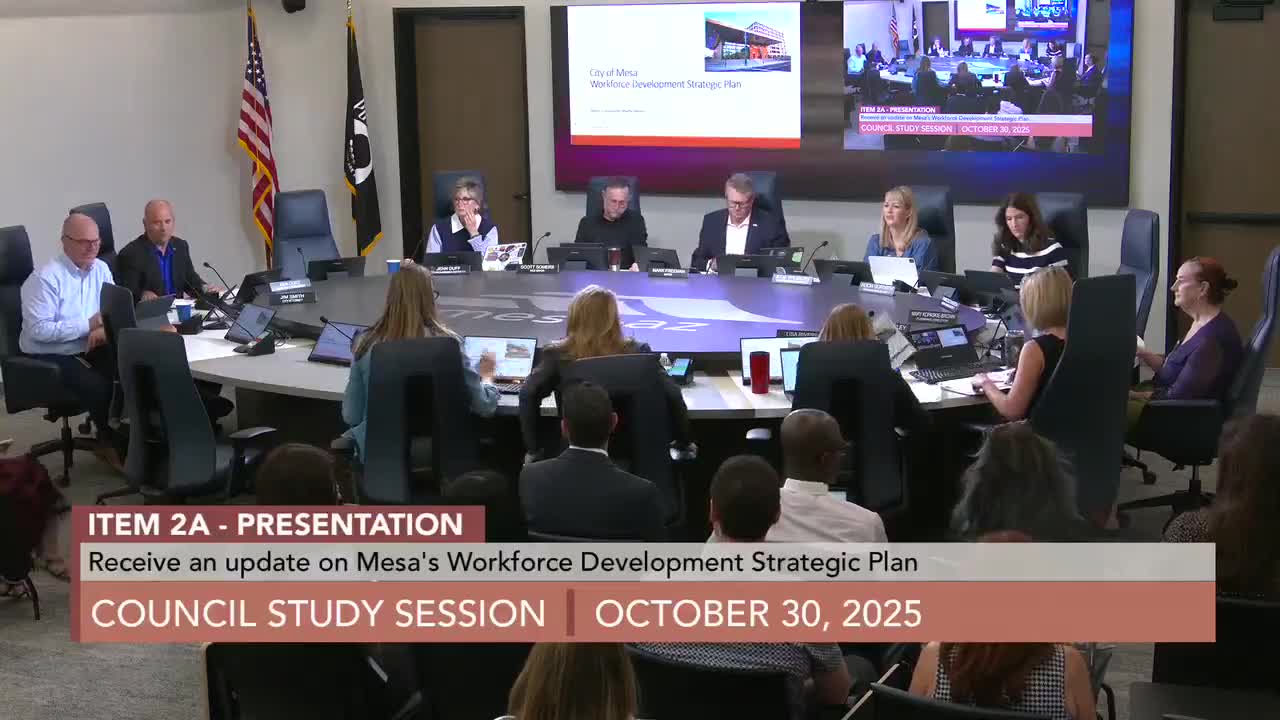
Summary
City economic development and workforce staff presented an update on Mesa's workforce development strategy that prioritizes partnerships, data-driven metrics and postsecondary access.
City economic development and workforce staff presented an update on Mesa's workforce development strategic plan, stressing the city's role as a convener and partner rather than as the direct provider of K-12 instruction.
Jay O'Donnell, economic development director, and Sarah Tolar, education and workforce administrator, outlined a multi-year effort dating to 2010 and cited milestones including Mesa K Ready (2018), Achieve60AZ stateside goals and the Mesa College Promise. "You cannot have workforce development without education," O'Donnell said, noting third-grade reading and eighth-grade math proficiency as critical leading indicators for future labor-market outcomes.
Staff described four priorities: supporting workforce alignment and growth, building intentional cross-sector connections, enhancing internal workforce development (including an employee tuition-reimbursement program) and improving postsecondary attainment. Examples included a public-facing data dashboard developed with Data Achievement; quarterly convenings among economic development, K-12 and postsecondary partners; industry-focused hiring events with Maricopa County; and the Mesa College Promise, which the presentation said has grown from roughly 50 initial enrollees to about 250 per year.
Councilmembers pressed staff on metrics and results. Councilmember Go Forth asked why overall attainment hadn't improved since 2010; staff responded that some programs (Mesa College Promise) are recent and that broader economic trends (recessions, unemployment) also affect postsecondary enrollment. Staff said they can disaggregate progress-meter metrics by school, district and census geography to target interventions. "We can drill down as deeply as to third grade classes," staff said.
Presenters said the strategy is designed to be data-driven, to align city and regional resources, and to remove barriers to education. Staff urged continued, multi-stakeholder engagement and signaled plans to measure outcomes and refine programs over time.