
Utah Supreme Court hears challenge over opt-out deadline and whether disputed Summit County incorporation election should proceed
Get AI-powered insights, summaries, and transcripts
Subscribe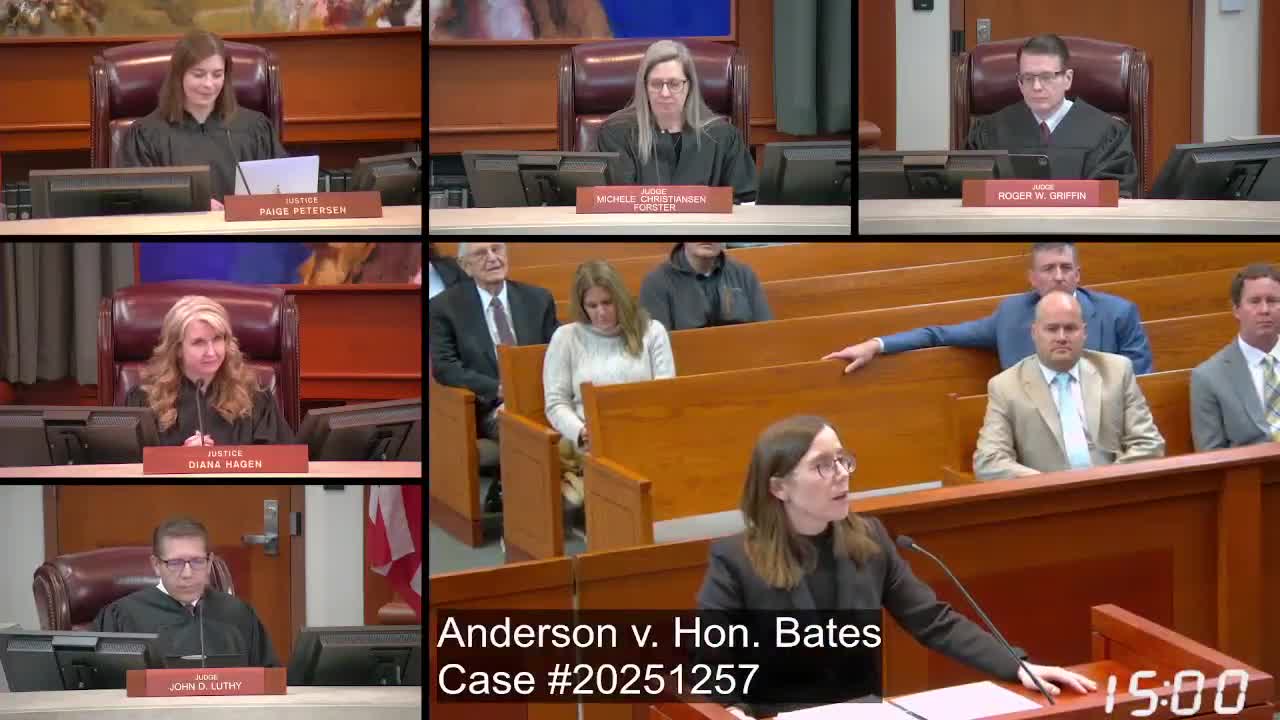
Summary
In oral argument before the Utah Supreme Court, Caroline Olsen, counsel for petitioner Derek Anderson, urged the court to reverse a district court ruling that struck down parts of the stateincorporation law and to allow a contested Summit County incorporation election to proceed; respondentscounsel said the election is compromised and that affected landowners face disenfranchisement and other harms.
SALT LAKE CITY In oral argument before the Utah Supreme Court, Caroline Olsen, counsel for petitioner Derek Anderson, asked the court to reverse a district courtruling that struck down parts of the stateincorporation statute and to allow a disputed Summit County incorporation election to proceed.
"The question before the court is whether an election should be canceled because a district court wrongly ruled that a statute is unconstitutional under rational basis review. It should not for 3 reasons," Olsen told the justices, listing (1) the statuteis constitutional, (2) Anderson and the public would face irreparable harm if the election were canceled, and (3) the record shows the election can still be free and fair.
The case centers on statutory amendments that set deadlines for when specified landowners may exclude their property from proposed incorporation boundaries. Petitioners argue the cutoff treats similarly situated landowners differently and that the district court was correct to find the statute unconstitutional; Olsen countered that the statute serves multiple legitimate legislative ends, including establishing predictable deadlines to assess feasibility and to finalize boundaries for a ballot. She emphasized that the area at issue has a small population (she said the areapopulation is about 103) and that only one question appears on the county ballot for affected voters, making post-decision canvassing and in-person voting feasible.
Olsen also invoked the Purcell principle and recent U.S. Supreme Court authority, arguing that when a lower court alters election rules near an election, this court should correct a constitutional error rather than allow an election to be canceled because of confusion the lower court introduced. "Once that error has been injected by the district court, the Supreme Court should come in and rectify that constitutional error," she told the justices, citing Republican National Committee v. Democratic National Committee (May 2023) in her argument.
Respondentscounsel Janet Conway disputed that relief is appropriate and said the election has been compromised by confusion, alleged manipulation of boundaries and voter-registration questions. "The election is completely compromised," Conway told the court, describing property owners in the area as primarily second-home owners who, she said, may be ineligible to vote under the election code and who rely on private infrastructure such as roads and wells. Conway said some residents were advised by the county clerk that if they had returned a blank ballot after the district courtnotice they were not permitted to come in and fill out a corrected ballot.
Justices pressed both sides on legal standards and remedies. They asked whether the challenge is an as-applied attack or a facial challenge, and whether Utahcase law requires a separate reasonableness inquiry under the stateconstitutionthe so-called uniform-operations clause. Olsen said the substantive standard for review is correctness of the lower courtruling under rational-basis review and stressed deference to the legislature on economic and property classifications; respondents argued the statutory choice creates an arbitrary, burdensome classification for specified landowners that warrants closer scrutiny under Utah precedent.
The court also explored practical fallout. Counsel and several justices discussed what a remand or reversal would require of county election officials, whether ballots already mailed could be counted, and whether the certification could simply be re-used for a future election cycle. Olsen urged clarity for local officials and said the court has authority, in appropriate language, to direct officers charged with administering elections to preserve the courts jurisdiction and effectuate any writ. Conway responded that rescinding the district courtorder later would not compensate landowners who relied on the district courtruling to stand down and that rerunning the election in a subsequent cycle would not necessarily be an adequate remedy.
Both sides warned of likely additional litigation depending on the courts ruling. Olsen said reversing the district court would protect votersinterest in voting on a certified measure and avoid inviting a wave of disparate challenges to the incorporation statute; Conway said allowing the election to proceed amid questions about registration and boundary manipulation would spawn litigation about voter eligibility and the fairness of the process.
The court took the matter under advisement at the close of argument. No immediate ruling was announced.