Get Full Government Meeting Transcripts, Videos, & Alerts Forever!
Get email alerts on the Land Use topic
No spam. Unsubscribe anytime.
Board refers Town and Country Village (El Dorado) project back to planning commission after lengthy hearing
Summary
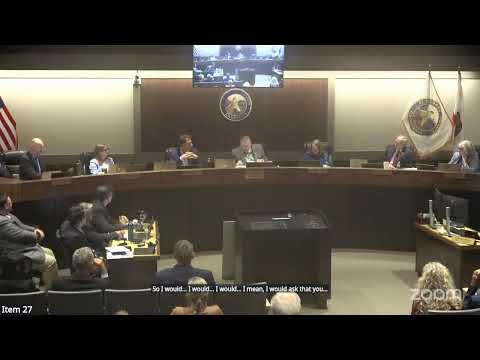
After a marathon hearing and several dozen public comments, the El Dorado County Board of Supervisors referred the Town and Country Village (El Dorado) project back to the Planning Commission for additional review of sewer/water conditions, project scale and related conditions.
The El Dorado County Board of Supervisors on Oct. 28 opened a multi‑entitlement hearing on the Town and Country Village (El Dorado) project — a proposal that would amend the Bass Lake Hills Specific Plan and the county General Plan, rezone roughly 60 acres, certify a Final Environmental Impact Report and approve a plan development permit, tentative map and conditional use permit for a mixed resort, lodging and village concept.
Project summary
The applicant and its consultants said the project development area includes two five‑story hotels (150 rooms each), a civic/event center with museum and retail, and a northern “residential cottage” village of 112 cottages (56 proposed as workforce/employee housing; 56 available as market‑rate rentals). The larger program study area was analyzed programmatically in the EIR and includes potential future multifamily residential and commercial uses; the applicant has presented an “alternative” rezoning map that would delay PD overlay application to the program study area and require further review for any future development there.
Key technical points raised
– Sewer/water: The EIR studied two public sewer alignment options (roughly 10,000 feet of new pipe; applicant’s preferred alignment runs west then south to tie into existing Rusey Ranch sewer infrastructure). Estimated public‑sewer construction cost cited by staff is approximately $7 million; water connection and required EID annexation were also documented. The applicant proposed on‑site septic systems only as an interim or fallback option limited to the immediate project development area if off‑site sewer easements could not be obtained. Planning staff’s recommended draft conditions state that if easements cannot be acquired and the board chooses not to pursue eminent domain, the project development area may be built using a state‑permitted septic alternative, but annexation to EID would be required before development proceeds in the program study area.
– Traffic and CIP: County DOT confirmed the project would widen a segment of Bass Lake Road to four lanes and contribute to transportation impact fees; however DOT and staff cautioned that some interchange improvements are costly and depend on future CIP revenues and grants. The applicant described additional contributions into the Bass Lake Hills PFFP and TIF programs.
– CEQA and biological resources: Consultants described mitigation measures for nesting birds and other special‑status species and said the FEIR responds to comment. Labor and union‑retained experts asked for recirculation on biological and diesel particulate/air impacts; staff and consultants said revisions to mitigation were clarifications and did not trigger CEQA recirculation thresholds, and noted project mitigations require pre‑construction surveys and other standard measures.
Public comment
More than 50 people commented in person and online over a multi‑hour period. Supporters — including local residents, tourism and business advocates, and an arts‑and‑culture group — praised the design, museum and potential economic benefits (applicant estimated an annual $2.6 million net contribution to the county general fund). Opponents and community groups said the project would erode the Bass Lake Hills open‑space buffer, overload transportation and emergency services, and risk water and sewer shortfalls; several local service districts and labor groups asked for clearer mitigation or additional review.
Planning Commission position and board action
The Planning Commission (on Sept. 10) recommended certifying the Final EIR and adopting CEQA findings, but voted narrowly on related land‑use entitlements and added recommendations that the project connect to public sewer upon commencement and that future development in the program study area not exceed the programmatic totals analyzed in the EIR. After the Oct. 28 hearing, the board voted to refer the matter back to the Planning Commission with direction to refine sewer/water conditions (including annexation/timing), align fire/DOT conditions so they are consistent and revisit height/scale questions and the program‑area rezoning approach. The motion to refer was approved by voice vote.
What happens next
The project will return to the Planning Commission for additional review and then back to the Board of Supervisors for final discretionary action if staff and the applicant proceed. The referral preserves options for the board to require off‑site public sewer connections and to insist on more specific limits for the program study area before granting final entitlements.