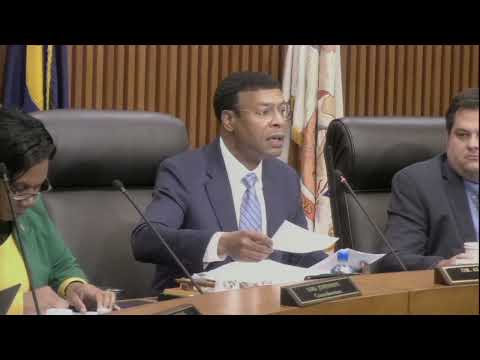
Norfolk council approves conditional rezoning for Kalana Shipyard after contested public hearing
Loading...
Summary
At a meeting of the Norfolk City Council, members considered and adopted an ordinance to rezone property at 344 West Indian River Road and 335–350 Emmett Place from multifamily/residential plan‑development districts to a conditional Industrial Deepwater District requested by Kalana Shipyard.
At a meeting of the Norfolk City Council, members considered and adopted an ordinance to rezone property at 344 West Indian River Road and 335–350 Emmett Place from multifamily/residential plan‑development districts to a conditional Industrial Deepwater District requested by Kalana Shipyard.
The rezoning, which the planning commission recommended 6–1, drew extensive public comment from Berkeley residents and allied organizations who said the neighborhood already bears industrial impacts and should not be further industrialized without enforceable mitigation and community benefits. Michelle Olche, representing 1,252 members of Chesapeake Climate Action Network in the City of Norfolk, said, “We strongly oppose the proposed rezoning request” and urged the council to reject it on grounds of climate resilience and environmental justice.
Residents described decades of noise, sandblasting dust, bright yard lighting and truck traffic. Pastor Robert Green of Burning Bush Worship Center, which sits adjacent to the site, told the council, “We want shipbuilding to flourish in Berkeley, but not dispense of anyone’s health, welfare, or well‑being.” Multiple speakers said prior city plans had identified the parcel for housing and community uses; they asked the council to require independent environmental and health impact assessments, a community benefit agreement and enforceable mitigation before permitting any expansion.
Mayor and staff repeatedly clarified that the council’s action concerned only a land‑use designation. As the mayor said during the hearing, “this is not a proposed expansion, what we’re voting on tonight,” and city staff noted that any building, land disturbance or new ingress/egress would require separate site‑plan and permitting review. Staff also said operational regulatory matters such as sandblasting and emissions fall under the Virginia Department of Environmental Quality’s permitting and enforcement, not the zoning vote.
Kalana’s counsel, Rob Beeman, said the rezoning is intended in part to relocate parking and storage uses out of the existing shipyard, which he said would free space for reconfiguration at the current shipyard and could reduce certain neighborhood impacts. “We see this application as helping to address those concerns and not making those concerns worse,” Beeman told council members. Jordan Webb, identified in the hearing as Kalana’s president and general manager, attended and was available to answer questions.
Council members debated outreach and accountability. Several cited a strategic vision and community plan that Kalana provided to the Civic League in 2024 and urged the company to follow through on measurable, time‑bound commitments; others urged the city and applicant to develop enforceable remedies and continued resident engagement. Council members also noted limits on municipal authority: the DEQ and other state or federal agencies retain primary enforcement authority over certain industrial operations and over dredging permits referenced by residents.
The rezoning ordinance was called and a roll call recorded. Individual council members made statements on the record before casting votes; several contemporaneous comments pledged ongoing oversight, community meetings and follow‑up on mitigation measures should the applicant pursue later permits.
Next steps: rezoning changes allowable land uses under the zoning code but does not, by itself, authorize construction or ground disturbance. Any future building, site work, or changes in access would require site‑plan review, engineering approvals, and applicable environmental permitting. Residents and the applicant both emphasized that additional permitting steps and outreach would be required if the applicant moves forward with development or operational changes.
Reported planning commission recommendation: 6–1. Transcript records extensive public opposition and applicant and staff statements; the applicant reported ongoing engagement with the Civic League and a Berkeley strategic vision document dating to 2024.