
Board votes to close Cook Literacy Model, adopt boundary map option 1 and surplus property
Get AI-powered insights, summaries, and transcripts
Subscribe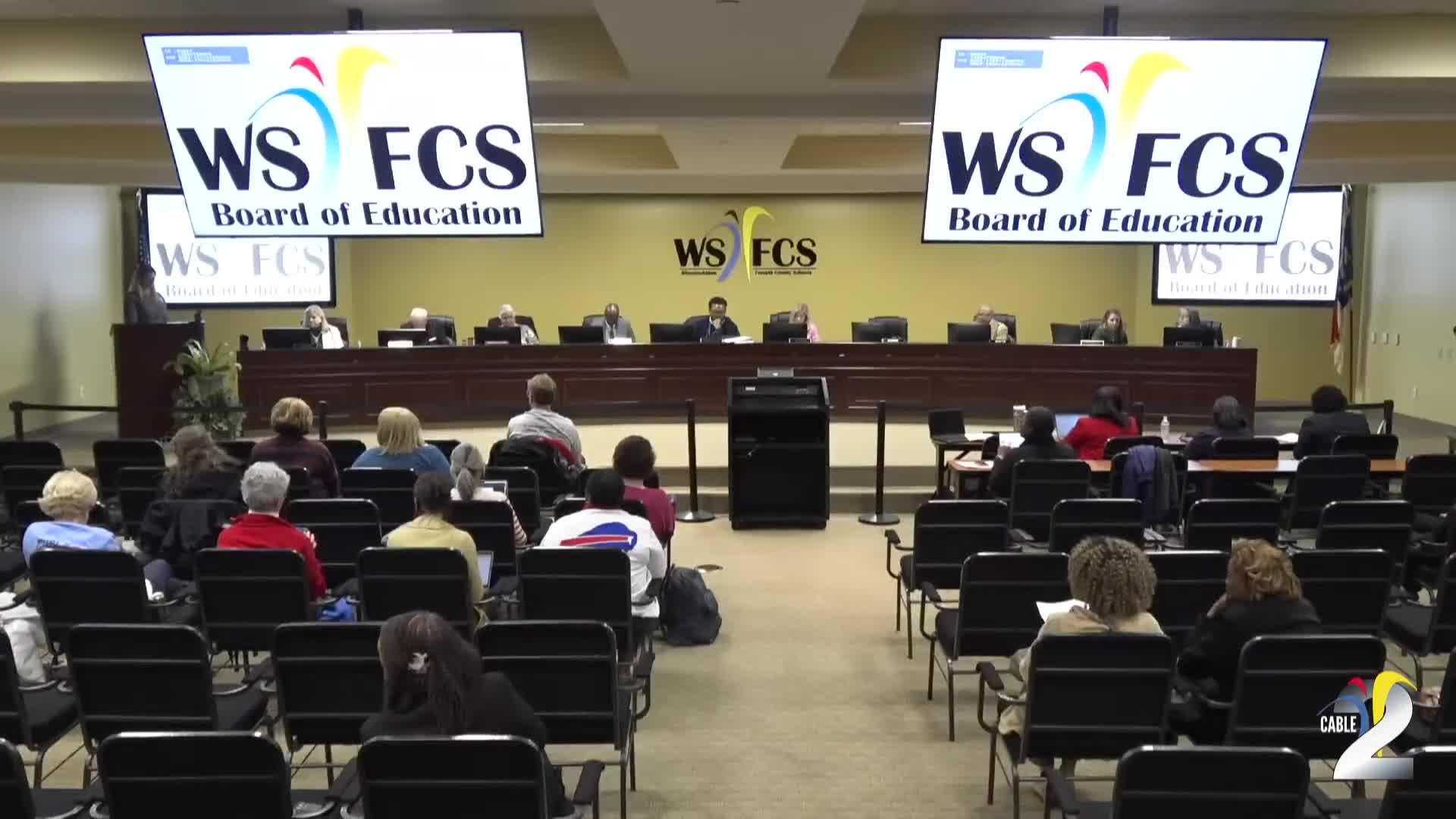
Summary
Following a facilities review and public input, the board approved closing Cook Literacy Model Elementary School at the end of the 2025'026 school year, approved residential boundary changes (Option 1) reassigning affected Cook addresses mainly to Ashley, Brunson and Kimberly Park, and voted to surplus the Cook property to pursue reuse options.
The Winston-Salem/Forsyth County Schools Board of Education voted Oct. 28 to close Cook Literacy Model Elementary School at the end of the 2025'026 school year, immediately begin processes to surplus the property and adopt staff'recommended residential boundary Option 1.
Staff presented facility and enrollment data showing Cook's building (built 1950; major renovation in 1999 and renovations in 2019) has a capacity of about 500 students but a first-month ADM of 186, which staff said represents roughly 37% utilization. Rebuild cost estimates for an elementary replacement were presented at about $50 million. Staff recommended Option 1 for reassigning residentially zoned Cook students to three neighboring schools (Ashley, Brunson and Kimberly Park) while nonresidential students would follow assigned residential schools or apply through magnet/choice processes.
Frank Pentano (student assignment) described the options and said a closure taking effect in June 2026 would affect roughly 125 K— students who live in the Cook zone; staff also noted existing out-of-zone enrollment at receiving schools and said some transfers may need to be managed to keep class sizes within limits.
Public comment: Several speakers with ties to Cook and Boston-Thurmond area asked the board to preserve Cook's history and to ensure that any reutilization of the facility serves community needs. Cook staff and community members described academic gains and the school's role in the neighborhood. A staff representative reminded the board that Cook "exceeded growth every year" and urged retention or consolidation with Whitaker as alternatives.
Board action: The board approved the Cook closure motion (7'0 to 1), approved residential boundary Option 1 (7'0 to 1), and then voted unanimously to surplus the property to begin community conversations about reutilization. Staff said surplusing is not a sale but starts a process for exploring reuse and preserving elements of Cook's history (for example, preserving building names or reusing building materials in a community project).
Financial and operational notes: Staff estimated annual cost avoidance (operating and admin) of about $1.2 million and indicated an estimated one-time tax-value recovery of about $2.8 million if the property were sold; that sale was not approved and would require later board action. Staff said they would notify Cook staff and families promptly, provide FAQs and offer priority transfer opportunities to district staff.
Next steps: If the closure stands, students from the Cook residential zone would start at newly assigned schools in August 2026; staff said it will coordinate transfers, manage capacity at receiving schools (including possible class-size waivers in the short term) and pursue community engagement on repurposing the site.