Get Full Government Meeting Transcripts, Videos, & Alerts Forever!
Get email alerts on the Middle Housing topic
No spam. Unsubscribe anytime.
Gilbert staff present middle-housing text amendment; Nov. 5 hearing and Nov. 18 council action scheduled
Summary
Development Services presented a draft text amendment to implement 2024 middle-housing legislation, clarifying where duplexes, triplexes, fourplexes and townhomes may be allowed, limiting townhome size and parking, and scheduling a Nov. 5 public hearing and Nov. 18 council action to meet a Jan. 1, 2026 statutory deadline.
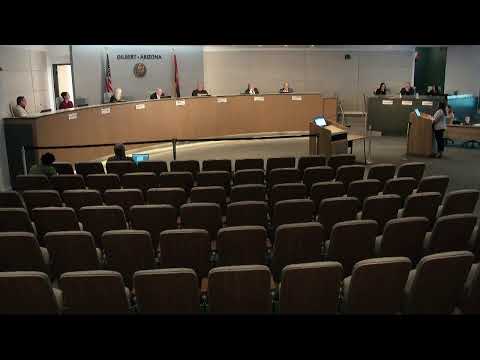
Development Services presented a proposed text amendment to the Gilbert Town Council on middle housing — duplexes, triplexes, fourplexes and townhomes — and recommended scheduling a public hearing on Nov. 5 with council action on Nov. 18 to meet a Jan. 1, 2026 compliance deadline.
Ashley, Development Services staff, told council the revisions are intended to implement requirements from the 2024 legislative session. "If the municipality does not adopt these regulations prior to 01/01/2026, middle housing would be allowed by right on all single family lots, without limitation," Ashley said, summarizing the consequence of not adopting local rules.
The draft would allow middle housing on lots zoned single-family that are entirely within 1 mile of the Central Business District and inside the CBD boundaries; it would also allow middle housing as part of any new single-family development of 10 contiguous acres or more, limited to no more than 20% of the development’s net area and no more than 20% of the lots. The staff report notes the town earlier designated the Heritage District as the Central Business District to conform with the statute.
The draft reflects statutory limits on what the town may require for middle housing. Ashley listed items the town cannot impose: restrictions that would cap middle housing at fewer than two stories; a floor-area-ratio (FAR) requirement below 50%; development standards or permit requirements more restrictive than those for single-family dwellings in the same zoning district (including greater setbacks or shorter heights); owner-occupancy requirements; mandatory compliance with the commercial building code or a requirement for fire sprinklers; and parking requirements greater than one space per unit.
To implement the statute while minimizing conflicts with existing definitions, the draft creates a distinct middle-housing section with definitions that apply only to middle-housing development rather than replacing the town’s broader duplex/multifamily definitions. The draft also limits townhomes created under the middle-housing provisions to no more than four units and prohibits adding accessory dwelling units to those townhomes, per staff’s explanation.
On process, Ashley said applications would be reviewed to ensure the town is not making the middle-housing review more onerous than a typical single-family development and that these projects must be built on legal lots and not constructed in phases. The draft also adds a parking classification for middle housing that requires one parking space per unit, different from typical multifamily standards.
Council member Chuck Bongiovanni asked whether the town could prohibit middle-housing units from being used as sober-living homes. Ashley said the question had not been explored and that staff would take it back for further research.
Staff said it will present the draft at a Nov. 5 hearing for a recommendation to council and return for formal action on Nov. 18 to ensure the ordinance takes effect before the Jan. 1, 2026 statutory deadline.