
Researchers map three policy paths for heavier passenger vehicles: fees, regulation and built environment investments
Get AI-powered insights, summaries, and transcripts
Subscribe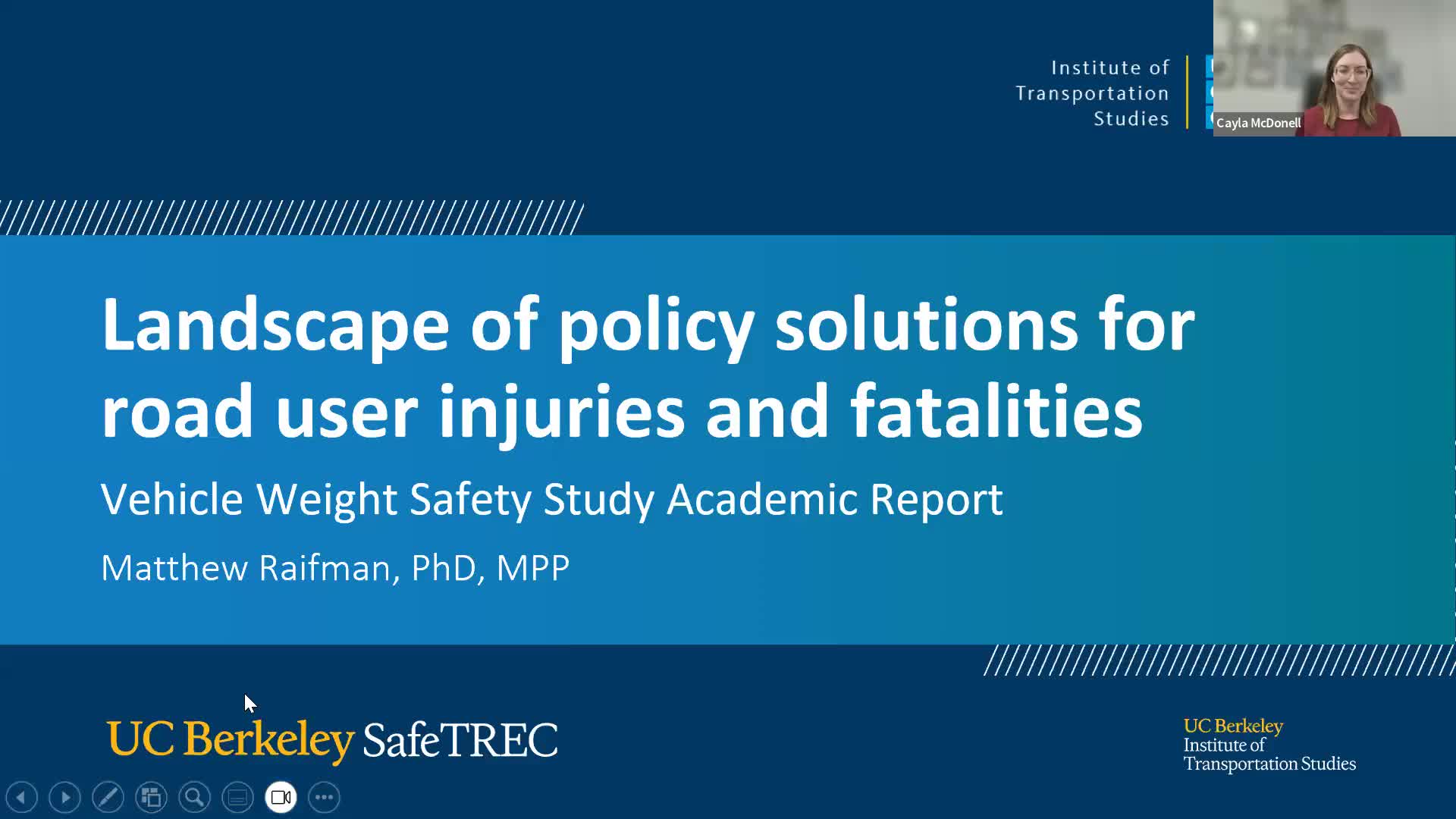
Summary
California task force researchers presented three policy families—fees/taxes, regulatory standards, and built‑environment investments—as possible responses to safety concerns related to larger passenger vehicles and asked whether weight is the best proxy for safety.
California researchers asked the task force Sept. 9 to consider three broad policy families to address safety questions tied to larger, heavier passenger vehicles: market-based fees (taxes/fees to internalize external costs), regulatory standards (design and crashworthiness rules), and built‑environment investments (lighting, traffic calming, separated bike/ped infrastructure).
Dr. Matthew Raifman, a presenter for the task force research team, said fees and taxes can be used to ‘‘internalize’’ the safety externalities of larger vehicles and that regulators should evaluate whether vehicle weight is the right proxy for safety. "Is weight the right proxy for safety, or can we move to a direct vehicle‑safety metric?" Raifman asked during the presentation.
On regulation, Raifman reviewed the federal role: the National Highway Traffic Safety Administration sets Federal Motor Vehicle Safety Standards (FMVSS) for vehicle manufacturing, while states regulate how vehicles operate on roads (registration, inspections, traffic laws). He noted recent U.S. rulemaking proposals intended to improve pedestrian protection and add automatic emergency braking and forward‑collision warning standards for new vehicles, and contrasted U.S. practice with Europe’s Euro NCAP, which includes pedestrian crash assessments.
Equity issues were a recurring theme. Raifman said regulations generally affect only new vehicles and thus benefit areas and buyers with newer fleets; regulatory changes have a fleet‑turnover lag (U.S. average ~11.8 years). He also noted that some occupations may legitimately require larger vehicles, raising questions about exemptions or compliance pathways.
Built‑environment investments were presented as critical complements to any vehicle‑focused policy. Raifman summarized evidence that lighting, traffic calming, curb extensions, leading pedestrian intervals, and protected bike lanes substantially reduce risks for vulnerable road users—in some cases yielding 40–90% reductions in specified crash categories in published studies—and that combining revenue mechanisms with infrastructure spending could create a ‘‘virtuous cycle’’ of safety improvements.
Task force members pressed on data limits and practical questions: how to combine occupant and non‑occupant safety into a single rating, how to prioritize countermeasures (members emphasized speed management and deconfliction), and whether market incentives (‘‘carrots’’) for smaller/lighter vehicles or driver licensing changes are viable near‑term options. Researchers noted data gaps—VIN/weight linkage is incomplete—complicating causal analysis of heavier vehicles in specific crashes.
What’s next: staff scheduled an Oct. 29 meeting to examine vehicle‑weight fee options in detail; the research team flagged elasticity and equity analyses, NCAP/consumer testing possibilities, and built‑environment funding as priority topics for follow‑up.