Get Full Government Meeting Transcripts, Videos, & Alerts Forever!
Get email alerts on the Transportation Traffic Calming topic
No spam. Unsubscribe anytime.
Kalispell debates $3 million Safe Streets grant for East Oregon as FHWA limits work to temporary measures
Summary
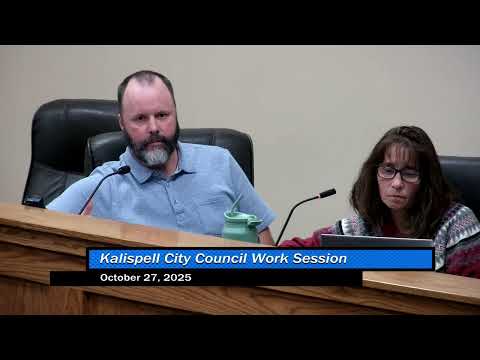
City staff told the Kalispell City Council on Oct. 27 that a federal Safe Streets for All demonstration grant would cover about $2.4 million of a $3.0 million project on East Oregon Street, but recent Federal Highway Administration guidance requires temporary, removable installations that concern staff and residents.
City staff told the Kalispell City Council on Oct. 27 that a federal Safe Streets for All demonstration grant would cover about $2.4 million of a $3.0 million package for safety work on East Oregon Street, but recent Federal Highway Administration guidance requires temporary, nonpermanent installations that concern both staff and residents.
Nelson, the city’s community development manager, said the city originally applied in 2024 for a package of three projects that totaled about $9.7 million. East Oregon was awarded as a partial, standalone demonstration project: the city’s packet shows a $3.0 million project scope with $2.4 million in federal award and a required 20 percent local match of roughly $600,000. Nelson said the award paperwork now specifies “temporary” or portable treatments rather than the permanent quick-build or concrete features the city budgeted for.
The change in allowable construction methods has practical consequences for the city. Susie, the public works director, and Keith Haskins, deputy director of public works, told council that temporary devices—plastic curb extensions, bolt-down roundabout elements and portable hybrid beacons—are likely to be damaged by winter snowplows and, in the city’s climate, “won’t last.” Haskins estimated a portable element might last about "one season" under local conditions, and staff said Kalispell has no dedicated replacement fund or maintenance mechanism for repeatedly replacing damaged temporary devices.
That durability and maintenance question split members of the council. Councilmember Dahlman told staff, “I’m a no if it’s not permanent,” and several other councilmembers voiced reluctance to commit significant local dollars to temporary installations that might fail in a single winter. Councilmembers and staff discussed the option of asking FHWA to reallocate the award to other projects submitted in the original application — including leading pedestrian intervals on Main Street, Meridian and Idaho — which would be more permanent and largely located in tax increment financing (TIF) districts that could cover the match instead of general reserves.
Staff said the original package had included higher-cost permanent features such as concrete mini-roundabouts and a HAWK (high-intensity activated crosswalk) system and budgeted about $200,000 for pre/post analysis and monitoring software (identified in the staff presentation as “Cidian”) to document safety outcomes. Federal Highway Administration officials, staff said, now intend demonstration grants to be used for temporary installations that can be tested and removed rather than permanent construction, limiting the city’s ability to build the kind of long-lived improvements the grant application anticipated.
Public comment was strongly engaged. Neighbors and business owners along East Oregon gave mixed testimony:
- Gail Thomas, a resident at Oregon and Fourth Avenue East North, opposed roundabouts at that intersection and said a small roundabout would create congestion and safety risks at houses with front-yard parking. She said a roundabout there would "devalue" property and asked council to protect homeowners. (Public comment, Oct. 27.)
- Logan, a resident at 220 E. Oregon St., urged stop signs and suggested bolt-down removable speed bumps that can be removed before winter plowing as an affordable mitigation.
- Frank Meeley, a longtime resident, questioned whether the street has the crash history to justify the proposed changes and called the project "a solution in search of a problem."
- Michelle Mayberry, who grew up on Third Avenue East, described frequent driveway conflicts and narrow street conditions with snow piles and warned that roundabouts could increase hazards for nearby homes.
- Tim (resident) and others urged measures that would slow passing motorists, favoring speed bumps or other physical friction rather than roundabouts that they said may not sufficiently reduce speed.
- Tammy Severson, a business owner on East Oregon, urged the council to use federal funds to test safety measures on East Oregon and said the 20 percent city match should not be discarded without attempting a demonstration.
Council and staff discussed legal and technical constraints. Staff noted that the MUTCD (Manual on Uniform Traffic Control Devices) establishes warrants for stop signs and that professional-engineering judgment is sometimes used to deviate from warrants; staff cautioned that installing stop signs solely to address speed can increase rear-end collisions if warrants are not met. Councilmembers and staff agreed the city needs a clear traffic-calming policy that sets standards, funding mechanisms and consistent criteria for when different countermeasures are appropriate.
Next steps identified at the meeting: staff will continue discussions with FHWA about whether the award or scope can be reallocated (for example to leading pedestrian intervals in TIF areas), and the city will pursue drafting a traffic-calming policy for council consideration in early winter. No formal vote or binding decision to accept or reject the grant was taken at the Oct. 27 work session.
Kalispell staff and the council highlighted competing priorities: accepting federal funds that would require temporary measures and a general-fund match, or seeking reallocation toward more permanent treatments that may be funded differently. Council members and residents agreed on the need to reduce speeds and improve safety on East Oregon, but they differed on which specific tools and funding sources are appropriate.