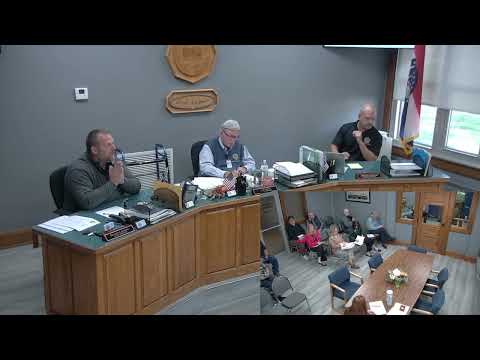
Christian County commissioners explain 1.5% use tax proposal, pledge large county-levy rollback if voters approve
Loading...
Summary
Commissioner (Speaker 1), a Christian County commissioner, said the measure before voters would place a 1.5% county use tax on out-of-state online purchases and argued it would level the playing field for local retailers.
Commissioner (Speaker 1), a Christian County commissioner, said the measure before voters would place a 1.5% county use tax on out-of-state online purchases and argued it would level the playing field for local retailers.
"The use tax is a tax that is for someone who purchases something online from out of state. They would pay the regular county tax of 1.5%, which is the same exact tax they would pay if they walked into 1 of our local stores and purchase something," Commissioner (Speaker 1) said.
The commissioners described the proposal as part of a broader financing strategy to address stagnant sales-tax receipts and a growing demand for county services. Commissioner (Speaker 1) said a county work study showed sales tax revenue has not kept pace with rising costs for roads, law enforcement and prosecutions, and that the county previously tried and failed to place a county-level use tax on the ballot in 2013.
"Our sales tax revenue has been very stagnant. And we fund almost everything through sales tax here," Commissioner (Speaker 1) said, adding that the proposed change would allow the county to avoid increasing the property-tax levy.
Under the commissioners' plan as described in the meeting, the county would roll back the county portion of the property tax levy by roughly 77''78%. Commissioner (Speaker 1) gave a numerical example: "If your bill was $45, it would be cut down to about $34.34 dollars of that would be cut." He also said a household would need about $200 per month (about $2,400 per year) of out-of-state online purchases before the use-tax shift would result in a higher net tax burden under the proposed swap.
Commissioner (Speaker 2), who described prior service as a city official in Ozark, and Commissioner (Speaker 3) both framed the proposal as an attempt to change the county's revenue "business model" in response to online shopping and population growth. Commissioner (Speaker 3) said the county currently expects to receive about $900,000 in county property and personal-property taxes and that, under the rollback, the commission would return roughly $700,000 to taxpayers (approximately 77.78% of the county portion).
Commissioner (Speaker 2) acknowledged shortcomings in public outreach and said the county lacks a dedicated public information officer. Commissioners listed recent media interviews and local presentations intended to explain the measure, including coverage by the Springfield News-Leader, Christian County Headliner, The Daily Citizen and KY3.
Commissioner (Speaker 2) also raised a separate funding issue: a previously approved marijuana sales tax the county had planned to collect was voided by the Missouri Supreme Court, and the county was required to refund amounts collected, reducing expected revenue.
The Hancock Amendment was cited in discussion about how quickly the county could reverse a levy rollback if use-tax collections fell short; one commissioner said the amendment constrains rapid reinstatement of the prior levy level. When asked whether cities in the county already have some form of local use tax, commissioners confirmed that Nixa, Highland Mill, Clever, Billings and Fremont Hills levy local use taxes but noted city-level taxes do not replace a county-wide measure.
Commissioners emphasized outreach and said they remain accessible to residents seeking more information. Commissioner (Speaker 3) described door-to-door and one-on-one meetings that he said changed some residents' positions from "no" to "yes" after answering questions. Contact phone numbers for two commissioners were provided during the meeting.
No formal motion or recorded vote on placing the measure on a ballot appears in the transcript segment provided. The discussion in the transcript focuses on explaining the proposal, defending it against what commissioners described as social-media misinformation, and outlining the levy-roll back plan should voters approve the use tax.
Ending: Commissioners concluded by reiterating the fiscal rationale and their willingness to meet with residents about the proposal; the meeting transcript provided does not record any final action or vote on the proposal.