
Parents, teachers and advocates call on Polk County School Board to overhaul services for deaf and hard-of-hearing students
Get AI-powered insights, summaries, and transcripts
Subscribe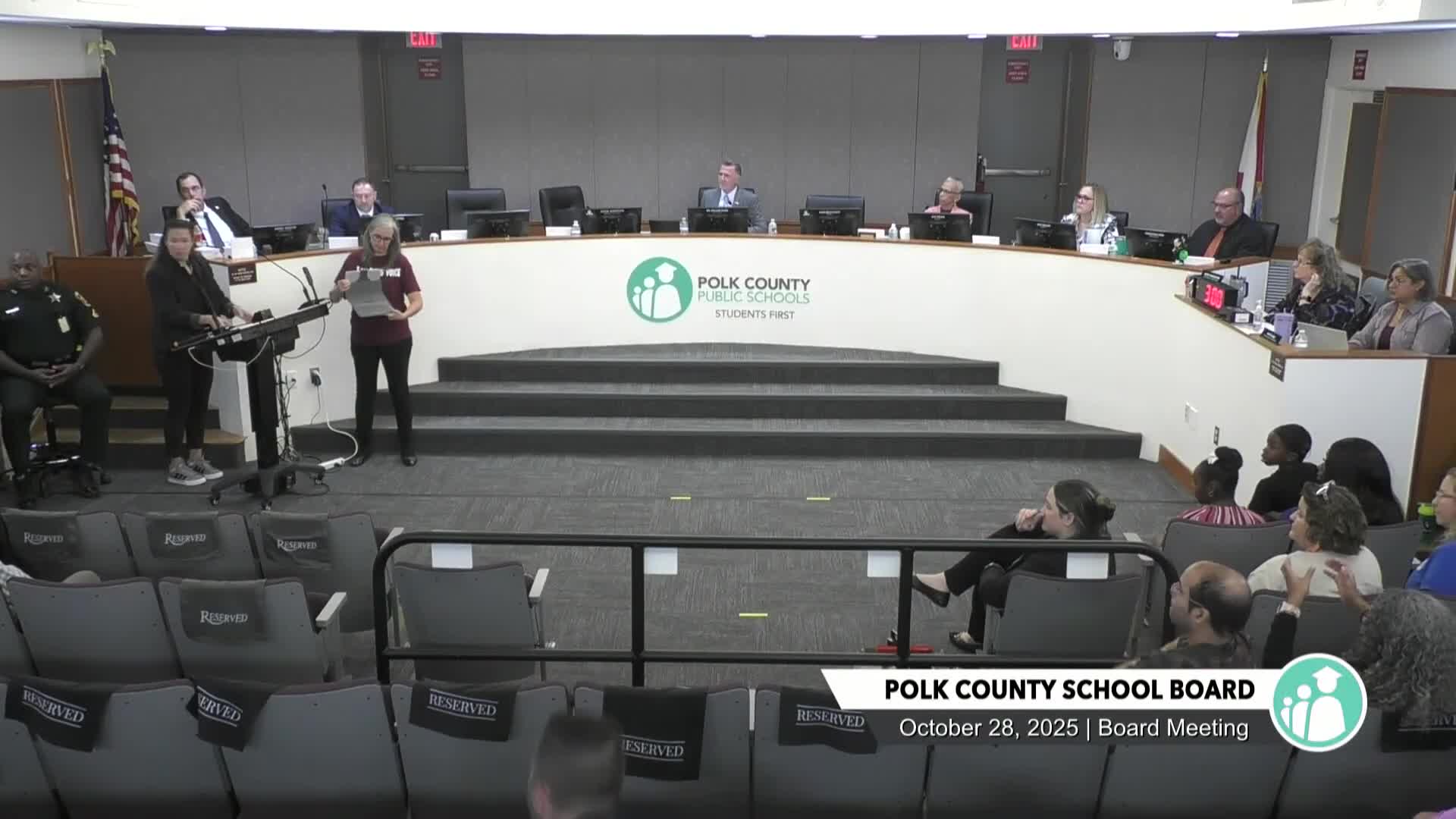
Summary
Dozens of parents, teachers and advocates told the Polk County School Board on Oct. 28 that the district is not providing consistent, research-based services to deaf and hard-of-hearing students and asked the board to open a formal investigation and implement programmatic reforms.
Dozens of parents, teachers and advocacy-group members told the Polk County School Board on Oct. 28 that Polk County Public Schools is "failing" deaf and hard-of-hearing (DHH) students and asked the board to open a formal investigation of district practices.
Advocates described repeated examples of children placed in classrooms without reliable ASL access, a shrinking DHH program staffing pool and what several speakers called an outdated instructional framework. "The current framework being applied to the education of deaf children in this district is disproportionately flawed," said Kathleen Sturworth Jackson, identifying herself as a deaf-education expert, and called for an investigation into IEP compliance, communication plans and progress-monitoring tools used for DHH students.
Speakers delivered a series of concrete requests the board could consider, including audits of curriculum and CBM (curriculum-based measurement) data, enforcement of Individualized Education Program (IEP) requirements tailored to DHH learners, recruitment and retention of certificated DHH teachers and credentialed ASL interpreters, and evaluation of technologies such as video remote interpreting (VRI) and other visual-language supports. "When deaf and hard-of-hearing students grow up without full language access, the effects last a lifetime in academics, literacy, social and emotional growth," said Diana Cobble, a college ASL instructor and a board member of the Deaf and Hard of Hearing Youth Advocacy Coalition of Polk County.
Multiple speakers — former and current interpreters, classroom DHH teachers and parents of deaf children — described language-deprivation consequences. "A child being left out, not because of ability, but because of inaccessibility," said Joan Slevin of the coalition, illustrating how incidental language exposure that hearing children receive is absent for many DHH students. Several parents said their children or grandchildren had to change schools or leave the district to receive adequate access.
Teachers and interpreters who spoke said the district once ran a stronger DHH program. "Back in the day when the program was excellent... they had early intervention, a dedicated preschool environment for deaf only and teachers in control of how students learned," said retired interpreter Sherry Spiegner. "The lack of program now does not provide these essentials."
Speakers asked for district-level changes in leadership and accountability. Jackson recommended a "complete investigation" and a reform plan that would range from revising cluster-site designs to hiring certified DHH specialists and building systems to ensure language access from early childhood onward. Several requested that IEP teams explicitly include DHH-learning standards and that progress monitoring tools be aligned to language and literacy outcomes for DHH learners.
Beverly Stochem, a retired Polk County sign-language interpreter, cited federal law in urging action: "These are the laws that we're supposed to follow," she said, referring to the Americans with Disabilities Act and the Individuals with Disabilities Education Act.
The board did not take formal action during public comment. Chair Dr. Allen acknowledged receipt of community concerns and the public record; several board members thanked speakers for their testimony and said they would follow up.
Why this matters: Speakers framed the issue as a systemic gap that affects early language development, subsequent academic achievement and life outcomes. Several told the board the district's responsibility under federal law requires access to language and qualified personnel. Community members offered to partner with the district in solutions and requested a transparent timeline for any review or corrective actions.
Next steps noted on the record: the board did not vote on any of the requests during this meeting. Multiple speakers asked for an immediate, transparent investigation; the board did not announce a timeline. The district's superintendent and staff will receive the public-record comments for follow-up.