Get Full Government Meeting Transcripts, Videos, & Alerts Forever!
Get email alerts on the Driveway Variance topic
No spam. Unsubscribe anytime.
Yellowstone County denies driveway‑width variance for 5337 Abbey Road
Summary
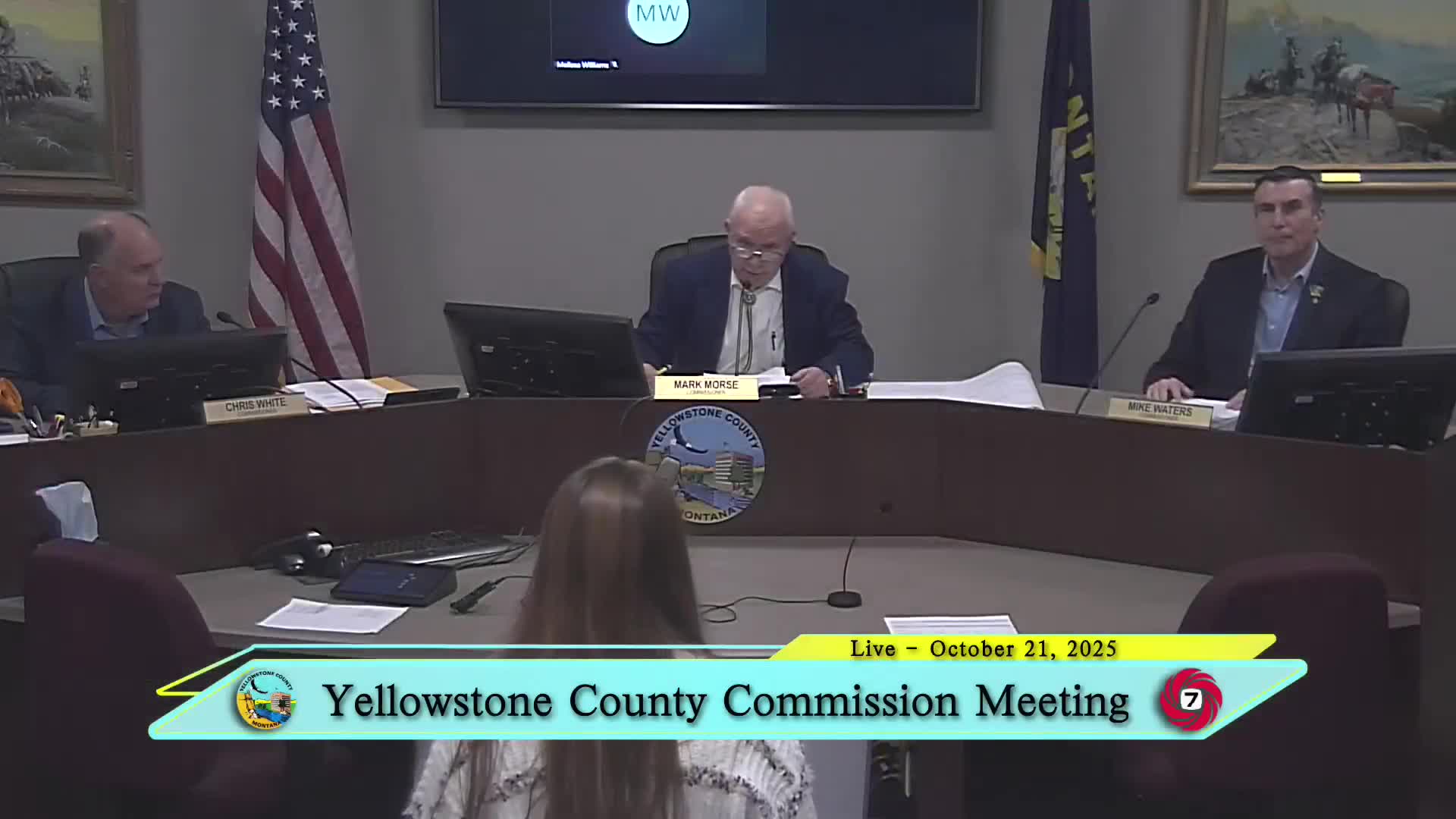
The Yellowstone County Board of Commissioners on Oct. 21 denied a variance appeal for the driveway approach at 5337 Abbey Road, following public comment from the property owner and a staff presentation describing the county driveway permit and inspection process.
The Yellowstone County Board of Commissioners on Oct. 21 denied a variance appeal for the driveway approach at 5337 Abbey Road, following public comment from the property owner and a staff presentation describing the county riveway permit and inspection process.
Mackenzie Sparks, who identified herself as the owner of the house at 5337 Abbey Road, told the board she bought an approach permit and did not understand the permit explicitly limited the approach to 30 feet. "The owner is Mackenzie Sparks, not Sam Sparks," she said, and asked the board to "grant a variance for this driveway to be left as is." Sparks said the driveway was poured at about 5 a.m. on Sept. 5 after a county staff member visited the site on Sept. 4 and told a subcontractor not to pour.
Monica, a Yellowstone County public works staff member, told the board the Yellowstone County road policy requires driveway approaches no wider than 30 feet, with a 50‑foot allowance if a lot has 150 feet of frontage. She described the permit process: an applicant marks the intended approach on site, staff visits to measure the markers, and staff releases the permit only after that inspection. Monica said staff had noted similar violations in the subdivision and elsewhere and that she denied the variance based on four justifications summarized in the staff report, including that the property does not have unique physical characteristics that would prevent compliance and concerns about safety and uniform access control.
Ronnie, the county inspector who visited the site, confirmed she photographed stakes at the site and said the marked approach measured about 30 feet at the time she inspected it. Ronnie said she later observed forms and concrete that extended well beyond the marked width and that she asked the on‑site subcontractor to contact the builder, who she was told was Sam Sparks.
A commissioner moved to deny the variance appeal; the motion was seconded and the board voted in favor. The clerk recorded the vote as "aye," and the board announced the variance appeal was denied.
The county record and staff presentation indicate the following clarifying details: the county road policy sets a 30‑foot maximum approach width except where a lot has a 150‑foot frontage and a 50‑foot allowance applies; the permit process requires on‑site marking and inspection before concrete is poured; county staff reported the driveway contains an 18‑inch culvert and a two‑foot shoulder where required; staff said the subdivision contains multiple other approach violations and that staff is coordinating with the Home Builders Association on enforcement guidance going forward.
The decision is final from the commissioners' dais. The record shows the owner asked for a variance and said she was not directly contacted by county staff before the concrete was poured; staff said there had been an on‑site contact with a subcontractor and that the inspector had asked that person to call the builder. The board did not direct further staff action in the meeting transcript beyond the vote to deny the variance.
Provenance: Transcript statements supporting this article include Mackenzie Sparks' comments beginning at 00:03:17 and staff presentations and the denial motion and vote beginning at 00:07:39 and 00:15:52, respectively.