Get Full Government Meeting Transcripts, Videos, & Alerts Forever!
Get email alerts on the Parks Infrastructure topic
No spam. Unsubscribe anytime.
Smiths Fork Park redesign moves toward engineering phase as committee weighs turf, lights and parking
Summary
Committee discussed advancing engineering and design for a long‑planned Smiths Fork sports complex, reviewing funding set‑asides, possible design approaches (turf vs. natural grass), and community-use tradeoffs. Staff said moving design into 2026 will provide updated cost estimates and more public feedback.
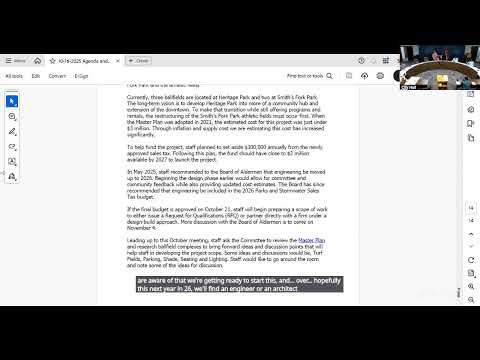
Smithville Parks and Recreation staff briefed the committee on plans to advance engineering and design for the Smiths Fork Park athletic complex, saying design work will be moved into 2026 so the city can update cost estimates and gather community feedback.
Staff said the parks and stormwater sales tax approved in 2020 and the 2021 parks and recreation master plan identified Smiths Fork as a priority. At the time the master plan estimated the project at just under $3,000,000; staff told the committee inflation and supply costs have driven that estimate higher and presented a target of setting aside $300,000 a year from the sales tax, which would put roughly $2,000,000 in the fund by 2027.
"Beginning the design phase earlier would allow the committee and community feedback while also providing an updated cost estimate," a Parks and Recreation staff member said. The staff member said the board of aldermen has recommended that engineering be included in the 2026 parks budget and that the project presentation to the aldermen will be moved to the first meeting in December.
Committee members discussed a range of design and program options, including installing turf fields, adding lights, improving parking and shade, and building a multipurpose or "flex" area rather than dedicating space to a single sport. Participants described a possible four‑field layout in a cloverleaf pattern that would relocate two fields from Heritage Park to Smiths Fork so that games and practices would be consolidated in one complex.
One committee member described tradeoffs for turf: it can extend playing hours and reduce weather cancellations but requires long‑term maintenance and eventual replacement that may be costlier in a public setting than on a privately managed facility. Another member noted possible revenue from sponsorships and from hosting tournaments but cautioned Smithville lacks the hotel and dining infrastructure of larger regional complexes.
Staff also reported site changes that affect design options: a nearby house scheduled for demolition is being annexed and the developer plans to add short‑term camping cabins, which may reduce adjacency concerns for some field locations.
No final design decision or formal commitment to turf, lights or a specific layout was made. Staff said next steps are to develop a scope of work for engineering, issue a request for qualifications or pursue a design‑build option, and bring draft designs to the committee and public for feedback. The committee discussed meeting more frequently once an architect or engineer is on board.
Committee members asked staff to consider: drainage and tiering to improve field playability, lighting with automatic shutoffs to limit nighttime disturbance, a small concession/restroom hub or food‑truck space rather than a large staffed concession, flexible concrete pads for temporary ramps or courts, parking expansion that could start as gravel and be paved later, and sponsorship opportunities for fence banners and naming rights.
Staff said the city will present alternative design and construction delivery options to the board of aldermen and return to the committee with a proposed scope for engineering work.