
Laredo council votes to comply with Abbott order amid warnings of $1.6 billion in lost TxDOT funds
Get AI-powered insights, summaries, and transcripts
Subscribe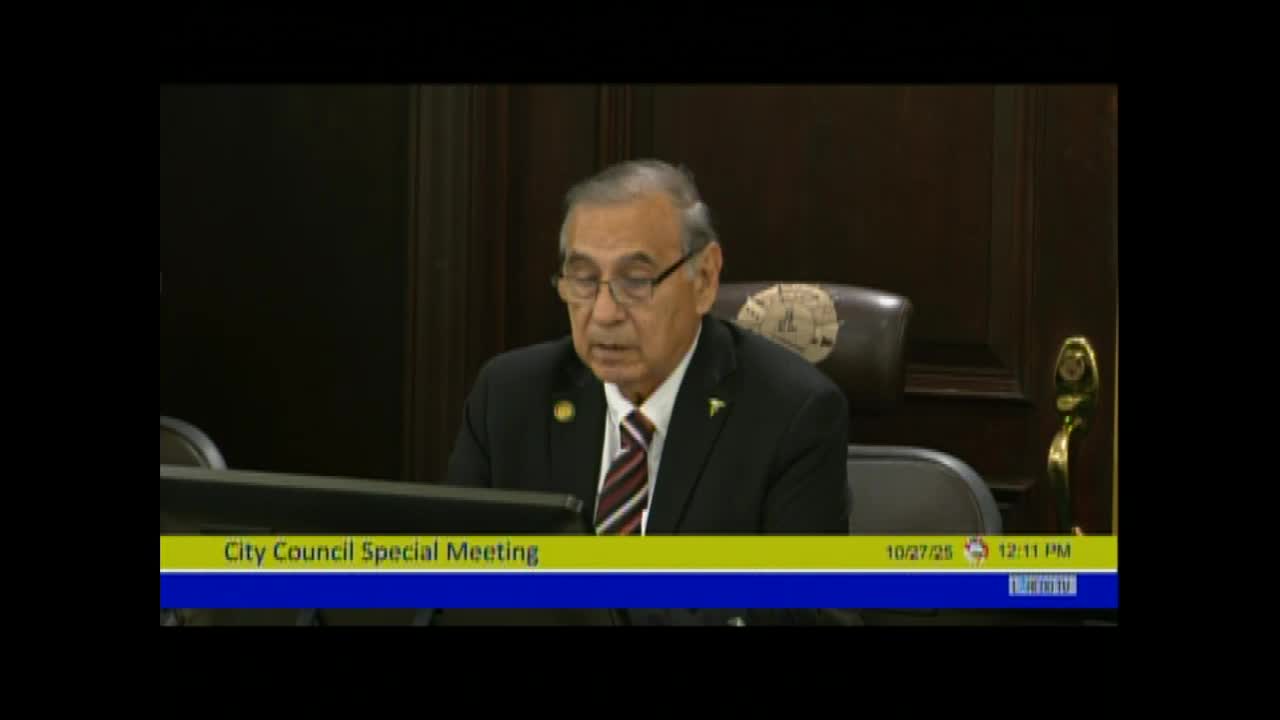
Summary
Laredo City Council voted Oct. 27 to be "in compliance" with Gov. Greg Abbott's Oct. 8 executive order and a Texas Department of Transportation letter directing removal of political or nonstandard roadway markings, after public testimony and legal advice that failure to comply could jeopardize roughly $1.6 billion in TxDOT road funding.
Laredo City Council voted Oct. 27 to be "in compliance" with Gov. Greg Abbott's Oct. 8 executive order and an accompanying Texas Department of Transportation letter that instructs cities to remove political or nonstandard markings from roadways, after members heard more than 30 public comments on both sides of the issue.
The mayor, Victor D. Trevif1o, opened the special meeting by telling residents the city attorney advised the council it "does not have the ability to alter or delay compliance on this matter or to take action against the law," and warned that failure to comply could jeopardize roughly $1.6 billion in TxDOT funding for Laredo road projects.
Why it matters: Council members and multiple speakers described the decision as a legal and fiscal dilemma rather than a simple policy choice. Supporters of removing the street mural argued the city must protect trade and infrastructure funding; opponents said the mural is a protected form of community expression and urged the council to resist the directive.
What the council did: Mayor Trevif1o moved that the city be in compliance with the governor's order and the TxDOT letter; the motion was seconded. After public comment and legal discussion, the council called the question and held a roll-call vote. The transcript records the outcome as four in favor and one opposed; the motion was recorded as passed. The council then recessed into executive session to consult with legal counsel and, upon return, passed motions directing staff to proceed as advised in executive session.
Public comment and competing arguments: The meeting featured a long public-comment period in which residents, business groups and nonprofit leaders urged opposite outcomes.
- Monica Martinez, executive director of the Laredo Chamber of Commerce, urged adherence to TxDOT safety and uniformity standards, saying the city's road network supports "billions of dollars in trade" and asking the council to "adhere to TxDOT's guidelines so that our community can continue to move forward."
- Tricia Cortez of the Rio Grande International Study Center briefed council on specific projects she said could be affected, naming the Loop 20 expansion (cited in the meeting as a $344 million project) and State Highway 84 (cited as $122 million), and warned those projects were already under construction when the TxDOT letter arrived.
- Residents and activists opposed to removing the mural framed their remarks as free-speech and cultural-preservation arguments; several speakers said the mural helped galvanize local opposition to a border wall and that removal would erase an element of community history. One commenter suggested any removal should be accompanied by a commemorative plaque or privately funded replacement.
- Opponents of the mural told the council it is improper for a political message to appear on taxpayer-funded roadways and emphasized the city's fiscal constraints. Jose Salazar, identified in the meeting as Webb County Republican chair, said Laredo "needs a 1,600,000,000.0 for its infrastructure," and urged the council to avoid risking those funds.
Legal and procedural context: Council members reviewed the 2020 permitting history for the 2020 street mural, noted prior debates and safety concerns, and referenced the Texas Manual on Uniform Traffic Control Devices and TxDOT enforcement authority. City legal staff repeatedly advised the council that local action contrary to state or federal directives could create liability; the attorney recommended discussing potential liabilities in executive session.
Votes and follow-up: The transcript records a roll-call where the motion to comply was recorded as passing with four in favor and one against; names tied to individual votes were not listed in the public transcript excerpt. The council moved to executive session to consult with legal counsel and, after returning, approved motions "as directed" for staff to proceed with the legal guidance obtained in executive session.
Background and timeline: The street mural at issue was installed and permitted during 2020 amid debate; council members recounted earlier votes that created the current policy environment for murals on public streets. TxDOT issued a letter dated Oct. 8 that the mayor and staff said was attached to a governor's directive and that provided a 30-day removal notice that local officials indicated set a Nov. 7 compliance window.
What comes next: Council members and staff said legal counsel will follow up and that staff would proceed as directed after executive session. The mayor also noted an update on related border-security discussions would be scheduled for the Nov. 3 council meeting.
The reporting in this article is based on the Oct. 27, 2025 Laredo City Council special meeting transcript and on remarks on the record at that meeting. No outside interviews or documents were used.