George Elementary highlights social-emotional learning, student engagement and new math strategies
Loading...
Summary
George Elementary Principal Laura Villafano told the Quincy School District board on Oct. 28 that the school is emphasizing social-emotional learning, student goal setting and classroom strategies intended to boost math engagement.
George Elementary Principal Laura Villafano told the Quincy School District board on Oct. 28 that the school is emphasizing social-emotional learning, student goal setting and classroom strategies intended to boost math engagement.
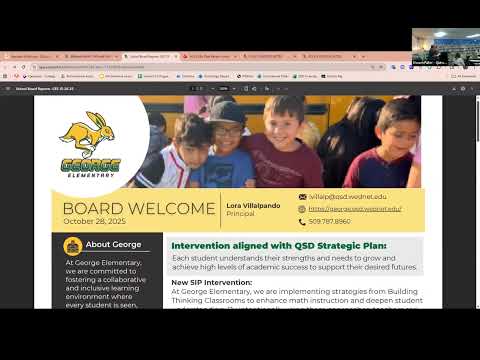
“At George Elementary, we are committed to fostering a collaborative and inclusive learning environment where every student is seen, heard, and valued,” Villafano read from the school’s mission and vision handout. She told the board George has about 170 students and described six school improvement strategies the staff are using.
Villafano said the school is piloting techniques from Building Thinking Classrooms to shift teachers’ roles from “lecturer to a facilitator that creates an environment for deep thinking,” and she asked the board to visit the school to observe the work. Counselor Raf Sarmino described a “Wall of Achievement” to showcase student strengths and said the project is intended both to recognize students and to create role models inside the building. “Hope gives us purpose,” Sarmino said, explaining how the display and related activities tie to SEL work.
The school reported student support results drawn from the Panorama survey and local screening tools. Villafano said staff identified students for daily lunchtime SEL groups—what staff call “lunch bunches”—that meet during the lunch period to build emotion-regulation and related skills. She told the board the school uses evidence from classroom walks and other data to guide instructional coaching and family engagement events, including STEAM family nights and a trunk-or-treat event.
Board members asked how the school links SEL strategies to families. Villafano said some schools send information home and hold parent meetings at the building, and she encouraged parents to ask students what they are learning in class and to contact the school for more information.
The principal closed by inviting board members to visit George family events and to observe classroom strategies in person.
The presentation was informational; no board action was taken.