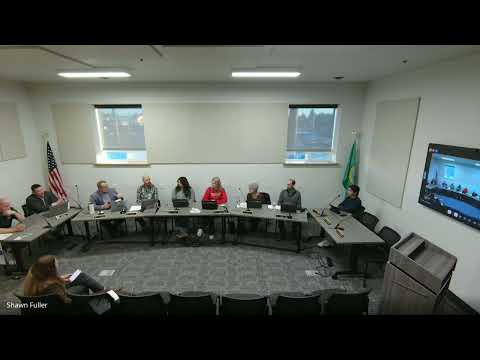
Quincy board reviews replacement-levy options and potential bond refunding, consultant outlines scenarios
Loading...
Summary
Financial advisor Corey Plager outlined four replacement‑levy scenarios and described how booming local assessed value and a callable 2016 bond could affect taxpayers. Trustees discussed whether a $1.20–$1.25 levy would close an insurance and utilities funding gap and enable capital and security improvements; no final levy resolution was adopted.
Corey Plager, financial advisor with D.A. Davidson, told the Quincy School District board on a levy‑planning presentation that “levies are for learning, and this is flexible revenue.” He described replacement levies as an amount‑based local revenue source that requires a simple majority — “50% plus 1” — to pass and contrasted levies with capital bonds, which are validated and used for buildings.
Plager reviewed the district’s long history of local voter support and rapid assessed‑valuation growth tied to commercial and data‑center development. He said that growth has expanded the district’s tax base and that, as property values rise, a fixed levy amount can translate into a lower tax rate per $1,000 of assessed value. He presented four example levy scenarios: maintaining current rate (status quo), a small increase (+5¢), a larger step (+9¢), and a repeat of the previous $1.25 ask. Plager described these as jump‑off points for the board to consider, not staff recommendations.
Board members framed the levy discussion around near‑term cost pressures. A district staff member said insurance and utilities together are producing a structural gap that has been covered by levy funds and estimated that a $1.20 levy would address that gap, while $1.25 would provide additional discretionary capacity for capital and security projects and to preserve programs. Trustee comments emphasized maintaining current services — technology replacement, transportation and bus purchases, consistent furniture and facilities updates, and safety upgrades such as access‑control readers — and avoiding repeated short levies.
Plager also briefed the board on the district’s 2016 bond, which reaches its first callable date this spring. He said refinancing could shorten taxpayer debt service at today’s likely lower interest rates and that last‑week estimates showed potential savings near the state’s recommended 5% threshold for refinancing. “The savings were directly reduced tax for taxpayers,” he said, noting that district budgets do not retain refinancing savings.
No formal levy resolution was adopted at the meeting. Staff and the consultant will return with refined projections, a recommended election date and ballot language, and a prioritized list of maintenance and capital needs for the board to review before the board’s anticipated November resolution deadline for a February election.