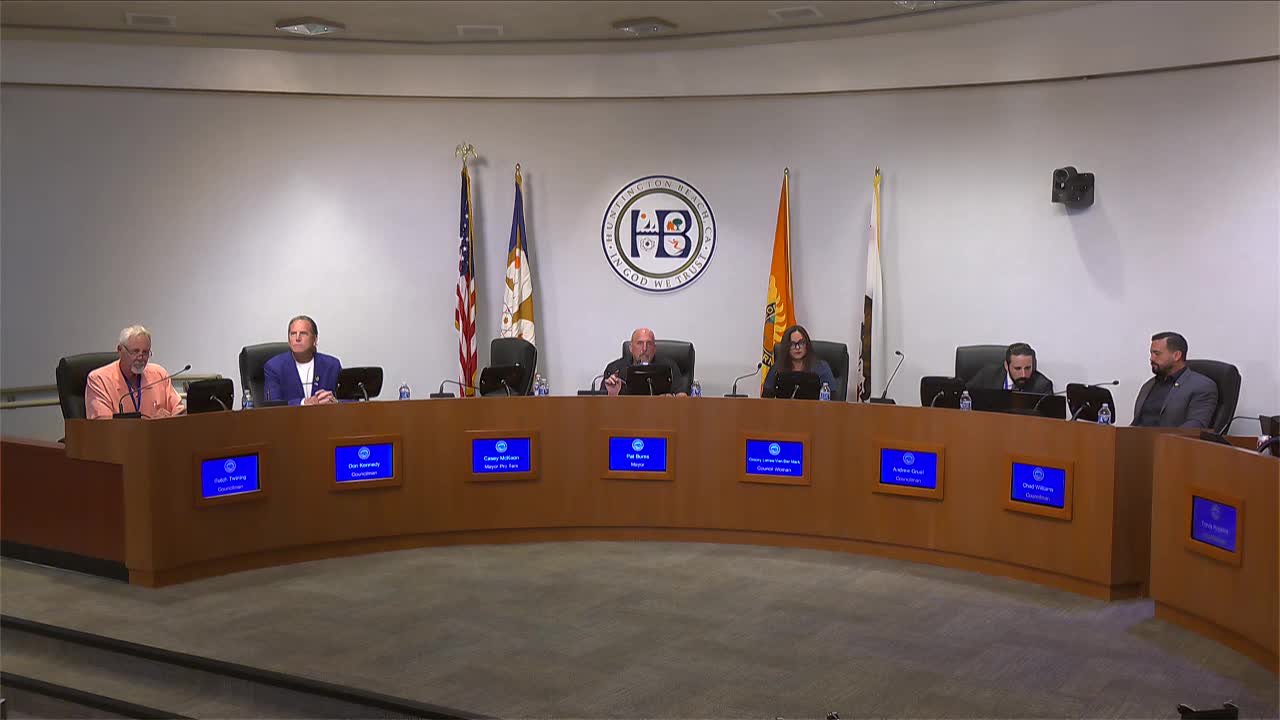
Huntington Beach council approves TEFRA for Pelican Harbor, trims proposed 99‑year affordability term to 60 years
Loading...
Summary
After public testimony urging protection of seniors and extended debate over municipal subsidies and developer financing, the council approved a TEFRA resolution enabling tax‑exempt bonds for Pelican Harbor and substituted the developer’s proposed 99‑year affordability extension back to 60 years in a 4–3 vote.
Huntington Beach city leaders on Oct. 31 approved a Tax Equity and Fiscal Responsibility Act (TEFRA) resolution allowing tax‑exempt financing for the Pelican Harbor senior affordable housing project and voted to limit an affordability covenant to 60 years rather than the 99‑year term the applicant requested.
The special meeting drew more than a dozen public speakers during a continued public hearing, many urging the council to preserve housing for low‑income seniors and people with disabilities. Mayor Burns closed public testimony before a lengthy council discussion that centered on how tax credits, tax‑exempt bonds and Section 8 vouchers finance the project and on the fiscal precedent set by long affordability terms.
Advocates said Pelican Harbor provides housing for unhoused seniors and described the development as largely filled with Huntington Beach residents. "My hope is that each of you will look at the good that this project provides, the housing that's provided for those who struggle," said Father Nathan Bjornstead of St. Wilfred's Episcopal Church. Several residents described the site as having removed blight and reduced calls for service in the neighborhood.
Developers and their representatives answered technical questions about the capital structure. Mike Massey, chief development officer at Jamboree, said the project’s capital stack includes low‑income housing tax credits (a roughly $20 million allocation that is monetized by a buyer), a $3 million city loan and additional subordinate financing; he told the council Jamboree could bridge shortfalls and that "it is very, very unlikely" residents would be displaced if the TEFRA did not proceed. Massey said the majority of units in the project are supported by Section 8 vouchers and that about 87% of residents have ties to Huntington Beach.
Council debate split along two lines: members who said approving a 99‑year tax‑exempt affordability term would set a damaging fiscal precedent and those who said a yes vote would secure long‑term housing for 43 very‑low‑income seniors and avoid the immediate risk of displacement. Council members pressing the fiscal‑precedent argument noted that affordable projects are often funded through public subsidies, developer fees and voucher programs and questioned how surplus cash flow is used. "Where does it stop?" one councilmember asked, raising concerns about repeated, long property‑tax exemptions.
Other council members emphasized operational certainty and immediate resident protections. Council proponents pointed to savings from reduced emergency responses and the fact the property was built and occupied; they also noted the city’s $3 million subordinate loan would be at risk if the project defaulted. The council considered staff analysis showing the site’s prior vacant‑lot property tax generated approximately $18,000 annually, and that construction costs were roughly $35–36 million and current net operating income (NOI) was stated in the hearing at about $314,000 per year.
On the motion before the body, a councilmember offered a substitute that reduced the developer’s requested 99‑year affordability term back to the project’s original 60 years. The substitute passed on a roll call vote, 4–3. The substitute preserved the TEFRA approval while limiting the duration of the extended affordability covenant the applicant had sought.
The council did not adopt additional changes to the financing terms on the record at the meeting; staff and the developer said they would follow up on remaining technical questions about financing and operating details. The City Clerk announced the next regularly scheduled City Council and Public Financing Authority meeting for Nov. 4 at City Hall.
Votes at a glance: Substitute motion to set affordability covenant at 60 years and approve the TEFRA resolution — Passed, 4–3 (roll call recorded at the meeting).