Get Full Government Meeting Transcripts, Videos, & Alerts Forever!
Get email alerts on the Affordable Housing topic
No spam. Unsubscribe anytime.
Huntington Beach delays vote on Pelican Harbor bond conversion after council questions taxpayer risk
Summary
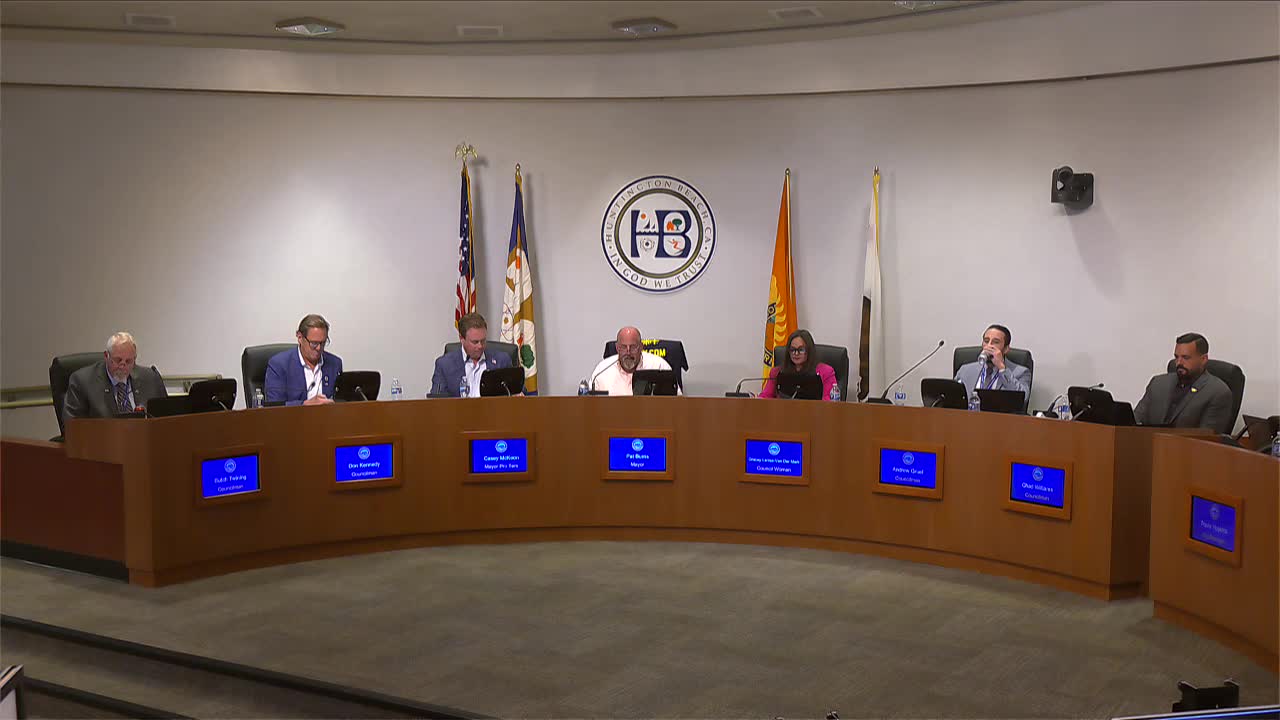
The Huntington Beach City Council voted 4–3 on Oct. 21 to continue a TEFRA public hearing on converting tax‑exempt bond financing for Pelican Harbor senior supportive housing to Oct. 28 to allow more time for negotiation and review.
The Huntington Beach City Council voted 4–3 on Oct. 21 to continue a Tax Equity and Fiscal Responsibility Act (TEFRA) public hearing on the long‑term conversion of tax‑exempt bonds for Pelican Harbor, a 43‑unit supportive housing project for formerly homeless seniors.
City Housing Manager Charles Kovac told the council the project was completed in December 2024 and occupied in January 2025 and that a December 2024 expiration of the original TEFRA required the council to reconvene a hearing so a portion of the previously issued bonds could be converted from construction to permanent financing. “If not completed, the bondholder could lose the ability to keep the bonds tax exempt which would create financing instability for the project and increase the risk of foreclosure,” Kovac said.
The council and members of the public pressed developers and staff for details about where the city’s roughly $3 million in loan funds originated, how tenant rents and subsidies work, and what would happen to city and other subordinate loans in the event of a default. Kovac said most of the city loan came from federal HOME program funds, with about $200,000 from local inclusionary in‑lieu fees. He described tenants as extremely low‑ and very‑low‑income disabled seniors, many subsidized by County vouchers and programs; occupancy is 100 percent of the 43 units, and staff estimated roughly 86 percent of residents have ties to Huntington Beach.
A representative for developer Jamboree Housing said the project’s financing margins are slim and that the organization had deferred developer fees and used internal bridge funding to complete the project. “We have collected about $300,000 in developer fee,” the Jamboree representative said, and added that earlier construction delays and exhausted extensions left little additional flexibility in the capital stack.
Council members who opposed immediate approval said they were concerned about long‑term taxpayer exposure, noting the property tax exemption tied to the tax‑exempt financing and asking whether the city was obtaining sufficient compensation for hosting the TEFRA hearing. Supporters emphasized the immediate risk to tenants if conversion failed and the choices available to preserve the project’s tax status.
Rather than adopt the staff recommendation (resolution 2025‑65 and related amendments to the affordable housing agreements), council moved to continue the hearing to a date certain — Oct. 28, 2025 — to give staff, the developer and councilmembers time to pursue additional structuring options that might yield greater protections or compensation for the city. The roll call on the continuation was: Councilman Twiney — no; Councilman Kennedy — yes; Mayor Pro Tem McKeon — no; Mayor Pat Burns — yes; Councilwoman Gracie Vandermark — no; Councilman Grull — yes; Councilman Williams — yes.
The TEFRA process itself does not create a new city liability: the bonds were issued by the California Municipal Finance Authority and are the developer’s obligation. But staff and the developer told the council that losing tax‑exempt status or failing to convert the construction financing to permanent financing could materially increase interest costs, strain project cash flow and, in the worst case, put subordinate public loans at risk.
Council scheduled the continued public hearing date for Oct. 28, 2025. During the continuance period, staff said it will provide council with available audited financials, compliance materials and any additional restructuring proposals the developer can offer.
The city’s negotiated benefits for hosting the TEFRA hearing as described by staff include an extension of affordability covenants from 60 to 99 years, a new annual payment to the city of $5,000 for 99 years, and an increase in the interest rate on the city’s subordinated loans from 3 percent to 5 percent beginning in year 20 of the loan terms — items staff said would increase projected repayment to the city over time.