Get Full Government Meeting Transcripts, Videos, & Alerts Forever!
Get email alerts on the Governance topic
No spam. Unsubscribe anytime.
Edmonds council debates written rules for amendments, community presentations and attorney access
Summary
Councilmembers debated proposed changes to Edmonds' rules of procedure, including a guideline to circulate amendment language in advance, a limited process for community presentations, and clearer guidance on contacting the city attorney and recording abstentions.
Edmonds councilmembers reviewed a package of proposed changes to the council's rules of procedure at their Oct. 21 Committee of the Whole, focusing on three contested areas: advance notice for council amendments, a new community-presentation policy, and guidance on contacting the city attorney and on abstentions.
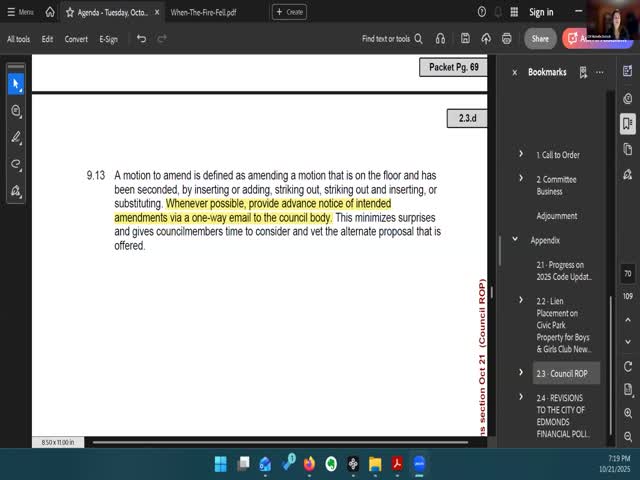
Advance notice for amendments: Vivian proposed language encouraging members to circulate proposed amendments by e-mail before a meeting so colleagues and staff have time to vet the proposal. Some councilmembers said advance circulation is a best practice that reduces meeting-time surprises; others raised transparency questions and asked staff to confirm there are no legal issues with circulating text to the full council prior to a public meeting.
Community-presentation policy: Staff proposed allowing up to four presentations a year (no more than two per quarter) by nonprofit community organizations or other community groups sponsored by a council majority, each up to 20 minutes. The proposal would exclude city boards, commissions and other jurisdictions. Council debate was robust: supporters said the controlled process would create access while limiting meeting burden; opponents worried about staff time, unfavorable optics if for-profit presenters were allowed, and the administrative burden of vetting presenters. Council converged on permitting nonprofit and sponsored community groups and on the sponsorship/majority approval step as a gatekeeper.
Attorney access, remote attendance and abstentions: The package broadened guidance on when members may consult the city attorney (including concerns about others'behavior), clarified conditions for remote participation and added abstention language. Councilmembers discussed whether abstentions should be announced before votes to avoid influence from the roll-call tally and agreed to check other cities' phrasing as a follow-up.
Why it matters: Written rules codify practices that affect transparency, council workload and public trust. The changes were presented as guidelines and best practices rather than mandatory new penalties; several items will be refined with city attorney input before returning to a future council packet.
Next steps: Staff will check legal implications for amendment-circulation language, work with the city attorney on privilege/public-records guidance tied to attorney contacts, and return revised language to the council in a future packet for possible adoption.