Get Full Government Meeting Transcripts, Videos, & Alerts Forever!
Get email alerts on the Housing Policyp topic
No spam. Unsubscribe anytime.
Huntington Beach council delays TEFRA approval for Pelican Harbor senior housing to seek stronger taxpayer protections
Summary
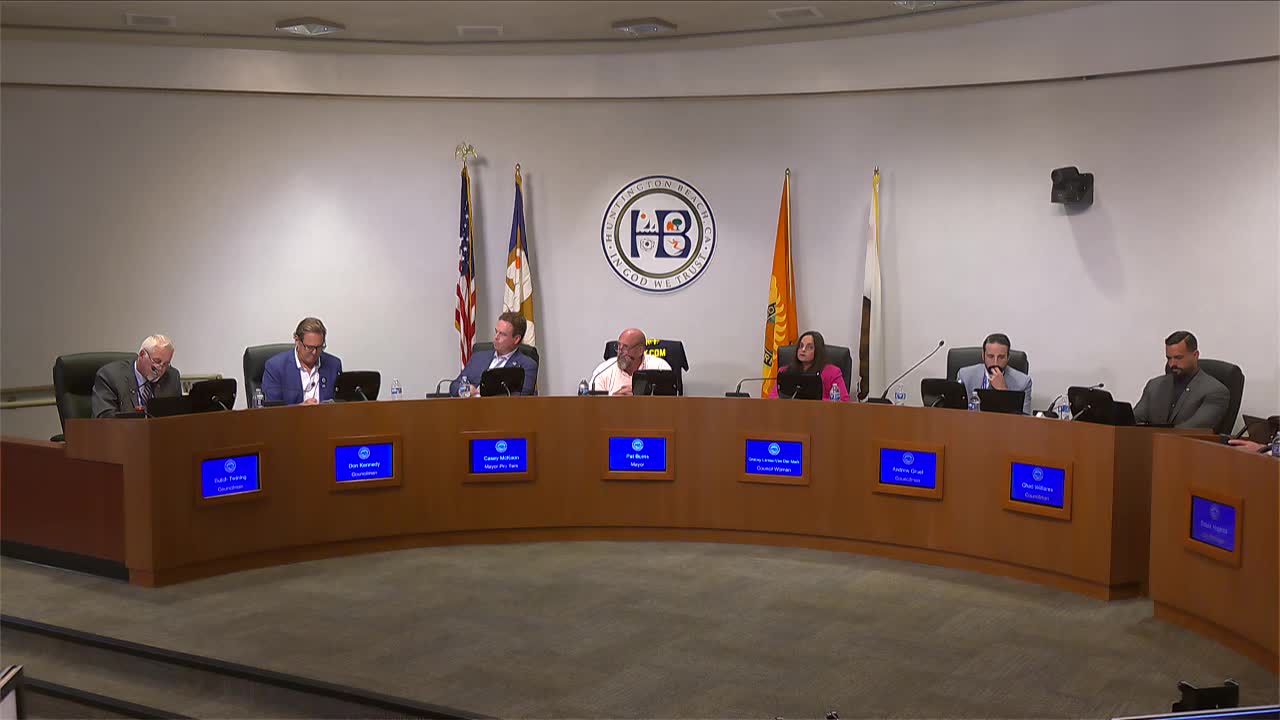
Huntington Beach — The City Council voted 4–3 on Oct. 21 to continue a TEFRA public hearing for Pelican Harbor Apartments, a 43-unit permanent supportive housing development for formerly homeless seniors, after extensive questioning about financing, subsidies and the city’s subordinate loans.
Huntington Beach — The City Council voted 4–3 on Oct. 21 to continue a TEFRA public hearing for Pelican Harbor Apartments, a 43-unit permanent supportive housing development for formerly homeless seniors, after extensive questioning about financing, subsidies and the city’s subordinate loans.
Charles Kovac, the city’s housing manager, told the council the project at 18431 Beach Boulevard was completed in December 2024 and serves extremely low- and very-low-income, formerly homeless seniors. “Pelican Harbor is a 43-unit permanent supportive housing development that was completed in December 2024 and occupied as early as January 2025,” Kovac said in his presentation.
Kovac said the city provided roughly $2.8–$3.0 million in loans made up primarily of federal HOME funds with about $200,000 from the city’s inclusionary housing in-lieu fund. The development was financed originally with tax-exempt bonds issued by the California Municipal Finance Authority (CMFA), 4% low-income housing tax credits, and state and county grants, and the TEFRA hearing is a federal tax-law procedural requirement to retain tax-exempt status for a portion of those bonds.
Council members pressed the Jamboree Housing representative and staff on multiple points: how rents are set and subsidized for the mostly extremely low-income residents, how much of the building’s occupants have Huntington Beach ties, the timing of audited financial statements, projected loan repayment to the city, and the impact if the bonds lost their tax-exempt status. Staff said about 86% of residents have ties to Huntington Beach and that audited financials for the first operating year will be available in January. The developer and staff repeatedly described “razor-thin” operating margins for projects serving extremely low-income residents.
As part of the negotiated benefits for the city in exchange for hosting the TEFRA hearing, Jamboree agreed to extend the affordability covenant from 60 years to 99 years, to begin an annual $5,000 payment to the city for 99 years, and to change the interest terms on the city’s loans (raising simple interest from 3% to 5% beginning in year 20). Staff estimated the interest change would increase the future repayment amount owed to the city by roughly $5.0 million over the life of the loan; the $5,000 annual payment was described as generating about $495,000 over 99 years. Kovac said the changes represented “a favorable renegotiation for the city.”
Several council members said they supported the project’s mission to keep seniors off the street but wanted more time to review the developer’s audited financials and to explore whether additional taxpayer protections were possible. Councilmember Chad moved to continue the TEFRA item to Oct. 28 to give staff, the developer and council time to pursue additional restructuring; the motion passed on a roll call vote of Yes — Kennedy, Burns, Grull, Williams; No — Twiney, McKeon, Vandermark.
The continued hearing is procedural; staff and the developer said failing to secure a renewed TEFRA approval could cause the bondholder to lose the tax-exempt status on the outstanding portion of the bond financing, potentially raising debt-service costs and increasing the project’s default risk. Kovac told council that if the conversion to permanent financing could not proceed with tax-exempt treatment, the developer might need to provide additional equity or the financing structure would have to be renegotiated.
The council’s October 28 date-certain continuation will reopen the public hearing and give members time to review financial audits and pursue additional conversations with the developer and staff. The TEFRA hearing does not authorize new construction, change tenant rights, or alter the completed project; staff said the item is narrowly focused on preserving tax-exempt status for an existing financing component.
Details to watch for at the continuation include the developer’s audited operating statements, the precise schedule for subordinate loan repayments to the city, and whether the council pursues higher or indexed payments in lieu of taxes or other protections for the city.