Get Full Government Meeting Transcripts, Videos, & Alerts Forever!
Get email alerts on the Rezoning topic
No spam. Unsubscribe anytime.
Oak Grove aldermen unanimously rezone two Twelfth Street parcels from M-1 to R-1
Summary
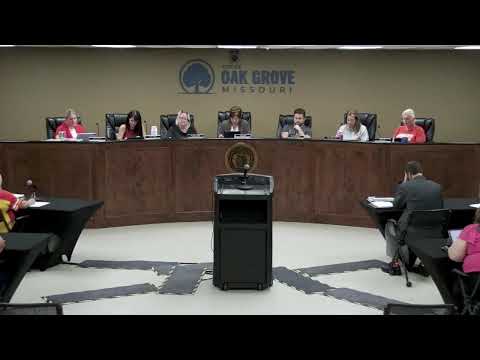
On Oct. 6, 2025, the Oak Grove Board of Aldermen unanimously approved ordinances to rezone two vacant parcels on the north side of Twelfth Street and Cemetery Road from M-1 (light industrial) to R-1 (single-family residential).
On Oct. 6, 2025, the Oak Grove Board of Aldermen unanimously approved ordinances to rezone two vacant parcels on the north side of Twelfth Street and Cemetery Road from M-1 (light industrial) to R-1 (single-family residential). The west parcel is approximately 1.3 acres and the east parcel approximately 6.3 acres. The board adopted Bill 25-16 (becoming Ordinance 2142) for the 1.3-acre parcel and Bill 25-17 (becoming Ordinance 2143) for the 6.3-acre parcel.
Planning staff — identified in the meeting transcript as Matt — told the board the city’s review focuses on compatibility with surrounding uses, infrastructure capacity and alignment with the city’s guidance documents. “Staff finds that the proposed zoning change from M-1 to R-1 is generally compatible with adjacent properties,” Matt said, noting that the proposed rezoning would reduce the length of shared boundaries between residential and industrial zones and likely produce fewer infrastructure demands than industrial use would.
The Planning and Zoning Commission held a public hearing on Sept. 6 and recommended unanimous approval of both parcels. During the Oct. 6 Board meeting no members of the public spoke for or against the rezoning during the public hearings. Board discussion referenced the city’s future land use map, which still designates the sites for industrial use but is advisory; Pam Pope noted the area’s historic industrial uses tied to the nearby train tracks and said the change reflected the neighborhood’s long-term transition toward residential development.
City staff also clarified the city uses a Euclidean zoning structure (each district has its own allowed uses) rather than a cumulative or pyramid zoning system in which lower-intensity uses are automatically permitted in higher-intensity districts. The board discussed whether a future party (for example, Evergy, which is adjacent to the area) could prompt a rezoning back to industrial; staff confirmed rezoning can be initiated by either a property owner or the city.
Board action: For each parcel the board moved for first and second reading by title only and then voted to adopt the ordinances. The city clerk read the full ordinance title twice for each bill. Roll-call votes on both adoptions were recorded as yes from Melissa Johnson, Shane Shawbaker, Kelly Neto, Tracy Newcomer, Rachel Kilmer and Pam Pope; both measures passed and were assigned Ordinance Nos. 2142 and 2143.
Why it matters: The rezoning removes a small, long-vacant industrial designation in an area that has seen residential development nearby. Staff said the change is not expected to create significant infrastructure or environmental impacts and could reduce long-term land-use conflicts between industrial and residential properties.
What’s next: The ordinances are adopted; any future change to zoning would require the same public process (planning review, public hearings and aldermanic action).