Get Full Government Meeting Transcripts, Videos, & Alerts Forever!
Get email alerts on the Zoning topic
No spam. Unsubscribe anytime.
Joplin Council reviews 38-section rewrite of zoning code; staff to bring ordinances for first reading
Summary
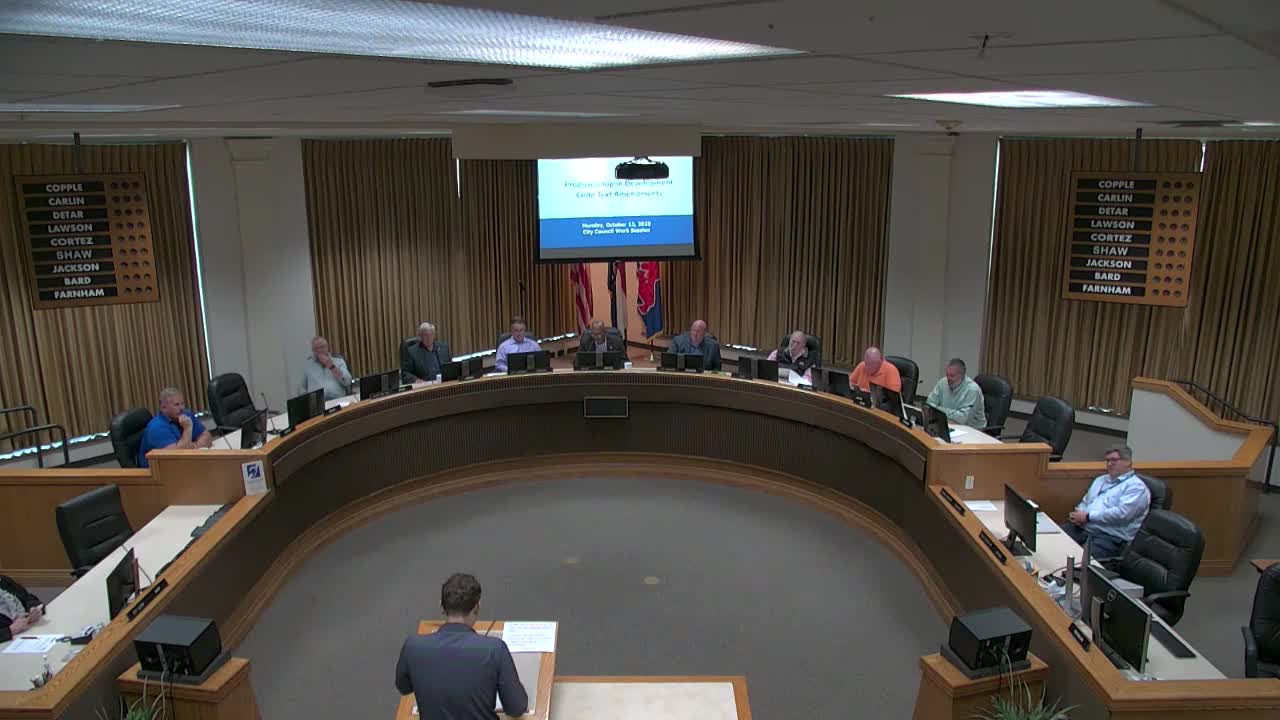
City staff presented a 38-section package of proposed amendments to Joplin's form-based zoning code during an Oct. 13, 2025, work session, and council members asked clarifying questions before directing staff to place the revisions on the next regular meeting agenda for first reading and any required public hearing.
City staff presented a 38-section package of proposed amendments to Joplin's form-based zoning code during an Oct. 13, 2025, work session, and council members asked clarifying questions before directing staff to place the revisions on the next regular meeting agenda for first reading and any required public hearing.
"We adopted our new code about 3 years ago and it was a totally new code," said Troy Bolander, a city staff member who introduced the scope of the changes, noting the code shifts Joplin from an auto-oriented zoning approach to a form-based emphasis on design and site planning.
Staff member Tyler gave a section-by-section summary of the proposals. Key items include an outbuilding exception for large, rural parcels (an accessory structure may be placed in front of a primary building on parcels larger than 40,000 square feet if it sits at least 60 feet back from the right of way); clarification that the state-mandated 185-foot owner-notice requirement applies to special use permits and rezonings while street vacations will continue to rely on targeted mailings to adjacent or impacted owners; and removing fee amounts from the zoning code so the code cites a separate, up-to-date fee schedule.
The package also proposes a permanent waiver of rezoning fees for property owners seeking historic-preservation rezoning; a shift in bicycle facility guidance toward protected bike lanes consistent with NACTO recommendations; and an amendment to allow major utility facilities such as substations to seek a special-use permit in nonindustrial districts when necessary. The draft consolidates previous medical-marijuana provisions and updates them to reflect Missouri's recreational framework while preserving use restrictions staff previously adopted.
Other notable changes: apartments would be permitted by right in the highest-intensity commercial C-3 district to support mixed-use redevelopment; many existing auto-sales sites would be treated as permitted uses in C-3 (to address widespread nonconforming status under the new code); updated animal-care/kennel standards to align definitions and specific-use standards (removing a conflicting 20-animal cap and retaining a threshold of requiring a 2-acre minimum only when a facility exceeds 50 animals); allowance of drive-up commercial storage in C-3 subject to site-design standards; and a recommendation to treat residential and nonresidential ground-mounted solar panels as accessory structures allowed by right, subject to lot-coverage limits.
Staff also proposed clarifications to fence rules (privacy fences limited to 12 feet past the rear building line, with 4-foot open construction forward of that line), explicit allowance of T-post and woven-wire fencing in agricultural and industrial districts, and additional flexibility for landscape buffers on built-out or infill sites (allowing a narrower 15-foot buffer with higher planting counts or alternative plantings elsewhere on site).
On mobile and micro retail, staff proposed a tightened definition for small-scale retail under 1,000 square feet (food trucks, kiosks, sales receptacles) that remains generally allowed in approved districts but gives staff authority to require site-plan review or a special-use permit for more permanent or atypical installations. Councilmember John Jackson (name as used in the transcript) raised concerns about so-called "membership lounge" businesses that some operators have used to avoid sales-tax obligations; Tyler said the draft prohibits on-site use at retail/manufacturing locations but does not, in its current form, resolve private-club or sales-tax enforcement questions.
Council members pressed staff for clarifications on several items. Councilmember Lawson asked whether the bike-lane changes affect the sharrows on Main Street; staff said sharrows remain a separate treatment and the proposed language focuses on design options that physically separate bicyclists from motor vehicle traffic where feasible. Councilmember Shaw raised concerns about increased vehicle parking and multiple-occupancy properties in residential neighborhoods; staff discussed enforcement limits imposed by federal case law protecting certain group homes and suggested parking-permit or enforcement approaches might be considered in a separate effort.
Tyler summarized specific numeric clarifications captured during the presentation: the 185-foot notice radius tied to state statute (applies to special use and rezoning), the 60-foot right-of-way setback for permitted outbuildings on large parcels, the 1,000-square-foot threshold for micro retail, the alignment of kennel definitions to allow up to 50 animals by definition (with a 2-acre floor only when over 50), and the alternative ADA-accessible parking layout (either an 11-foot space plus a 5-foot loading aisle or an 8-foot + 8-foot option consistent with federal standards).
Council gave general direction to staff to take the draft off the table at the next meeting and place it on the agenda for first reading and any required public hearing. No formal ordinance vote was taken at the work session.
"We could decide to place it on second and third reading and ask for a motion to take it off the table at the next meeting," Tyler said; the mayor and council signaled they wanted the item placed on the next agenda for first reading and public hearing.
Next steps: staff will prepare the ordinance language and supporting materials for placement on the next regular council agenda for first reading and any public hearing required by the code or state statute.