Get Full Government Meeting Transcripts, Videos, & Alerts Forever!
Get email alerts on the Education Goals topic
No spam. Unsubscribe anytime.
Manchester sets 2025-26 goals focused on literacy, staff retention and systems
Summary
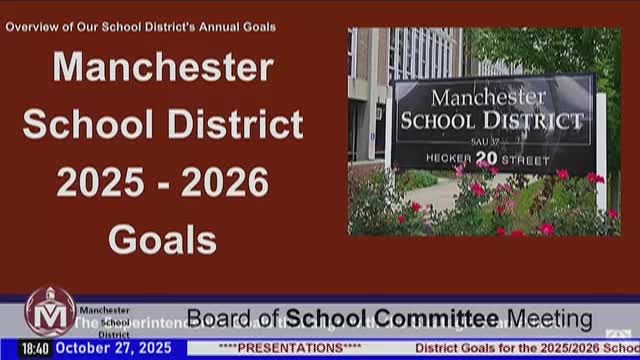
Dr. Camille Espinola, superintendent of the Manchester School District, presented the district—2025—26 goals to the Board of School Committee on Oct. 27, saying the work is organized around three pillars: grow our learners, grow our educators, and grow our systems.
Dr. Camille Espinola, superintendent of the Manchester School District, presented the district—2025—26 goals to the Board of School Committee on Oct. 27, saying the work is organized around three pillars: "grow our learners, grow our educators, and grow our systems." The plan is informational only this month; no board action was requested.
The district set multiple measurable targets for the year. For student outcomes, administration said it aims for 85 percent of K—2 students to demonstrate growth in reading proficiency by June 2026 as measured by state and local assessments, and to increase the graduation rate by 5 percentage points over the 2024-25 baseline. For staff the district will "maintain or increase" its staff retention rate from 2024-25 to 2025-26; the 2024-25 retention baseline cited in the presentation was 90.71 percent. For systems, leaders said they will deliver a tax-cap-compliant budget and complete priority 1 capital projects on time and on budget.
Leslie Whitney, executive director of teaching and learning, described the instructional supports designed to meet the literacy goal, including quarterly benchmarks, outcome-based contracting piloted in four schools, and competency-based instruction at elementary and middle levels with high-school staff to be trained. Wendy Perrin, executive director of multilingual learner education, said the department aims for 85 percent of English learners to meet annual ACCESS growth targets through aligned curriculum and strengthened interim assessments.
Administration framed the goals as a districtwide, cross-department effort that depends on data monitoring and regular professional development. "When our systems, our staff, and our students move together, progress is not accidental," Dr. Espinola said. Board members pressed for baseline data behind the 85 percent target and were told the district used prior-year data and a consultant (EAB) to set a rigorous yet achievable target; administration committed to returning with historical baselines and a mid-year update in February.
Board members also asked how goals will translate to school-level targets. Administration said goals are intentionally school-specific for attendance, behavior and curriculum (the "ABC" goals), and that principals and assistant superintendents will meet monthly to align supports and review progress. Several board members asked that the district provide more detail on measures such as the portion of students making a full year of expected growth, which administration agreed to include in follow-up reporting.
Context and next steps: The district leadership emphasized the presentation is year-one operationalization of a multi-year strategic plan. Administration said some data releases (notably state assessment and graduation-year figures) remain embargoed and may require adjustments when the state releases final results. A mid-year report to the board is scheduled for February and an end-of-year report in June.