Get Full Government Meeting Transcripts, Videos, & Alerts Forever!
Get email alerts on the School Facilities topic
No spam. Unsubscribe anytime.
Manchester outlines aging schools, estimates hundreds of millions for replacement and upgrades
Summary
District officials told legislators Oct. 15 that Manchester operates 20 school buildings with an average age of roughly 75 years and described a long-term capital backlog. Speakers cited a new high school cost estimate in the low hundreds of millions and said cumulative modernization needs run substantially higher.
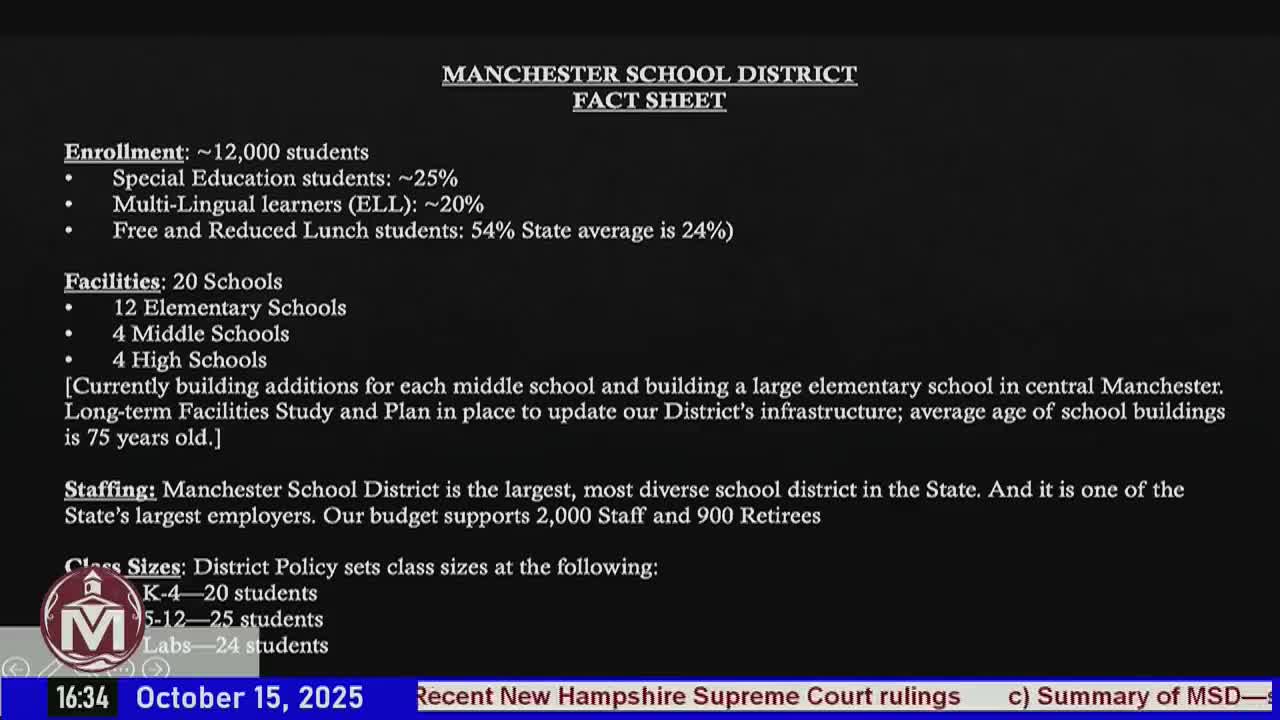
District presenters said Manchester operates 20 schools—12 elementary, four middle and four high schools—with an average building age of about 75 years. Committee member Dr. Sean Parr described an active long-term facilities plan that includes additions at all four middle schools and a planned new central elementary school.
Parr said the district’s recent consolidation included closing two underused buildings and that a separate long-term plan is in place to modernize campus infrastructure and address health and safety needs. “We have 3 schools in Manchester today that have no insulation on their exterior walls,” Parr said, noting recurring maintenance needs.
Cost estimates discussed at the meeting varied by scope. Parr and other speakers cited a figure in the range of $350 million to $400 million for a new high school in current dollars. A broader modernization estimate referenced in the discussion put replacement and major modernization on the order of several hundred million to over $700 million for comprehensive multi-building projects; speakers stressed these were planning-level figures and would require detailed engineering and cost study to refine.
Why it matters: Committee members and visiting legislators said facility condition affects student health and learning and that deferred maintenance compounds operational costs. Representative Patrick Priest and others emphasized the need for healthy school buildings and supported ongoing modernization work. District leaders said state-level capital aid is currently far short of what many districts need and that Manchester’s tax-cap constraint limits local revenue options to address major capital projects.
Next steps: The district asked legislators to consider state-level building-aid reforms and said it will continue to share facility plans and cost estimates with representatives. Representatives in the room were invited to a special-education presentation and other follow-up briefings the district will record and distribute.
No formal vote or capital appropriation was taken at the meeting.