Get Full Government Meeting Transcripts, Videos, & Alerts Forever!
Get email alerts on the School Funding topic
No spam. Unsubscribe anytime.
Manchester officials warn state aid cut would be ‘catastrophic’ for schools
Summary
Manchester School District leaders told visiting state legislators Oct. 15 that a proposed reduction in targeted state aid of about $12.6 million, together with a decades-long local tax cap and rising special-education and transportation costs, would force major service cuts, large staff reductions and reserves depletion.
Manchester School Committee member Dr. Sean Parr opened a meeting with state legislators on Oct. 15 by framing the city’s schools as a large, high-need district facing immediate budget pressure. “Our enrollment is fairly stable at around 12,000 students,” Parr said, noting that about 25% are identified for special education, roughly 20% are multilingual learners and 54% qualify for free or reduced-price lunch.
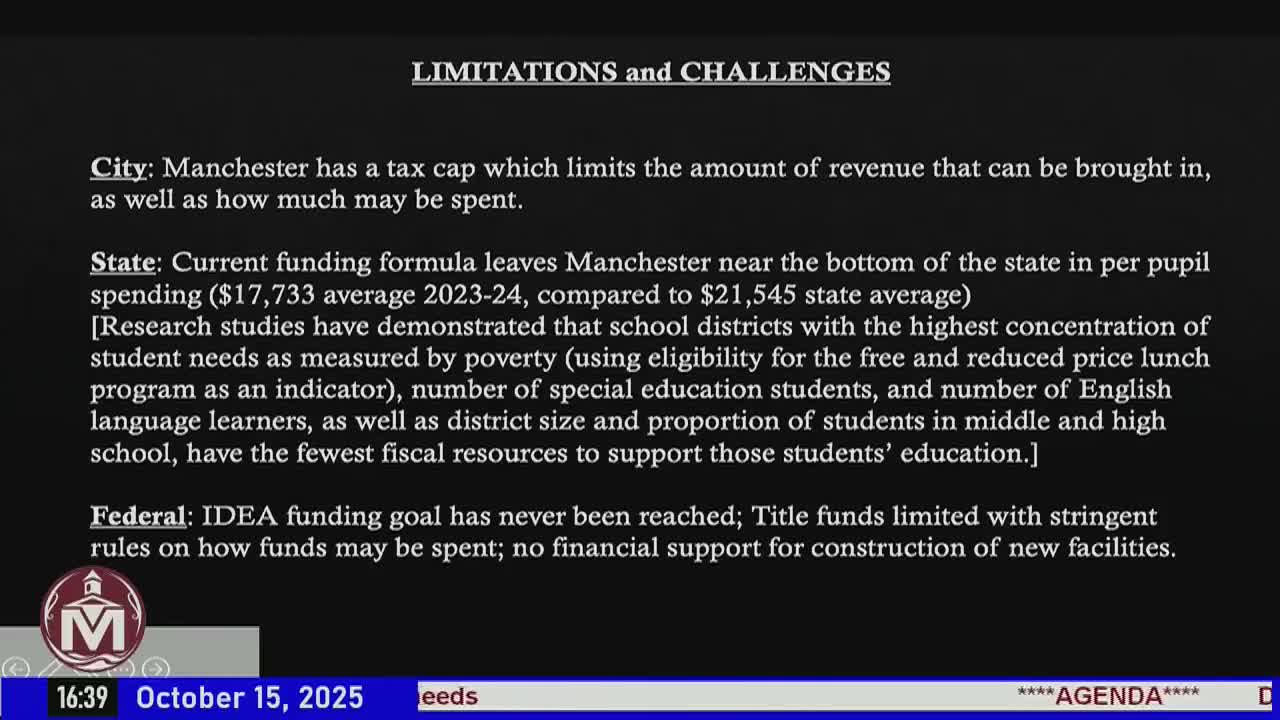
The committee’s presentation warned that local, state and federal funding changes leave Manchester among the lowest-funded districts in the state on a per-pupil basis. The presentation said Manchester’s average per-pupil spending was about $17,733 compared with a state average near $21,545 and said a state budget bill passed in June would cap Manchester’s targeted aid and reduce that aid by roughly $12.6 million beginning in fiscal 2028.
Why it matters: District leaders said the combined effect of the local tax cap, the proposed reduction in targeted aid and rising contractual and service costs is already pushing Manchester toward a financial emergency. “A $12,000,000 reduction would probably involve the elimination of 150 staff,” one school official said, warning the cuts would “blow up class sizes” and could lead to program eliminations, athletics cuts or school closures.
Legislative context: State legislators at the meeting described several bills under committee review. Representative David Luno (ranking member, Education Funding Committee) said House Bill 651, introduced in response to Claremont/adequacy litigation, was recommended by a subcommittee as inexpedient to legislate but would likely return to the House for further action in January. He and others described House Bill 772 as a vehicle that would set a minimum local share and provide state support to reach a calculated, district-specific funding level. Several representatives also mentioned HB675 (referenced by attendees as the measure tied to a $12 million reduction to Manchester); committee members said that measure had been retained in committee and could reappear in the coming session.
Operational pressures: Officials described sharp increases in special-education and transportation costs. District Attorney Upton, the superintendent’s designee, said private-provider rates for specialized transport have “literally doubled in the last five years,” and that some routes can cost the district “upwards of $900 per day,” depending on student needs. The district reported in the meeting that bringing some transportation in-house produced savings for services such as McKinney-Vento (homeless) transportation but that overall demand and specialized service costs continue to escalate.
Local tax cap and reserves: Speakers stressed the constraint the city’s tax-cap policy places on raising local revenue; one presenter said the cap has effectively reduced the city’s purchasing power over time because the consumer price index (CPI) used to set the cap does not match the cost pressures the district faces (health insurance, fuel, specialized services). The committee reported using emergency reserves this year and forecast reserves declining sharply if the proposed state aid reductions go forward.
Requests and next steps: Committee members asked the Manchester delegation to educate colleagues in Concord about the scale of need, the structure of targeted aid, and specific fiscal impacts. The committee offered to share data about how additional funding would be spent (for example, targeted dollars for truancy prevention or attendance liaisons) and invited legislators to further briefings. The meeting ended with a request that Manchester’s representatives press for changes to any proposal that would cut targeted aid and to support measures that account for district need and the tax-cap limitation.
No formal vote on state legislation occurred at the meeting; legislators described subcommittee recommendations and anticipated floor action in January.