Get Full Government Meeting Transcripts, Videos, & Alerts Forever!
Get email alerts on the Device Policy topic
No spam. Unsubscribe anytime.
Principals report early benefits of electronic device policy; district logs 680 violations, few suspensions
Summary
District leaders reported 680 documented cell phone violations through Oct. 13 with 17 incidents resulting in external suspension (about 2.5% of violations). Seven principals told the committee they have observed more on-task behavior, increased student-to-student interaction and fewer negative escalations since the policy's implementation.
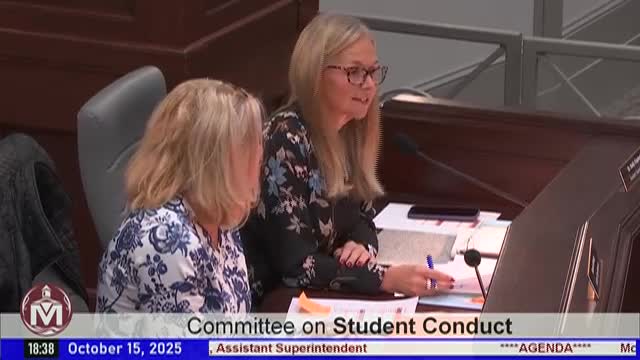
Assistant Superintendent Espinola updated the committee on district cell-phone procedures and principals from multiple schools described early effects of the policy.
Espinola reported that, as of Oct. 13, there were 680 documented cell-phone violations across the district; 17 of those incidents resulted in external suspension (about 2.5 percent of reported violations). Espinola also said 23 violations occurred at the middle school level (about 3.4 percent of the total). She told the committee that the district is monitoring monthly metrics for total violations, repeat offenders and suspension rates and will continue to emphasize proactive prevention and tiered responses.
A panel of principals from Memorial, Central, Manchester School of Technology, Parkside, Southside and Hillside said they are seeing largely positive effects. Deb Rookie, principal at Central High School, said she has "seen improved communication with students" and fewer negative interactions in common areas. Ben (Memorial principal) gave two anecdotes: one about higher library checkouts and another quoting a student who realized after the school day that an impulsive reaction no longer mattered: "By the time I got home... I realized I didn't care." Several principals said classrooms and cafeterias felt more focused and that teachers were covering lessons with fewer disruptions.
Principals emphasized consistent enforcement and administrative support for teachers. They described a shared protocol for confiscation and office intake so teachers can return promptly to instruction, and said that communication to families before implementation helped set expectations.
Committee members raised questions about laptops and instructional needs. Principals reported uneven Chromebook availability across buildings; some schools are allowing limited personal-laptop use as a temporary bridge where Chromebook capacity is not yet universal, while others reported having enough district devices. Schools identified workarounds for classes that require photography or specialized software (media centers, Chromebooks, clear-touch displays, district calculators).
Members also discussed alternatives to external suspension. Assistant Superintendent Espinola described the YMCA WISE RIFE program as an external option for students after suspension and committee members expressed interest in developing in‑school suspension or supervised on-campus alternatives so students are not simply sent home.