Bakersfield Elementary reports test gains, pushes attendance and behavior targets
Summary
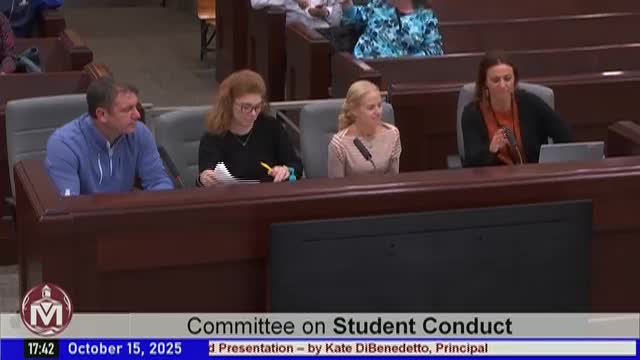
Kate Di Benedetto, principal of Bakersfield Elementary, told the Manchester School District Committee on Student Conduct on Oct. 15 that the school has seen measurable gains on state assessments and set specific targets for attendance, behavior and core instruction.
Kate Di Benedetto, principal of Bakersfield Elementary, told the Manchester School District Committee on Student Conduct on Oct. 15 that the school has seen measurable gains on state assessments and set specific targets for attendance, behavior and core instruction.
"This year our SAS scores are ELA 21 percent proficient or above and math 29 percent proficient or above," Di Benedetto said, citing spring 2025 results that she described as a meaningful increase from 2024. She said Bakersfield enrolls about 344 students in a Title I pre-K–4 school and that its preschool cohort is housed at the Bishop O'Neil Youth Center.
Di Benedetto and members of the Bakersfield leadership team described three district-aligned goals: raise students who attend 80–90 percent of days by five percentage points, increase use of Tier 3 individualized student success plans from roughly 25 percent to 75 percent, and improve proficiency on the New Hampshire SAS and ACCESS tests (a 3 percent target stated for ELA and math on the plan). Staff listed concrete interventions for each goal.
For attendance, the school uses a weekly attendance committee, teacher outreach after three missed days ("a caring phone call"), multilingual communications provided by the district, student daily attendance calendars that go home monthly, and a walking-bus partnership run by City Year for students in the Elmwood neighborhood. Di Benedetto said teachers play a primary role in initial family contact because of established relationships.
On behavior, Danielle Longo, Bakersfield social worker, said the school is implementing MTSS (multi-tiered systems of support) strategies and has already increased the number of student success plans this year, with early improvements noted in some Tier 2 and Tier 3 behaviors. Longo described partnerships with community providers that support behavioral health and bilingual counseling.
Melissa Sutherland, Bakersfield math coach, described instructional shifts she credits with progress: competency-based (CBE) math progressions, co-planning and co-teaching between EL and classroom teachers, modular practice assessments to familiarize students with the SAS platform, and targeted small-group testing accommodations. She said staff use interim assessments and frequent "check and adjust" cycles to inform instruction.
Committee members praised Bakersfield for the gains and asked how the school can share practices districtwide. Committee member Gonzales said he hoped the school could "disseminate how you're doing the work." Committee member Watt asked about adoption of the district's new communications tool, TalkingPoints; Bakersfield staff said phased IT rollouts have slowed full adoption but that they plan parent sign-up pushes at the November conferences and brief PD reminders for staff.
Bakersfield highlighted two additional items: expansion of a dual-language immersion program (now in kindergarten and Grade 1 cohorts) and a recent playground/turf upgrade funded by a grant. Staff said they are rebuilding parent engagement after declines during the COVID period and continue to celebrate student growth publicly.