Get Full Government Meeting Transcripts, Videos, & Alerts Forever!
Get email alerts on the Mental Health topic
No spam. Unsubscribe anytime.
Manchester updates Project AWARE supports as board presses on attendance and scale
Summary
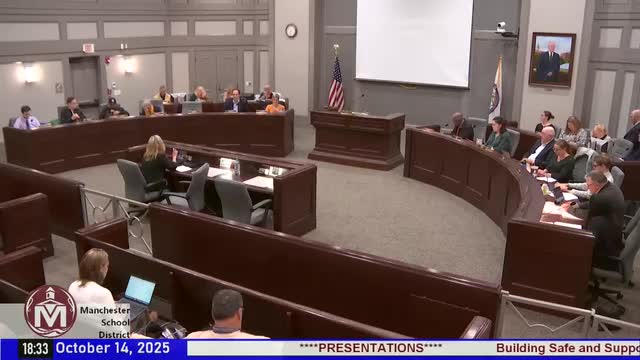
Stacy Champion, director of Multi-Tiered Systems of Support Behavior and Project AWARE, told the Board of School Committee on Oct. 14 that Project AWARE is a five-year, $7,600,000 federal grant entering year three that underpins the district’s effort to build systems for behavioral health, violence prevention and safe schools.
Stacy Champion, director of Multi-Tiered Systems of Support Behavior and Project AWARE, told the Board of School Committee on Oct. 14 that Project AWARE is a five-year, $7,600,000 federal grant entering year three that underpins the district’s effort to build systems for behavioral health, violence prevention and safe schools.
Champion said the work is organized by district-level teams — including mental health integration with Amaskig Health, a trauma-responsive and inclusive team, a violence-prevention team working with the Manchester Police Department, and a new staff-belonging and well-being group — and by 20 school-based Tier 1 teams that set schoolwide expectations, teach them and track outcomes. She said 18 of 20 school intervention teams are in place and community partners such as Elliott Hospital are providing staff training and supports.
The Empower/MPOWER campaign was built from 2023 YRBS data showing 58% of Manchester high school respondents reported they rarely or never got the help they needed for feeling “sad, empty, hopeless, angry, or anxious.” Champion said the campaign reduces stigma, promotes resilience, offers an anonymous reporting form, a one-minute explainer video, signage and a new student self-referral form that routes students to school counselors or clinicians.
District staff identified several outcome measures to evaluate Project AWARE and related programs: the number of middle- and high-school students who reach out for help, attendance trends, office referrals, suspension counts and school climate survey results. Champion reported a staff climate response rate increase to 54% (913 staff). She said one Department of Justice–funded student success model at Memorial and Hillside showed a 31% decrease in external suspensions for the specific cohort served, and the district is building alternatives to suspension that require parent consent and explicit participation criteria.
Administrators described other funding tied to the work: a $1,000,000 DOJ award to reduce suspensions and build a middle/high student-success model (operating at Memorial and Hillside), a $365,000 award to add a student-success role at Central High School that has been filled, and a pending $500,000 DOJ application to add a student-success position at West High School and purchase safety communication equipment. Champion said Parkside now has five-day-a-week mental-health clinician coverage and Amaskig Health positions were sustained through recent federal funding actions.
Board members pressed staff about the size of intervention cohorts (examples of 8 at Memorial, 15 at Hillside) and asked whether small cohorts produce meaningful, scalable results. Champion said the cohorts are intentional, focused on students with repeated suspensions or intensive needs; she emphasized that the funded role combines individual case work, group supports and coordination, not only work with a single small cohort.
Several board members and the student member raised chronic absenteeism as an urgent district issue. Committee members quoted district figures: elementary chronic absenteeism ~27%, middle ~34%, high school ~52%, district average ~36%. Board members said high absenteeism undermines gains from mental-health interventions and must be addressed alongside behavioral supports. Administration said attendance referrals are now being routed through MTSS-B intervention teams so the district will have more actionable attendance data tied to the behavioral-health initiative.
Student member Geary told the board he had seen Empower signage at West High but not an active student-facing rollout; staff said student teams at West had only just begun and pledged follow-up with student leadership. Several board members asked staff to monitor counselor capacity, noting guidance counselors’ responsibilities include college and career planning as well as mental-health supports — the district said it is auditing counselor time use to prioritize direct student services.
Why it matters: Project AWARE provides long-term federal funding and a districtwide framework for behavioral-health supports; the scale, measurement and staffing choices will determine whether targeted reductions in suspensions and improved help-seeking translate to broad improvements in attendance, classroom access and academic outcomes. Administrators committed to annual reporting through Project AWARE, continued grant seeking and data-driven staffing adjustments.
Next steps: staff will continue Project AWARE reporting (annual reports due each July), refine student-success roles and coordinate counselor staffing and community partners; board members asked for continued metrics on referrals, attendance and suspension trends.