Get Full Government Meeting Transcripts, Videos, & Alerts Forever!
Get email alerts on the Housing Mixed Use topic
No spam. Unsubscribe anytime.
Bellevue Planning Commission schedules public hearing on HOMA after debate over mandatory affordability, parking and retail rules
Summary
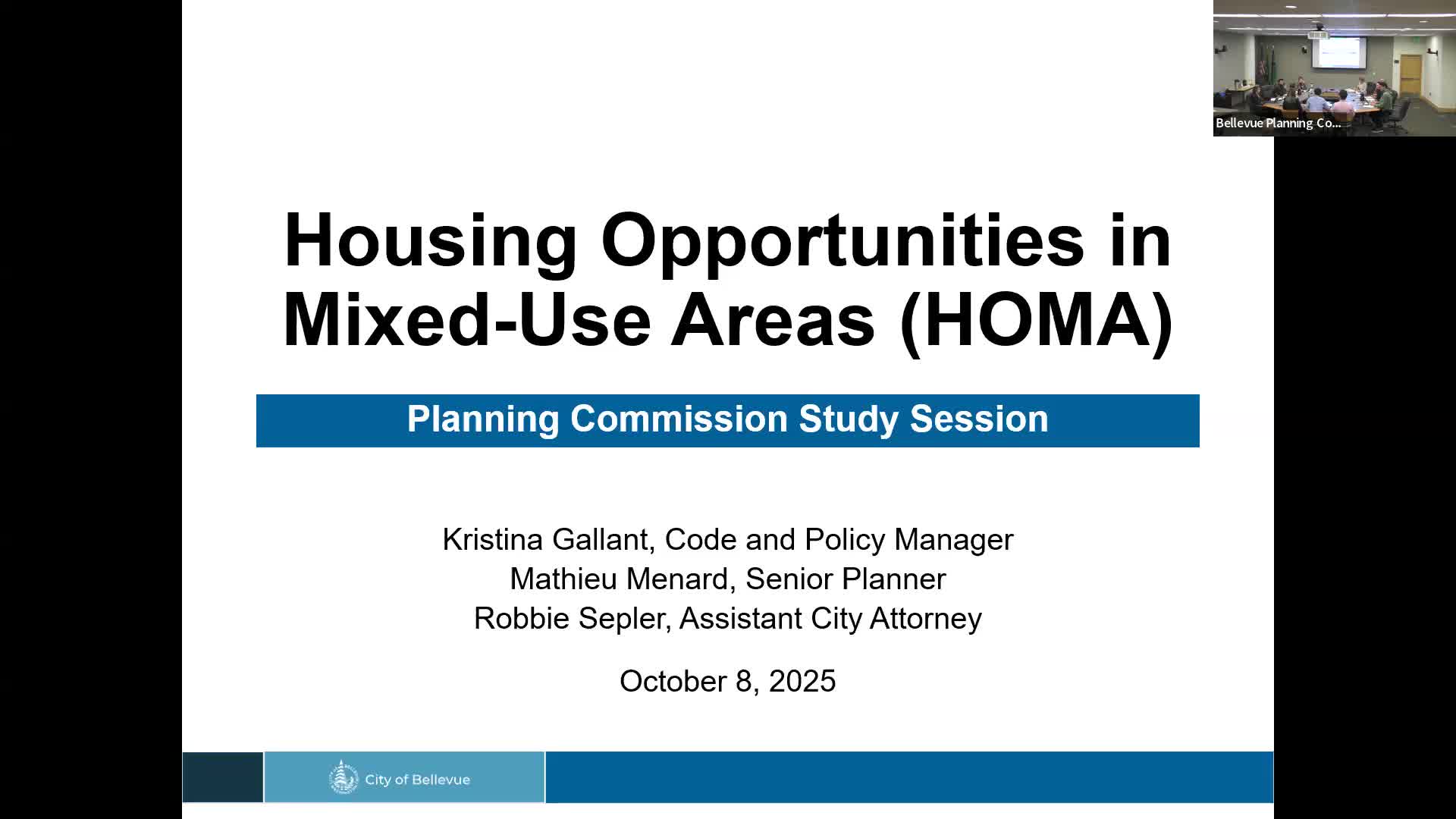
The Bellevue Planning Commission voted Tuesday night to direct staff to schedule a public hearing on the Housing Opportunity in Mixed‑Use Areas (HOMA) land‑use amendment, sending the package out for public notice and further public testimony, likely in early December.
The Bellevue Planning Commission voted Tuesday night to direct staff to schedule a public hearing on the Housing Opportunity in Mixed‑Use Areas (HOMA) land‑use amendment, sending the package out for public notice and further public testimony, likely in early December.
The hearing direction followed a study session in which city staff summarized draft code options for HOMA, including an Option A that would require developments of more than 10 dwelling units in HOMA districts to provide 10% on‑site affordable housing at 80% of area median income (AMI) with a 4:1 floor‑area bonus and a fee‑in‑lieu alternative. "This is a program that would require all developments over 10 units in the HOMA area to provide at least 10% affordable housing and 80% AMI," said Matthew Menard, senior planner in the Development Services Department, as staff explained the economic analysis and bonus structure.
Why it matters: HOMA would change where and how housing can be built in Bellevue's mixed‑use centers, affect the feasibility of projects, and provide a new funding stream for affordable housing. Staff told commissioners the package is intended to increase housing supply while producing funds or units toward Bellevue's housing targets.
What staff presented: City planners said their economic modeling found structured parking is currently the largest cost driver for feasibility. With the 4:1 density bonus, staff reported, some prototypes show improved residual land value relative to a no‑bonus scenario; without the bonus, requiring affordable units reduces feasibility for many mid‑ and high‑rise prototypes. Staff also outlined transition standards: mixed‑use parcels abutting residential districts would face a 25‑foot setback and a 15‑foot step back for portions of buildings over roughly 80 feet, a standard intended to preserve buffers for adjacent neighborhoods.
Public comment: The commission heard about 12 speakers during a packed public‑comment period focused overwhelmingly on HOMA. Supporters said the code could help revive underused shopping centers and add housing near jobs. "Allowing plentiful housing can make it feasible for site owners to reimagine and reinvent their properties into neighborhood treasures," Ruth Lipscomb of the Newport Community Coalition said.
Developers and property owners urged greater flexibility. "Capping building coverage at 65% makes development on sites under two acres nearly impossible," said Sean Thorsen, director of acquisitions for American Capital Group, and he argued mandatory retail and tight impervious‑surface limits would block feasible projects. Property‑owner and downtown stakeholders, including representatives of the Bellevue Chamber, asked for parity between downtown and other growth areas and for certain Wilburton standards to be applied downtown to offset any mandatory cost.
Opponents from neighborhood areas raised parking, traffic and scale concerns. Several Newport Hills residents said steep topography, narrow 1960s streets and limited transit in their neighborhoods mean added units would exacerbate congestion and parking shortages.
Legal and code notes: Staff said they are carrying language to consolidate nonconforming‑site provisions into HOMA that council directed into the update; those changes are intended to reduce the risk that phased master developments will be forced to perform costly upgrades to later phases. Assistant City Attorney Robbie Seppler described staff's proposal to allow transfer of up to 50% of a future phase's floor‑area capacity without triggering improvements to that phase and to cap required improvements at 20% of the value of any triggering change.
Commission action and next steps: Commissioner [mover not specified in transcript] moved to direct staff to schedule the required public hearing on the HOMA land‑use code amendment; the motion passed on a voice vote. Staff said a full strike‑out/strike‑in draft incorporating recent downtown stakeholder revisions and the nonconforming language will be circulated prior to the hearing. Commissioners may hold additional study sessions after the formal hearing. The public hearing notice will provide the official draft for comment.
What remains unresolved: Key tensions that surfaced in testimony remain unresolved in staff's draft: how many retail frontage requirements to set in neighborhood centers (staff proposed lower frontages in lower‑density districts and higher percentages in larger centers), the level of impervious‑surface and building‑coverage limits, and the mix of mandatory on‑site affordable housing versus fee‑in‑lieu or amenity credit approaches. Staff indicated they will provide updated analyses and redlines to the commission ahead of the public hearing.
Quotes and attribution in this story come from Planning Commission study session presenters and members of the public at the October 8, 2025 meeting.