Get Full Government Meeting Transcripts, Videos, & Alerts Forever!
Get email alerts on the Ndot Fees topic
No spam. Unsubscribe anytime.
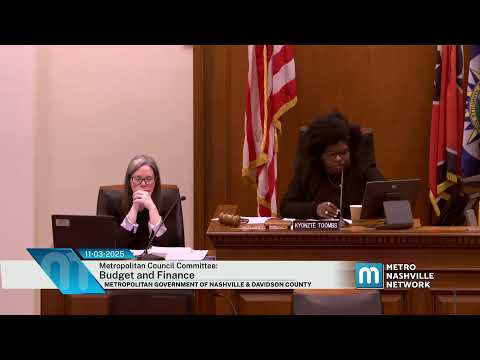
Council committee defers NDOT three‑year fee schedule after questions on outreach, calculations and accountability
Summary
NDOT Director Alarcon told the Finance Committee that the department hired a consultant to measure the actual cost of administering right‑of‑way permits and is proposing a three‑year, phased fee schedule to achieve cost recovery and hire additional field staff.
NDOT Director Alarcon told the Finance Committee that the department hired a consultant to measure the actual cost of administering right‑of‑way permits and is proposing a three‑year, phased fee schedule to achieve cost recovery and hire additional field staff.
"The study was strictly, to our right of way," Alarcon said, adding the city has not done a comprehensive fee update since 2003 and that the proposal is intended to bring permit fees in line with actual administrative costs. NDOT briefed the committee on a staffing plan that includes 10 new full‑time right‑of‑way inspectors in year one and additional specialists in years two and three to reduce reliance on external consultants.
NDOT presented a layered proposal that would incrementally raise fees for items including excavation permits, street and sidewalk closures, sidewalk café permits and special events. The department estimated cumulative revenue of roughly $14 million in year one (partial implementation), $25 million in year two and $37 million in year three; the presentation said those totals include indirect costs and are conservative projections based on recent permitting activity.
Council members pressed NDOT on several technical and policy points. Councilwoman Porterfield asked for a definition of "high impact" versus "low impact" and was told high‑impact areas are denser downtown corridors where lane and sidewalk closures have greater traffic effects, while low‑impact areas are suburban streets with more space for traffic detours. "So when they're excavating, it's not a one‑day process," Alarcon said, describing the bigger projects that drive the higher fees.
Councilmember Johnston asked how NDOT built the "total cost" figures. Alarcon said the consultant modeled the fees as if the work were performed by in‑house employees (salary plus fringe and indirect costs) rather than consultant hourly rates, and that bringing work in‑house reduces per‑hour cost compared with contracted consultants.
Several members, including Councilwoman Suarez and Councilman Huffman, said stakeholders had told them they were not consulted or lacked notice. NDOT said it conducted outreach beginning in February and held follow‑up virtual meetings, and the mayor's office confirmed staff had participated in stakeholder conversations. NDOT also added an amendment requiring an annual report with key performance indicators (KPIs) showing hires, permit turnaround and other metrics.
Amendment one (which removed a per‑square‑foot component from the sidewalk café calculation, raised the application fee, and expanded the excavation first‑permit threshold from 50 to 500 linear feet) passed on a voice vote. After further questions and an offer from the amendment sponsor to require periodic council review, the committee voted 7–2 to defer the ordinance one meeting to give NDOT time to provide additional documentation of outreach and to refine amendment language and timing.
The committee also discussed neighborhood exemptions and pro‑neighborhood features NDOT has piloted: a no‑fee program allowing neighborhood groups to check out traffic‑control equipment and use an NDOT traffic plan for short block parties and open‑streets events. NDOT said the barrier equipment is portable and that neighborhoods with adequate notice could have NDOT support with deliveries in some cases.
What happens next: the committee agreed to hold a one‑meeting deferral. NDOT will return with the agreed documentation, the required annual reporting language, and clarifications on high‑impact zone definitions and calculation examples before the committee votes again.