Board of Finance endorses Baltimore City Public Schools FY2027 capital plan
Loading...
Summary
The Board of Finance voted to endorse the Baltimore City Public Schools capital improvement program for fiscal year 2027 and the 2028–2032 planning period, covering a package of city and state funds and priority school projects.
The Baltimore City Board of Finance on Oct. 27 endorsed the Baltimore City Public Schools capital improvement program (CIP) for fiscal year 2027 and the multi-year plan through 2032.
City Schools presented a request that the program be submitted to the State Interagency Committee on School Construction as required by state rules. Alex Bennett, a data analyst in facilities planning for City Schools, told the board the full program includes $207,500,000 in city bond funds and $150,000,000 in state funds for a combined $357,500,000; the FY2027 request totals $52,500,000 composed of $27,500,000 in general obligation city bonds and $25,000,000 in state funds. The board moved to accept the endorsement and the motion carried.
The school system said the FY2027 request prioritizes four projects for state funding: the Southeast Building, Western High School, Lakeland Elementary, and the Northeast (Vanguard) building. Bennett said the Healthy School Facility Fund — previously a recurring $90 million statewide program that provided about $45 million annually to City Schools — ends with FY26 and will be replaced by a smaller Nancy Cobb facility priority fund, creating uncertainty about future state support.
Bennett summarized how the district uses its Comprehensive Educational Facilities Master Plan (CEFMP) and Comprehensive Maintenance Plan (CMP) to set priorities. He highlighted demographic shifts that have driven projects in Southeast and South Baltimore, including reopened schools that filled quickly and the planned conversion of a swing-space facility (the Southeast Building) into a permanent school site.
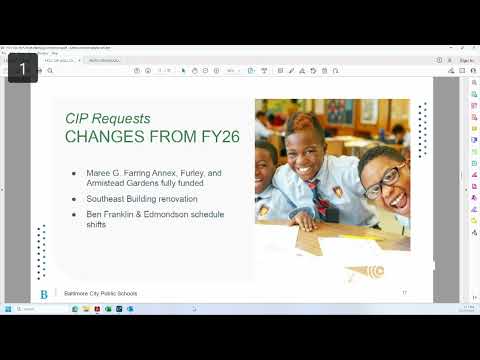
Board members asked for clarifications about individual projects and schedules: Bennett said the Lakeland project would replace a one-story prefabricated building with a two-story, 20-classroom prefabricated structure adding about 180 seats. He said the Marie G. Faring and Furley projects are reaching completion and that planned renovations at Ben Franklin and Edmondson high schools are intended to start with local funds while awaiting state support.
Bennett said the district routinely carries forward unfunded projects from prior years, prioritizes systems work (HVAC, roofs, windows, doors) through the final year of the Healthy Schools fund, and uses recurring city and state CIP dollars as the baseline for systemic work.
The board asked staff to provide a dollar-level accounting, and Bennett agreed to follow up with a summary of allocations and expenditures at a future meeting. The endorsement the board approved is the local-governing-body approval required to submit the program to the state as part of the construction funding process.
The presentation and discussion included questions about construction fencing at the historic City College site, the district’s sustainability practices for roofs and solar readiness, and how swing space is used temporarily while schools are renovated. No changes to the FY2027 dollar request were made by the Board of Finance at the meeting.
The board’s vote to endorse the CIP was procedural; the endorsement is one of several local approvals (school board, planning commission, Board of Finance, Board of Estimates) that City Schools must obtain before finalizing the state submission and proceeding toward mayoral approval.