Lifetime Citizen Portal Access — AI Briefings, Alerts & Unlimited Follows
Currituck commissioners review three redistricting drafts as Moyock growth reshapes districts
Loading...
Summary
Currituck County commissioners reviewed three draft election-district maps on Oct. 20 designed to rebalance districts after rapid population growth in the Moyock area.
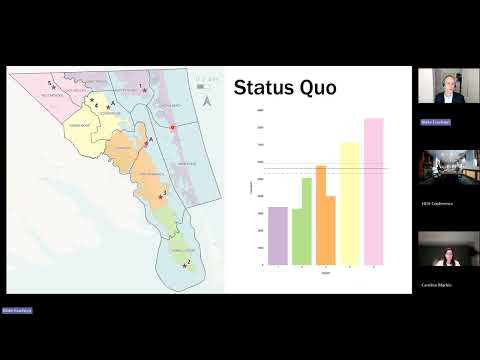
Currituck County commissioners reviewed three draft election-district plans prepared by county consultants on Oct. 20 as they seek to rebalance districts after rapid population growth in the northern mainland.
Caroline (consultant) told commissioners that the three drafts are meant to start discussion and that no decision was required at the meeting: "You don't have to make any decisions tonight," she said, adding that any adopted plan would later be placed on a referendum for voters to approve and would not be used for Board of Commissioners elections until 2028.
Blake, the mapping consultant, said county population estimates from the North Carolina Office of State Budget and Management indicate Currituck added roughly 4,443 residents—about a 16% increase—from 2020 to July 1, 2024. "Currituck was the third fastest growing county in the state, with a nearly 16% increase," Blake said, noting the state numbers are estimates and not usable at the census-block level for redistricting but useful to understand scale and direction of growth.
Consultants emphasized legal and technical constraints that shape any map. They said election districts must use census blocks (including water areas), meet population equality and contiguity requirements, and generally avoid pairing incumbents.
The consultants presented three primary options: Option A minimizes area change for Districts 1 and 2 but requires Districts 3 and 4 to shift significantly; Option B reduces splits in East Moyock and produces fewer changes to Districts 3 and 4; and Option C relies on the fact that Commissioner Jarvis will not seek reelection in 2028 and therefore reassigns Powell's Point into a different district, producing larger reassignments and labeling constraints.
Blake outlined specific precinct splits under the drafts: Option A splits Poplar Branch, Courthouse and East Moyock precincts; Option B splits Poplar Branch and Indian Ridge; Option C divides Poplar Branch in a way that the consultant said would not reassign residents because the split occurs on blocks with little or no population. The consultants told the commissioners that several individual precincts (for example, West Moyock and Courthouse) each contain population close to or exceeding the ideal district size, which constrains how lines can drawn.
Commissioners discussed the trade-offs. Commissioner Paul asked whether moving to six districts (plus one at-large seat) would ease balancing; consultants replied a six-district plan could be more disruptive but agreed to prepare one 6-district plan similar to Option A for review. Commissioners expressed concern about constituent confusion and messaging but several said any of the proposed options would be preferable to the existing imbalance that effectively makes Moyock "a district and a half." Commissioner Selena said voters in her area would likely prefer a plan that lets them vote in a district rather than under the present configuration.
Blake demonstrated an interactive web map that allows staff and commissioners to toggle Options A–C, view precinct boundaries, and search addresses to see proposed assignments.
Next steps: Caroline said consultants will return with fewer, refined options (including a 6-district variant requested by commissioners), staff will schedule a public hearing to gather community input, and if the board adopts a plan it would be included in a resolution that calls for a referendum and attachments describing the proposed districts. No formal vote or resolution was taken at the Oct. 20 work session.
Why it matters: The county's population shift—much of it concentrated in the Moyock and East/West Moyock precincts—requires redrawing district lines to meet legal population equality while balancing continuity for residents and incumbents. The board's choices now shape which residents are grouped together on the ballot and how commissioners will target outreach ahead of elections.
What remains unresolved: Commissioners asked consultants to return with a six-district plan similar to Option A, clarified that precinct boundaries and census-block constraints limit some changes, and set a timeline toward a public hearing and a potential resolution that would place a final map on a referendum ballot.