Pocomoke City council narrows community center field, asks firms to clarify costs and parking plans
Loading...
Summary
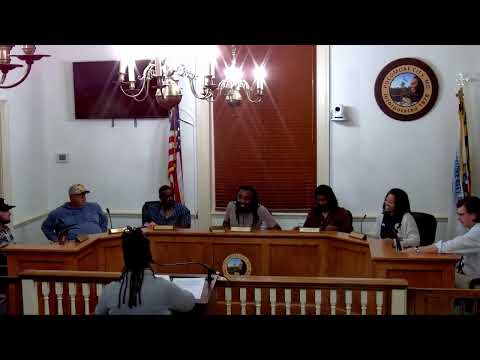
Pocomoke City councilors and staff spent their Oct. 15 work session reviewing 11 proposals for a proposed Pocomoke City community center (also called the life center), identifying a short list of finalists and asking firms for clarifications on costs, procurement roles and parking at the Maple Street site.
Pocomoke City councilors and staff spent their Oct. 15 work session reviewing 11 proposals for a proposed Pocomoke City community center (also called the life center), identifying a short list of finalists and asking firms for clarifications on costs, procurement roles and parking at the Maple Street site.
The discussion focused on three persistent issues: transparency of total project costs beyond architecture-and-engineering (A&E) fees; who would manage bidding and subcontractor approvals; and how the building and parking layout would work on the city-owned lot behind the old armory on Maple Street. Miss Matthews, the city staff member presenting the proposals, said several firms provided detailed A&E fees but omitted a lump-sum building cost that the city needs for a Community Development Block Grant (CDBG) application.
Why it matters: the city said it must demonstrate at least estimated A&E fees in its CDBG application; Miss Matthews said the CDBG program can award up to $800,000 and that awards are announced in December, and grantees must ‘‘spend down’’ funds over two years. That timeline makes firm cost information and a manageable procurement plan urgent for city staff preparing the application.
Becker Morgan: several council members said Becker Morgan’s proposal showed staged A&E fees for concept and schematic work and design development, but left unclear whether the firm or the city would run public bidding and construction administration. ‘‘It was just left unclear,’’ Miss Matthews said of the Becker Morgan submission, and council members proposed moving the firm to a ‘‘maybe’’ list pending answers.
David DeQuilling (Quillen) and Fisher: Miss Matthews said David DeQuilling’s submission tied schematic design to the budget and included a conditional $22,000 traffic-study line item ‘‘if required.’’ Council members questioned whether a traffic study was required for the site and who would pay for it. Fisher’s proposal broke out interim price checkpoints but, councilors said, failed to include a total lump sum that the grant application needs.
GMB and procurement questions: George Miles & Burr (GMB) drew praise for a detailed project schedule that included kickoff, grant application, and a projected mayor-and-council approval date in spring 2026; its A&E fees were listed below several competitors. Council members asked whether bidding and procurement would be handled by the city or by the selected design-construction team. City staff (Andrew) described the common delivery approach: a general contractor typically manages subcontractors under its contract, and that arrangement would be confirmed in the city’s agreement with a selected firm.
Site, parking and program: councilors repeatedly raised the site’s constraints — a narrow street network (one-way segments on Clark and Second), an oddly shaped lot behind the armory, and limited room for on-site parking. The lack of a clear parking layout led several members to press for traffic and parking plans from finalists. Program decisions also remained unresolved: members favored a multiuse gym capable of a full court, dividers for flexible rooms, and a ‘‘warming’’ kitchen rather than a full commercial kitchen because of ongoing maintenance, staffing and equipment-depreciation concerns.
Wheeler Goodman & Mask (WGM) stood out to several councilors for offering two delivery options (design-bid-build and design-build), including full construction administration, providing real-time pricing to better control cost overruns, and supplying renderings that showed parking and interior layouts. Council members also discussed Manns Woodward and C. Ralph as higher-cost options, and noted designs that included extensive glass or expansive features that could be expensive to maintain in a flood-prone area.
Next steps and transparency: council members expressed consensus — not a formal vote — to identify a top group of finalists (councilors discussed a top three with a possible fourth), to post bid materials online for public transparency, to schedule walk-throughs and recorded follow-up meetings with shortlisted firms, and to return to council in early November if necessary. Miss Matthews told the council she had sufficient A&E fee information for the grant application but would confirm deadlines and follow-up timelines by email.
No contract or award was made at the session; the council used voice consensus for direction. A motion to adjourn carried by voice vote after a public-comment opportunity.