Get email alerts on the Tiny Shelter topic
No spam. Unsubscribe anytime.
Clallam County task force explores tiny-shelter village models; staff flags permitting, code and funding hurdles
Summary
The Clallam County Homelessness Task Force discussed creating a permit-ready prototype for tiny-shelter villages to simplify approvals across cities, but members said state and local building codes, energy rules and operational funding present major barriers.
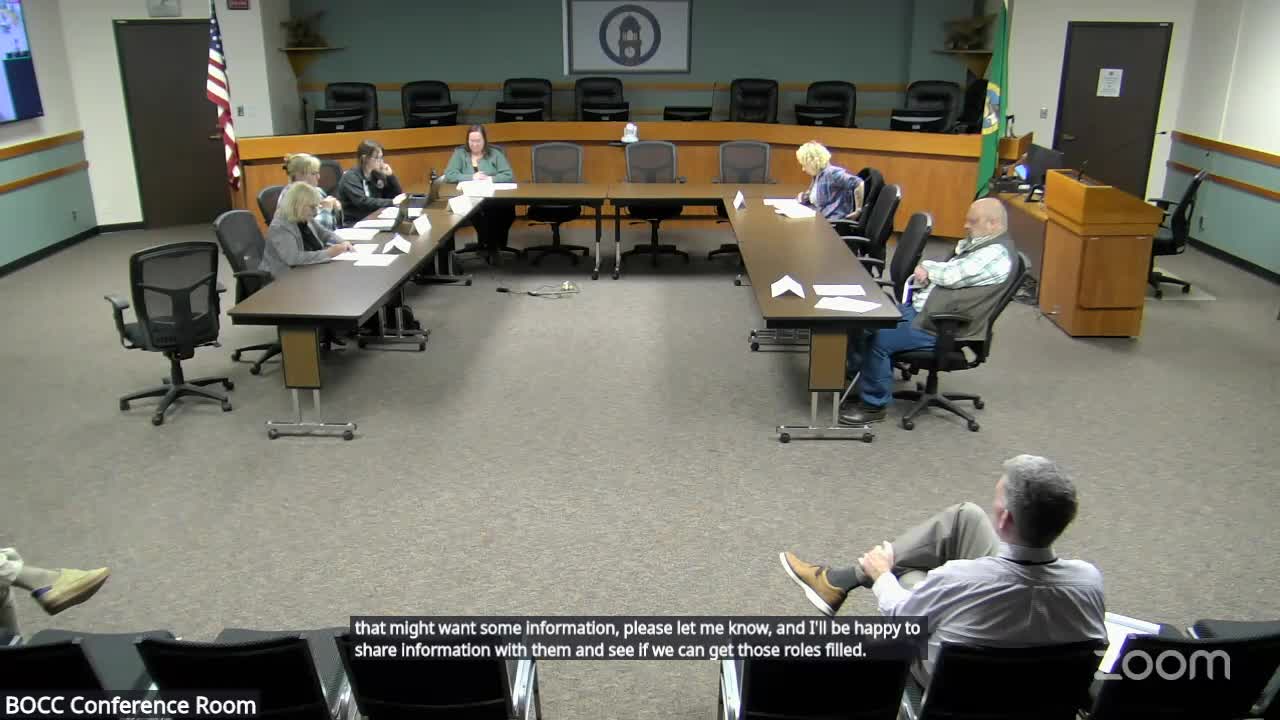
The Clallam County Homelessness Task Force held an informational discussion about exploring tiny-shelter villages that pair small living units with supportive services, with staff urging development of a prototype that could win preapproval for fire, safety and permitting requirements.
Bruce, speaking for county planning and permitting interests, said the group’s five-year plan calls for exploring tiny-shelter villages as a strategy to help people move toward employment and family housing. He described two permitting tracks: stick-built structures permitted by the county’s building code and prefab units that must be certified through Labor & Industries (L&I). “Right now, the…challenge in my mind is…1, what we call it, 2, who permits it,” Bruce said, adding that sanitation, group cooking and life-safety minimums would need coordinated review by L&I and the county’s environmental health office.
Task force members repeatedly raised costs and code conflicts. Bruce and others said energy-code requirements and HUD standards can make some modular or prefab prototypes uneconomical; one presenter noted cranes or foundations required during installation raise expenses. Task force members recommended researching other Washington jurisdictions’ models and working with the state “balance of state” coordination to learn how similar projects were funded and operated.
Several members urged the group to pursue a two-part approach: (1) develop a conceptual prototype — site layout, sanitation and service plan, proposed unit construction and siting (e.g., gravel pad vs. foundation) — and (2) convene L&I, DCD/municipal permitting and environmental health to identify minimums and preapproval options. Bruce said doing so could produce a “permit-ready” model that cities could adopt or accept via conditional-use processes, avoiding repeated, costly one-off reviews.
Members also discussed whether tiny-shelter villages would be classified as emergency shelter (short-term), transitional housing (longer-term) or a hybrid; that classification affects allowable duration and which funding streams and regulations apply. Bruce noted some funding and regulatory rules limit shelter duration (60 days for certain shelter models) while transitional housing can run up to two years, and he warned operational funding (services, staffing, meals) can be a larger long-term cost than the units themselves.
No property was identified during the meeting; the discussion remained at the conceptual stage. Task-force members agreed next steps should include compiling examples of completed projects in other Washington jurisdictions, drafting a conceptual plan and engaging state L&I and environmental-health staff to identify a pathway for certification and local permitting.
AI generated
The text on this page is AI generated. Summaries, highlights, analysis, and video transcripts are all produced from the original source material.
AI can make mistakes, so if you spot one, and we will fix it for everyone.
Note: the source content is unaltered by us. Any content source we link to, be it a video, an audio recording, or a document, is presented exactly as its publisher released it. That publisher is usually a government body, sometimes an individual official or another organisation.