Get Full Government Meeting Transcripts, Videos, & Alerts Forever!
Get email alerts on the Specific Plan topic
No spam. Unsubscribe anytime.
Planning Commission recommends Board approval of Thermal Ranch Specific Plan despite opposition; adds substation coordination condition
Summary
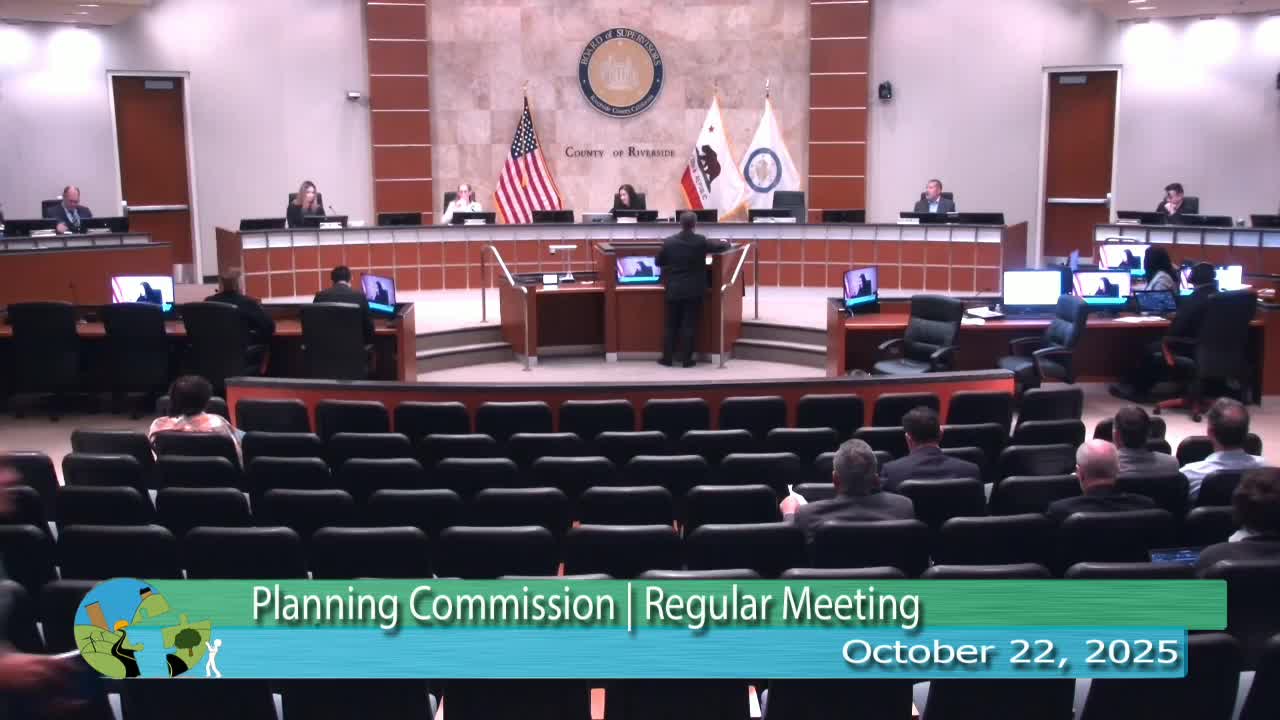
After extended public testimony and technical debate, the Riverside County Planning Commission on Oct. 22 recommended approval of the Thermal Ranch Specific Plan and related entitlements to the Board of Supervisors, but added a condition requiring the applicant to coordinate minimum substation sizing with Imperial Irrigation District before the Board hearing.
The Riverside County Planning Commission on Oct. 22 voted 3–1 to recommend the Board of Supervisors certify the Final Environmental Impact Report and tentatively approve the Thermal Ranch Specific Plan, a multi‑phased project that would create a 223‑acre equestrian facility, workforce housing, an RV park, commercial tourist uses, retail, and a mix of residential neighborhoods on a 619‑acre site in the Thermal area of the Fourth District.
Staff presentation and EIR findings
Planning staff (Russell Brady) described the project components, which include a 223‑acre equestrian facility with a central grand/ VIP barn, private and large barns, retail and dining areas, open riding fields and support facilities; the site plan showed a peak event capacity the EIR modeled at up to 8,100 attendees per day with roughly 40% on‑site at a given time (approximately 3,240 people). The project also includes a proposed workforce housing component (500 modular units on 18.4 acres), a 300‑space RV park, hotels and up to 1,161 standard single‑family lots and 191 attached condominium units in other planning areas. Staff reported the Final EIR (published Sept. 24, 2025) identified potentially significant unavoidable operational impacts for air quality (SCAQMD thresholds) and vehicle miles traveled (VMT). Because some air‑quality and VMT impacts could not be fully mitigated, staff advised the Board that a statement of overriding considerations would be required if the Board ultimately approves the project.
Public comment and concerns
The item drew extensive public comment. Labor representatives (ironworker and plumbers unions and Building Trades delegates) urged enforceable community benefits, local‑hire guarantees and living‑wage commitments. Community groups and residents—represented by Leadership Council, CARE California and others—asked the commission to continue the hearing to allow additional responses to recently submitted comments and, in some cases, to revise and recirculate the EIR. Their comments highlighted concerns about air quality in an already impacted basin, vehicle emissions from large event volumes, conversion of hundreds of acres of farmland, long construction durations (public commenters described build‑out timelines of up to a decade), water use tied to Colorado River supplies and manure management for thousands of horses (applicants and staff differ on daily removal frequency and storage practices). Several speakers said promised benefits (water tanks, power infrastructure) were insufficient without enforceable guarantees for nearby residents who lack drinking‑water consolidation, and asked the county to require agricultural‑conservation easements or other mitigation to reduce farmland loss.
Applicant response and infrastructure commitments
Applicant representatives (Jeremy Smith, CEO; counsel Jim Vaughn; project manager Martin Begania) said the project is intended to provide a permanent home for the Desert International Horse Park, to expand event weeks and economic activity, and to support local vendors and training opportunities. The team described two major infrastructure commitments they and partners would build and fund: an IID electrical substation to increase local distribution capacity and a 5,000,000‑gallon water tank in partnership with Coachella Valley Water District (applicant said about half of the substation/tank capacity would be for the project and the other half preserved as community benefit). Applicant counsel emphasized a multi‑year outreach program and the multi‑year EIR process and said recent letters largely restated previously raised issues; staff and applicant committed to prepare written responses to late comments for the Board record.
CEQA, unavoidable impacts and recommended action
Brady told commissioners the EIR documented that all feasible mitigation had been included but that VMT and some air‑quality emissions remained above SCAQMD thresholds and therefore were considered potentially significant and unavoidable. Because of those findings, staff recommended certification of the EIR and tentative approval of the entitlements and noted that identifying a statement of overriding considerations is part of the Board of Supervisors’ consideration if the Board chooses to approve.
Commission discussion and vote
Commissioners debated how to weigh infrastructure benefits, uncertainty over manure handling and air emissions, workforce and seasonal job claims, and the concerns of nearby residents and labor. Several commissioners spoke in favor on the basis that the project would fund critical infrastructure (a new substation and water tank) that could enable other community projects; others said the scale of environmental and community impacts warranted further assurances on mitigation and community benefits.
The commission voted 3–1 to recommend certification of the EIR and tentative approval of the Thermal Ranch project to the Board of Supervisors, adding a direction/condition that the applicant coordinate with IID and the supervisor’s office to finalize the minimum substation sizing and a percentage of excess capacity prior to the board hearing (staff and applicant indicated a working design of roughly 40 megawatts, about 200% of the project’s peak demand, was under discussion but subject to IID engineering confirmation). Commissioners also asked staff and the applicant to prepare written responses to the most recent public comments for inclusion in the Board materials.
What remains
Because the Final EIR identified potentially significant and unavoidable impacts for air quality and VMT, a statement of overriding considerations would be required for the Board to approve. The Board of Supervisors will receive staff recommendations, the Final EIR and the record of responses to comments at a future hearing; staff indicated they would prepare additional written responses to the late‑filed comments prior to that hearing. The applicant and staff also agreed to finalize the substation sizing and necessary will‑serve confirmations with IID prior to the Board hearing.
Selected direct quotes
"This investment has made the Desert Horse Park 1 of the top show jumping facilities in the country," said Jeremy Smith, the applicant’s CEO, describing economic activity from the existing operation. "We are building a new substation on the site. Fully funded by us…there'll be substantial excess capacity for the community," Smith added when describing infrastructure commitments.
Commissioners and members of the public provided detailed technical and procedural critiques on air quality, manure management, farmland conversion and community benefit agreements; staff and the applicant committed to prepare further responses to those submissions for the Board record.
Clarifying details: the Final EIR was published for public review in late 2024 and posted Sept. 24, 2025; staff said the EIR process included scoping, technical appendices and multiple comment letters. The EIR concluded some operational air emissions and VMT impacts remain above regional thresholds even after mitigation and therefore are potentially significant and unavoidable.