RCTC committee approves 2026 STIP programming, reprograms funds to projects ready to build
Loading...
Summary
The Budget Implementation Committee approved staff recommendations to program Riverside County's 2026 State Transportation Improvement Program share, reassigning funds from delayed projects to those nearer construction, and authorizing an MOU amendment with the City of Blythe to swap Palo Verde STIP funds with Measure A highway funds.
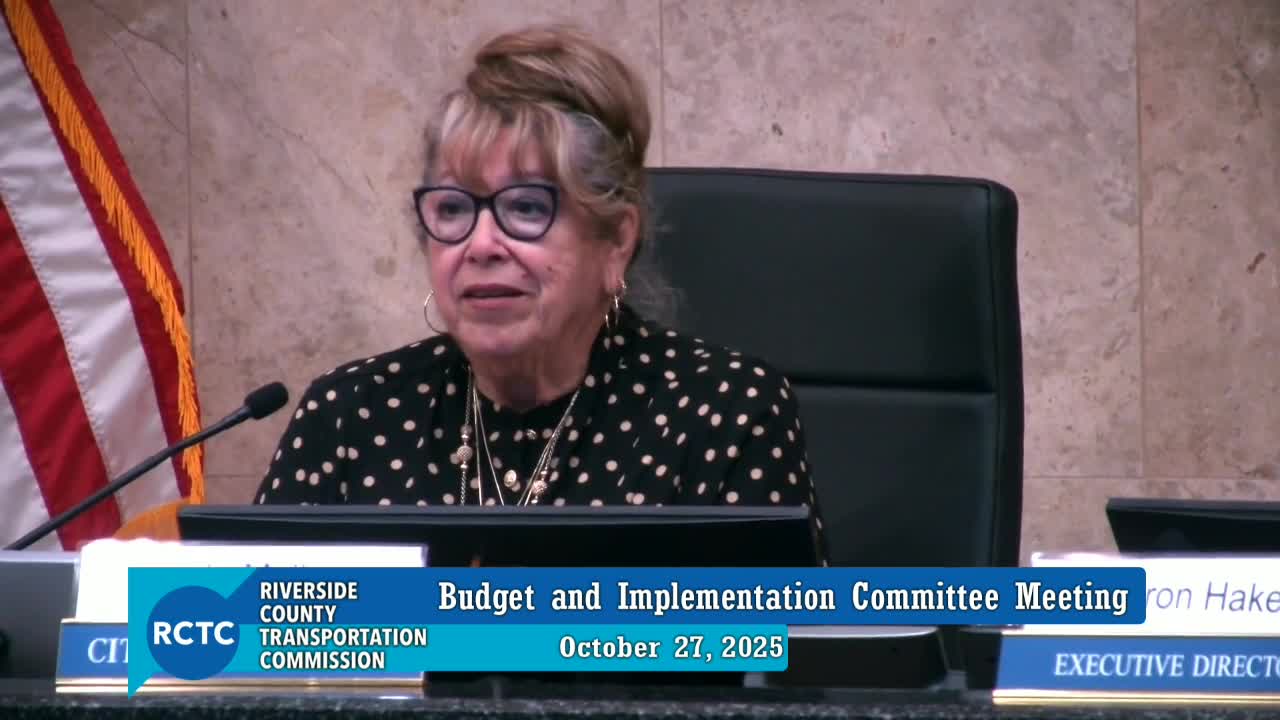
The Budget Implementation Committee of the Riverside County Transportation Commission approved staff recommendations Oct. 27 to program the county's estimated $32.7 million share of the 2026 State Transportation Improvement Program (STIP), reprogramming several earlier projects to align funding with updated delivery schedules.
Staff presentation summarized the county's STIP distribution and recommended actions: keep about 5% (roughly $1.6 million) for planning, programming and monitoring with RCTC; allocate roughly $25.0 million to Western County, about $6.0 million to Coachella Valley, and $115,000 to Palo Verde Valley; program the Coachella Valley's share to CV Sync Phase 4 in Rancho Mirage; and reprogram funding among specific projects including design funding for the I‑10 Highland Springs interchange, construction funding for the Pennsylvania Avenue grade separation, moving Temescal Canyon Road construction to a later fiscal year, and programming $17.9 million toward the I‑15 Express Lanes Southern Extension.
David (staff presenter) told the committee that the Highland Springs/I‑10 interchange remains scheduled for construction outside the STIP cycle and that staff therefore proposed programming $8 million to Highland Springs for design and moving the remaining STIP construction funds to the Pennsylvania Avenue grade separation project because it is ready sooner. He also explained that Temescal Canyon Road experienced schedule delays and cannot obligate certain federal STBG funds by the December 2026 deadline, so staff proposed swapping STBG for STIP funds and transferring the STBG funds to the I‑15 Express Lanes Southern Extension to avoid loss of federal funds.
Commissioners asked clarifying questions about the 5% planning set‑aside (confirmed to remain with RCTC), the cause of Temescal Canyon delays (staff said schedule/right‑of‑way issues are likely and they will check with Caltrans), and whether the STBG swap would face objections. Staff said surplus STBG funds under prior determinations could be reallocated and that interagency coordination with SCAG and Caltrans is ongoing. Aaron Hake (director) and other staff explained that the California Transportation Commission (CTC) makes the final statewide determinations and that RCTC will submit its package by the statutory Dec. 15 deadline; the CTC is expected to adopt the statewide program in March 2026.
Supervisor Chuck Washington moved to adopt staff recommendations for the seven STIP items and to forward the package to the CTC; Marietta seconded. The committee conducted a roll‑call vote and the motion passed. The matter will proceed to the full commission for final action and submittal to the CTC.