Get Full Government Meeting Transcripts, Videos, & Alerts Forever!
Get email alerts on the Ethics Board topic
No spam. Unsubscribe anytime.
Charter review subcommittee advances draft to create Clallam County ethics review board
Summary
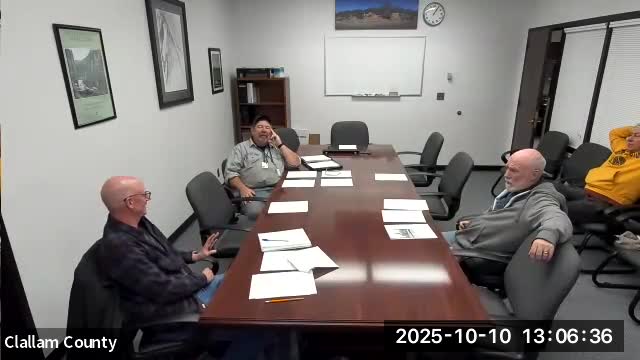
Clallam County Charter Review Commission ethics subcommittee members on Oct. 10 agreed to send a revised draft to the full Charter Review Commission that would create an ethics review board and set a schedule for further review.
Clallam County Charter Review Commission ethics subcommittee members on Oct. 10 agreed to send a revised draft to the full Charter Review Commission that would create an ethics review board and set a schedule for further review.
Commissioner Jeff Tozer (District 1) proposed language for how members would be appointed, saying, "members shall be appointed by independently elected county officials rotating annually so that no office is permanently assigned to a single district," and described a rotation schedule prepared by the county auditor to assign offices to districts.
The subcommittees discussion focused on three persistent issues: who should appoint board members, what evidentiary standard written complaints should meet, and whether the county should use outside investigators in some cases. Tozers draft initially listed four elective offices (auditor, treasurer, assessor and prosecuting attorney) as appointing authorities; members suggested replacing the prosecuting attorney with the director of the Department of Community Development (DCD) to avoid a perceived conflict where the prosecuting attorney might later represent the county in related matters.
Members also debated whether written complaints should require firsthand knowledge or a sworn verification. A memorandum cited recall-petition language that requires a statement describing acts in concise language with approximate dates and verification that the complainant has knowledge of the alleged facts; one member recommended adapting that standard for ethics complaints so the board would not be asked to investigate matters based solely on hearsay.
Several participants urged caution about relying exclusively on county-employed officials for investigations. An observer noted that using internal county offices for appointment and investigation risks the appearance of self-investigation; the observer recommended outside review for higher-risk or litigated cases to increase public confidence and reduce perceived conflicts.
The subcommittee discussed legal and financial trade-offs. Members cited a memo from attorney Diane Harvey (provided to the committee) and noted the countys existing Code of Ethics (referenced in the meeting as chapter 301 of the county code) currently lacks an enforcement mechanism. Committee members recognized that outside investigations and litigation carry significant costs but said they wanted a mechanism that produced enforceable findings or at least transparent conclusions.
On process, the subcommittee agreed to have Tozer revise the draft to incorporate the changes discussed (including the DCD director substitution and clearer complaint verification language) and circulate it to members for final editing. The group set a follow-up meeting for Tuesday, Oct. 14 at 11:30 a.m. (small conference room with Zoom), and planned to provide an update to the full Charter Review Commission at its next meeting.
The subcommittee did not adopt a formal vote or finalize statutory language; members described the action as advancing a draft and directing a staff/commissioner revision for further consideration by the Charter Review Commission.