Get Full Government Meeting Transcripts, Videos, & Alerts Forever!
Get email alerts on the Affordable Housing topic
No spam. Unsubscribe anytime.
Clallam County holds $15.90 housing fund steady while weighing bond, county-led and capacity options
Summary
County staff proposed a largely status-quo 2026 spending plan for the county'designated affordable housing fund while keeping contingency reserves and insisting on stronger project-delivery evidence for any large allocations.
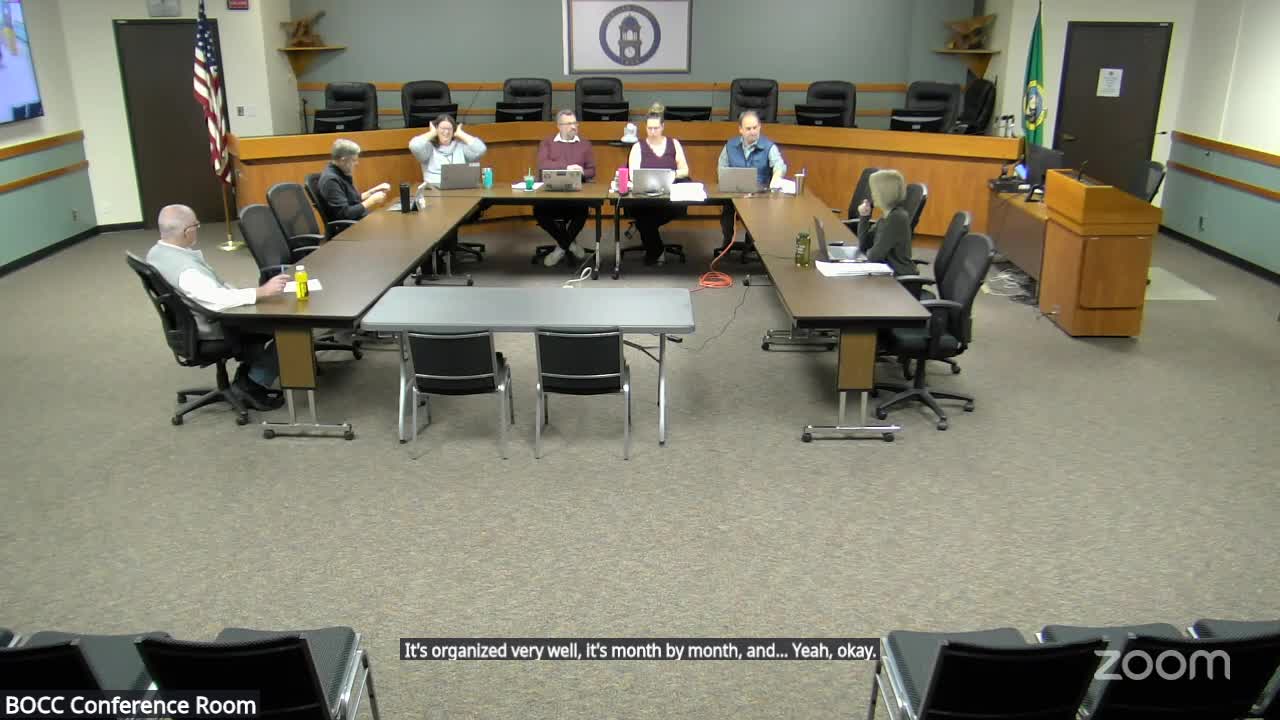
Clallam County staff presented the 2026 budget overview for the county'restricted affordable housing fund (the county'referenced "15.90" fund), saying investment income projections rose from $90,000 to $130,000 and that several large project amounts would carry into 2026.
The fund supports construction and planning for multiple projects, officials said. The budget includes an anticipated $1.5 million carryover for the Peninsula Behavioral Health Second & Oak project and a separate $1.5 million commitment for a Peninsula Housing Authority project identified in the meeting as "Gail's seventh project." Staff also said they planned to hold $1 million in an "unanticipated" line for emergent needs or new opportunities until grant results are known.
Why it matters: The fund is a primary local source of capital for affordable housing in the county; staff and commissioners said getting projects to shovel-ready status is critical to leveraging larger state or federal grants. County leaders noted that a single failed large project would expose the fund and argued for stronger due diligence and project-management requirements for recipients of larger allocations.
Key details
- Funding and carryovers: Staff reported higher investment interest and the three major allocations described above; receipts from the 15.90 sales-tax stream were described as steady, yielding roughly $1.5 million to $2 million in local commitments annually once ongoing obligations are subtracted.
- Grants and timelines: Staff said local applicants for the National Housing Trust Fund and the Washington Housing Trust Fund had pending requests; some projects indicated a potential 2026 start while others might not be fully funded until 2027 depending on grant awards and city-level incentives such as parking relocation.
- Risk and delivery: Commissioners and staff emphasized the county'wide risk of funding large projects that do not complete. They urged stricter evidence of delivery capacity (past performance, portfolio minimums) and recommended requiring projects to show fully secured funding before releasing large sums. One staff member noted project portfolios and a requirement that bidders show prior delivery of $10 million projects for certain solicitations.
- Bonding and leverage: Staff outlined that the fund can be used as a bonding revenue source up to a percentage of annual allocations, and suggested a bond-backed approach could increase leverage. Commissioners flagged the tradeoff: bonding ties up funds for debt service and requires reserves to meet debt covenants.
- Developer and contractor capacity: The group discussed limited local multifamily builders, prevailing-wage administration, and the need to train or attract contractors who can deliver three- and four-story multifamily projects. Staff and commissioners proposed educational outreach, a workshop series with the EDC and building association, and efforts to help local subcontractors qualify for prevailing-wage work.
County direction and next steps
Staff will keep the $1 million unanticipated line in reserve until grant outcomes are known and will return to the board for any reallocation. Commissioners asked staff to require clearer evidence of project readiness and to review bonding feasibility and reserve requirements over the next budget cycle. Staff also said they would bring a county-led cottage-village senior-housing concept back to the housing solutions committee for a 2026 work session if a suitable parcel is identified.
Speakers
- Administrator Milke, County Administrator (staff member) - Commissioner Johnson, County Commissioner (elected official) - Tim, Housing program staff (staff member) - Staff member, Housing finance staff (staff member)
Proper names
Peninsula Behavioral Health; Peninsula Housing Authority; Northview (Northview apartment/North View project); "Fifth and Hemlock" (project site); Washington Housing Trust Fund; National Housing Trust Fund
Clarifying details
- Investment income projection: increased from $90,000 to $130,000 in 2026 estimates. - Carryovers: staff described $1.5 million carryover for Peninsula Behavioral Health Second & Oak and $1.5 million reserved for a Peninsula Housing Authority project; $1 million held in unanticipated until grant outcomes known. - Bonding capacity: staff said the bonding capacity is commonly limited to a percentage (illustrated at roughly 50% of annual allocation in discussion) and would require a reserve equal to multiple years of debt service per standard practice.
Topics and scoring
1) affordable_housing — justification: central subject of the item and primary budget fund under discussion; {"topic_relevance":0.98,"depth_score":0.85,"opinionatedness":0.05,"controversy":0.45,"civic_salience":0.90,"impactfulness":0.85,"geo_relevance":1.00}
Provenance
[{"block_id":"00:02:03","local_start":0,"local_end":120,"evidence_excerpt":"Alright. Good morning, everyone. We are back here for more budget meetings. It is, I don't know, October 9, and we're here to talk about affordable housing. So how do we want to get this off today?","tc_start":"00:02:03","reason_code":"topicintro"},{"block_id":"00:43:31","local_start":0,"local_end":136,"evidence_excerpt":"I think I think a project somewhere in there, we could build 30 some units for about $8,000,000 and have it have it ready to go. You could build it within a year and move this sort of project forward.","tc_start":"00:43:31","reason_code":"topicfinish"}],