Get Full Government Meeting Transcripts, Videos, & Alerts Forever!
Get email alerts on the Governance And Procedure topic
No spam. Unsubscribe anytime.
Planning commission receives Brown Act refresher: public comment rules, serial meetings and public-records risks
Summary
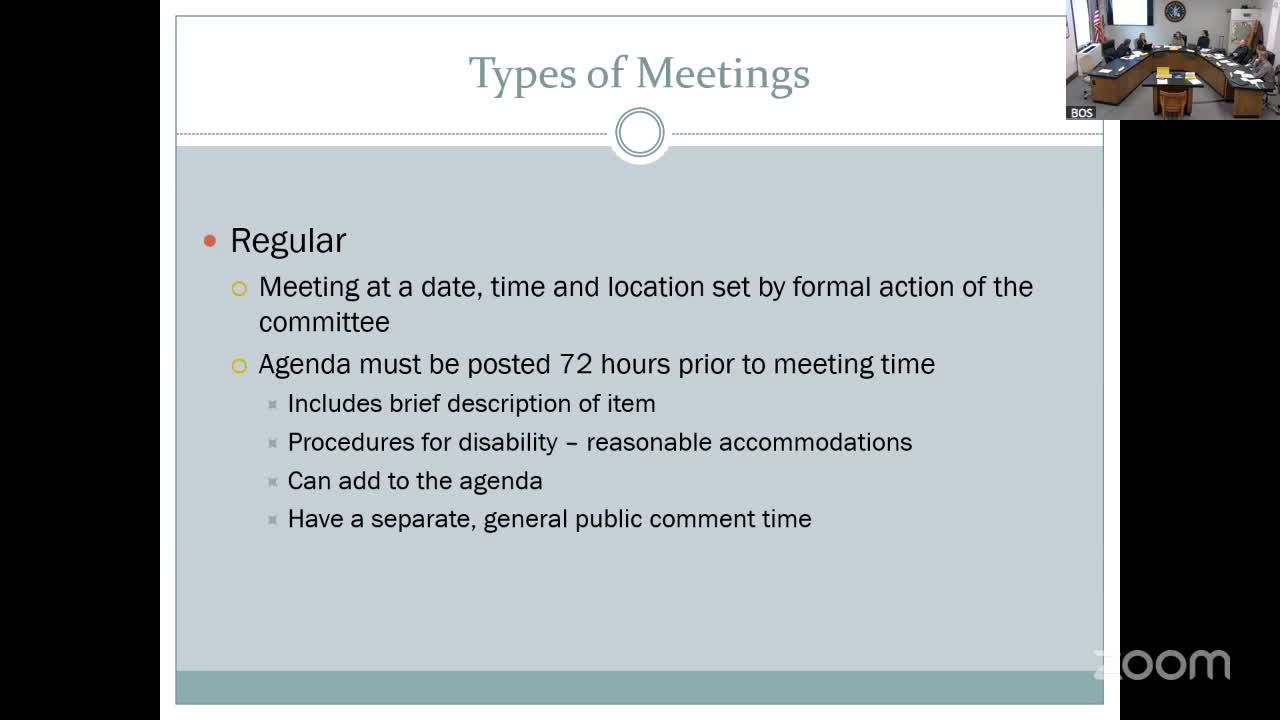
Commissioners attended a Brown Act training covering meeting types, remote-attendance rules, serial-meeting restrictions, public-comment time limits (3 minutes standard), and public-records-act considerations for commissioner communications.
Plumas County staff provided an extended Brown Act training during the Oct. 15 planning-commission meeting, reviewing open-meeting rules, how to avoid serial meetings and recommended practices for managing public comment.
Staff reiterated the core Brown Act principle: meetings of a governmental legislative body must be open to the public so deliberations occur in public rather than behind closed-door workshops. The trainer described typical exemptions (some attorney-client communications) and cautioned commissioners against daisy-chain or hub-and-spoke communications where members discuss agenda business outside of a noticed meeting.
Training takeaways emphasized practical rules commissioners can apply immediately:
- Public comment: standard practice is to limit speakers to three minutes during public-comment periods; commissioners may vote to extend time for a speaker by majority vote.
- Serial meetings: commissioners must avoid sequential one-on-one communications that, taken together, form a majority opinion; staff should not transmit deliberative messages that would amount to a quorum decision.
- Remote attendance: post-COVID teleconferencing rules reverted to pre-pandemic standards; a quorum must be physically within the jurisdiction unless specific exceptions apply and each remote location must be posted publicly.
- Public Records Act (PRA) caution: emails or records that exist on personal devices or private accounts may still be subject to PRA requests if they relate to public business; commissioners were advised to forward substantive messages to staff so records are preserved and available.
Staff urged chairs to be firm on time limits and to explicitly state when an item opens for public comment and when that public-comment period closes, to avoid repeated or duplicative testimony and to preserve orderly hearings.
Why it matters: Clear procedures reduce legal risk and make meetings more efficient and transparent. The training also highlighted that failure to cure Brown Act violations (for example, by re-noticing) can delay projects or, in rare cases, require redoing actions taken at improperly noticed meetings.