Get Full Government Meeting Transcripts, Videos, & Alerts Forever!
Get email alerts on the Environmental Policy topic
No spam. Unsubscribe anytime.
Port Angeles pilot tests ocean-based carbon removal at Project MACOMA
Summary
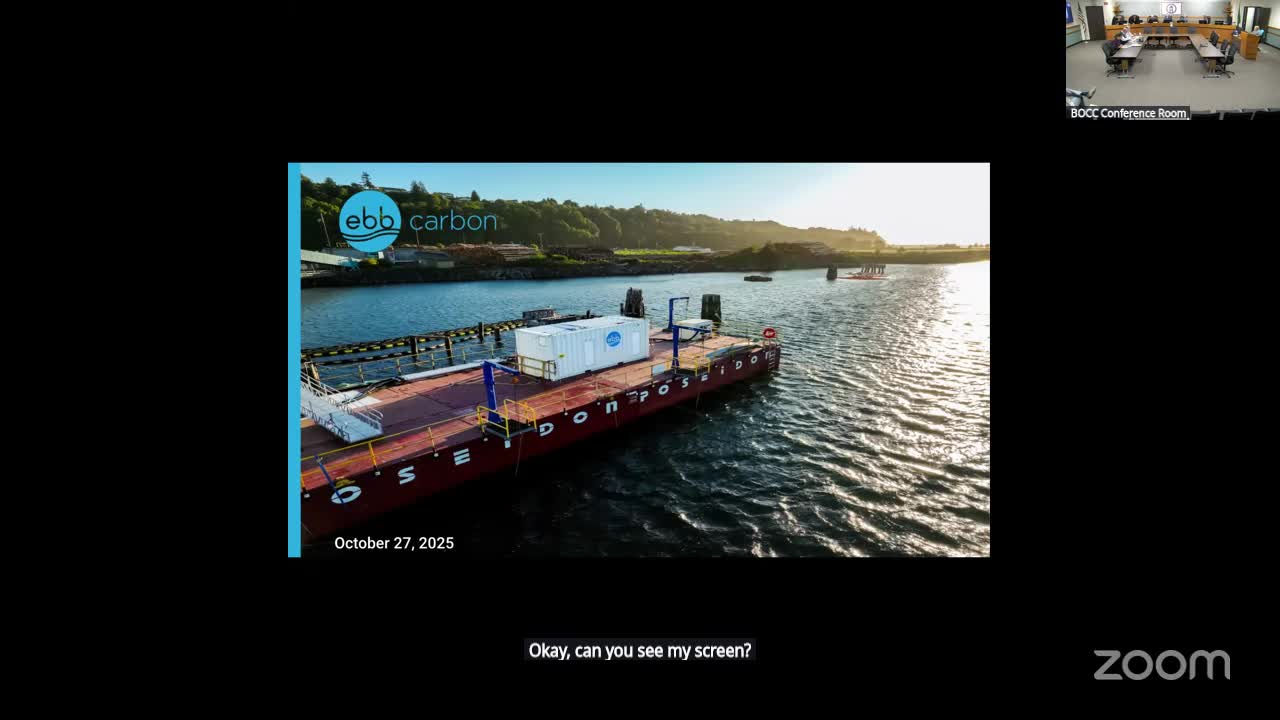
EV Carbon presented Project MACOMA, a small, fully permitted pilot at Terminal 7 in Port Angeles that the company says aims to remove acid from seawater and enable additional ocean uptake of carbon dioxide.
EV Carbon presented Project MACOMA, a small, fully permitted pilot at Terminal 7 in Port Angeles that the company says aims to remove acid from seawater and enable additional ocean uptake of carbon dioxide.
Kyla Westfall, vice president of external affairs for EV Carbon, described the company’s dual mission of reducing atmospheric CO2 and addressing coastal acidification, and told the joint meeting the pilot is “privately funded.” She said the technology removes acid from seawater, which EV Carbon then neutralizes by mixing the acidic stream with alkaline minerals (identified in the presentation as bursite) so the acidity does not return to the ocean.
The company cited laboratory and field research it has done in partnership with Pacific Northwest National Laboratory (PNNL) and with tribal partners. Westfall said Project MACOMA has state, local and federal permits and that the team conducted a dye dispersion test in July to validate modeling; she said the dye trial and related monitoring produced roughly 20,000 data points and corroborated the modeled dispersion patterns. She also said a laboratory study developed with the Lower Elwha Klallam Tribe used donated hatchery salmon and “determined that there were no adverse impacts…from a fish that would be swimming about, you know, let's say 10 feet away from our outfall.”
Project MACOMA is operating continuous in‑water monitoring and ecological safety protocols, Westfall said, and the team pauses operations if marine mammals or other protected species are observed nearby. She said the pilot has generated about 50 construction‑related jobs and currently employs three local staff. The project team will provide monthly reports to the Washington State Department of Ecology and intends to publish a final, public report summarizing findings when the pilot concludes. Westfall said the company will continue research at PNNL through 2027 under an agreement.
Commissioners asked technical questions about currents, the dye test and how the removed acidic material is handled. Westfall said the acidic component is neutralized with alkaline minerals on site and is not transported as hazardous waste. She also confirmed the pilot must vacate its current berth by May to accommodate planned port stormwater work and said the company would be willing to host an on‑site tour for commissioners.
Public comment at the start of the meeting included a resident who opposed the carbon removal presentation and asked whether local tax dollars were funding the project; Westfall stated Project MACOMA is privately funded.
Where things stand: Project MACOMA is a small, permitted demonstration with ongoing monitoring and tribal and lab collaborations. Westfall said the team will continue field and lab work, compile monthly Ecology reports and issue a public final report when operations conclude.