Get Full Government Meeting Transcripts, Videos, & Alerts Forever!
Get email alerts on the Infectious Disease topic
No spam. Unsubscribe anytime.
Health officer: COVID hospitalizations easing; RSV infant vaccine effective but pediatric COVID supplies tight; SNAP funding at risk
Summary
Dr. Allison Berry said COVID‑19 hospitalizations and ED visits are decreasing and that a small recent uptick represented incidental diagnoses rather than local transmission.
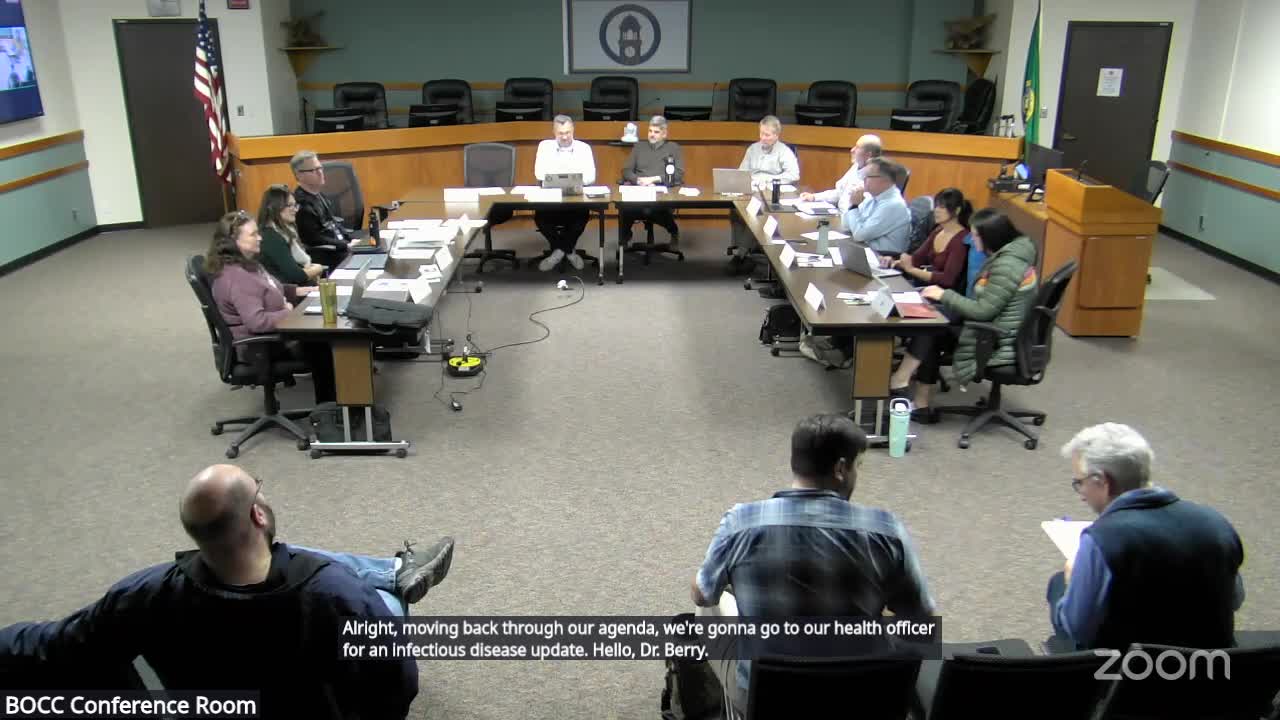
Dr. Allison (Alison) Berry, Clallam County health officer, briefed the board on regional respiratory trends and vaccine access on Oct. 21.
Lede: Berry said COVID‑19 hospitalizations and emergency‑department visits have fallen across the state and the region; a recent increase in local COVID hospitalizations was driven by incidental diagnoses in patients admitted for other reasons and does not represent a community outbreak.
Why it matters: Berry described three immediate public‑health priorities for the coming months: protecting infants and high‑risk adults with RSV and influenza vaccines; addressing limited pediatric COVID‑19 vaccine shipments; and monitoring federalnutrition program funding that affects food security locally.
RSV and other vaccines: Berry said the infant RSV product (Nirsevimab, a monoclonal antibody used as a vaccine proxy for infants) performed well in its first year of broad use, with an 80–90 percent reduction in RSV hospitalizations among vaccinated infants and an observed overall 40 percent reduction in pediatric RSV hospitalizations in populations that included unvaccinated children. She recommended Nirsevimab for infants under 8 months and for certain higher‑risk groups, and noted it is available through local clinics and the health department; for older adults RSV coverage may be subject to Medicare Part D rules.
Pediatric COVID vaccine access: Berry said state and local clinics have seen very limited pediatric COVID‑19 vaccine deliveries because federal distribution held back product; even when shipments arrive, quantities have sometimes been too small to meet demand. She urged parents to be persistent, noted the health department and local pediatric clinics are taking walk‑ins and scheduled clinics to improve access, and said staff are redistributing doses where possible.
Nutrition programs and federal funding: Berry said the USDA provided funding sufficient to keep WIC benefits available through November; by contrast, SNAP benefits face a likely funding gap and could run out in October unless federal action restores funds. She said SNAP supports families with children and many elderly or disabled people and stressed the program’s local economic multiplier effect.
Measles: Berry summarized national measles activity (about 1,596 reported U.S. cases at the time), warned the national case count is likely an undercount and that community transmission is occurring elsewhere in the country, and said Washington has had only imported cases so far and can contain those events if vaccination coverage is maintained.
Access and practical notes: Berry said the health department offers pediatric doses and walk‑in clinics and has helped redistribute RSV supplies to local pediatric clinics when doses were concentrated elsewhere. She urged parents to contact their pediatrician or the health department for vaccine questions and assistance.
Exact phrasing from the presentation: "For the population as a whole, including a large number of kids who were not vaccinated, we saw an overall 40 percent reduction in RSV hospitalizations." She also said, "If you haven't gotten your measles vaccine, give us a call at the health department or call your health care provider."
The board asked clarifying questions about RSV coverage, Medicare billing for older adult RSV vaccines and the public‑health impacts of potential SNAP cuts; Berry and staff said they would continue local redistribution efforts and outreach.