Get Full Government Meeting Transcripts, Videos, & Alerts Forever!
Get email alerts on the Noise Special Events topic
No spam. Unsubscribe anytime.
Downtown residents press Sarasota officials to curb loud special events, ask for tighter permitting and notification
Summary
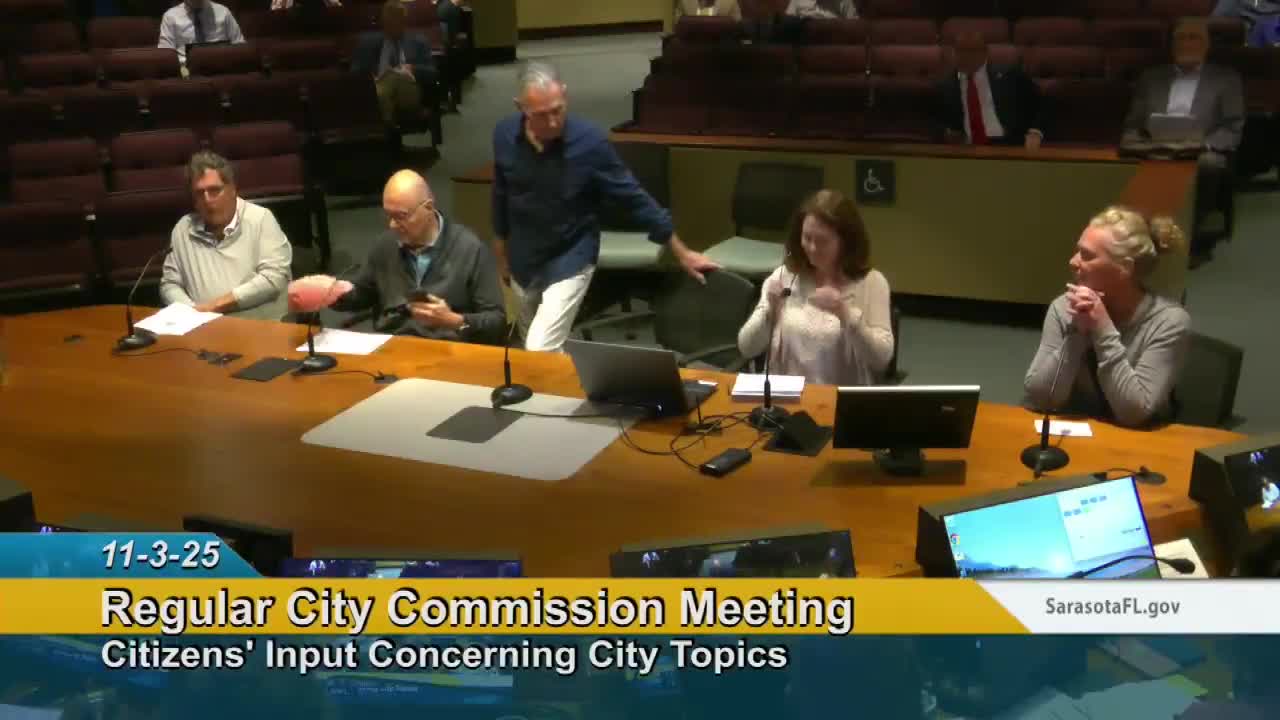
Downtown residents told the Sarasota City Commission on Nov. 3 that a string of late‑night events with loud bass has degraded life for nearby condo residents and urged changes to the special events and noise rules, including greater notice for residents, a lower sound cap and limits on repeat block parties.
Downtown residents told the Sarasota City Commission on Nov. 3 that repeated late‑night block parties and other special events have produced “pulse‑pounding” bass that is disrupting downtown condominium residences and asked the commission to tighten the city’s special‑events permitting and noise rules.
Speakers urged specific changes such as limiting the number of events an organizer can hold in a year, requiring city‑commission approval for closures and sound permits, moving sound limits into the city’s general noise ordinance, providing notice to affected downtown residents when special‑event applications are filed, and enforcing an end time of 10 p.m. for events that close streets.
John Simon, a downtown resident, opened the public‑comment segment by reading Sarasota Municipal Code section 20‑2 and describing a series of recent evenings when he said “pounding bass” from DJs and amplified sound made working in his building impossible. “When you take into account the cumulative effect of all these things, the special events people seem to be handing out these permits without any desire to mitigate the effects on near neighboring condominium people,” Simon said. John Bordeaux, another downtown resident, showed a graphic of 31 downtown special events that took place in a 12‑month period and urged limits, such as no more than one event per organizer per year and no more than one downtown night with street closures per month.
Karen Hicks raised a related concern about school‑zone cameras and fines, saying some residents view enforcement there as revenue generation rather than strictly safety. Celine O’Connor, a Lido Key resident, told the commission that although Ted Sperling Park is a County park, the city’s noise ordinance applies inside the park when county regulation is absent and asked the city to update the noise rules to address loud speakers, engine noise and modified vehicles.
Commissioners did not vote on policy changes at the meeting. Several commissioners acknowledged the public complaints and said staff should bring back options. Residents asked for sound‑expert studies and a clearer cap tied to public‑health guidance rather than only event‑by‑event special‑events limits. John Bordeaux specifically urged that sound limits be included in the city’s noise ordinance rather than only in an events‑only rule. The current special‑events ordinance includes an 85‑decibel limit for certain events; residents said DJs and stacked events can push overall ambient levels much higher.
The commission’s follow‑up direction was to ask staff to review the suggested changes and return with options, including notification procedures for downtown residents, coordination of street‑closure approvals, and whether the city should require events needing street closures or amplified sound to come before the commission rather than be approved administratively. The city did not adopt any new enforcement language or limits at the Nov. 3 meeting.
Residents who spoke John Simon — downtown resident (spoke to code section 20‑2 and cumulative noise from multiple events) John Bordeaux — downtown resident (distributed event map and recommended permitting limits) Karen Hicks — city resident (raised school‑zone camera/enforcement concerns) Celine O’Connor — Lido Key resident (asked city to extend noise coverage to county park areas and to update the noise ordinance) Jim Lampeau — downtown resident (urged balanced controls)
Why this matters: The downtown entertainment economy relies on special events, but residents said the number and intensity of events, especially late‑night DJs with heavy bass, is producing an ongoing quality‑of‑life problem. Changes to notification and permitting could affect organizers, businesses that depend on events, and residents who expect quieter nights. The issue ties into broader questions about where regulatory authority lies (noise code versus special‑events rules) and whether permits should be elevated to the commission for approval.