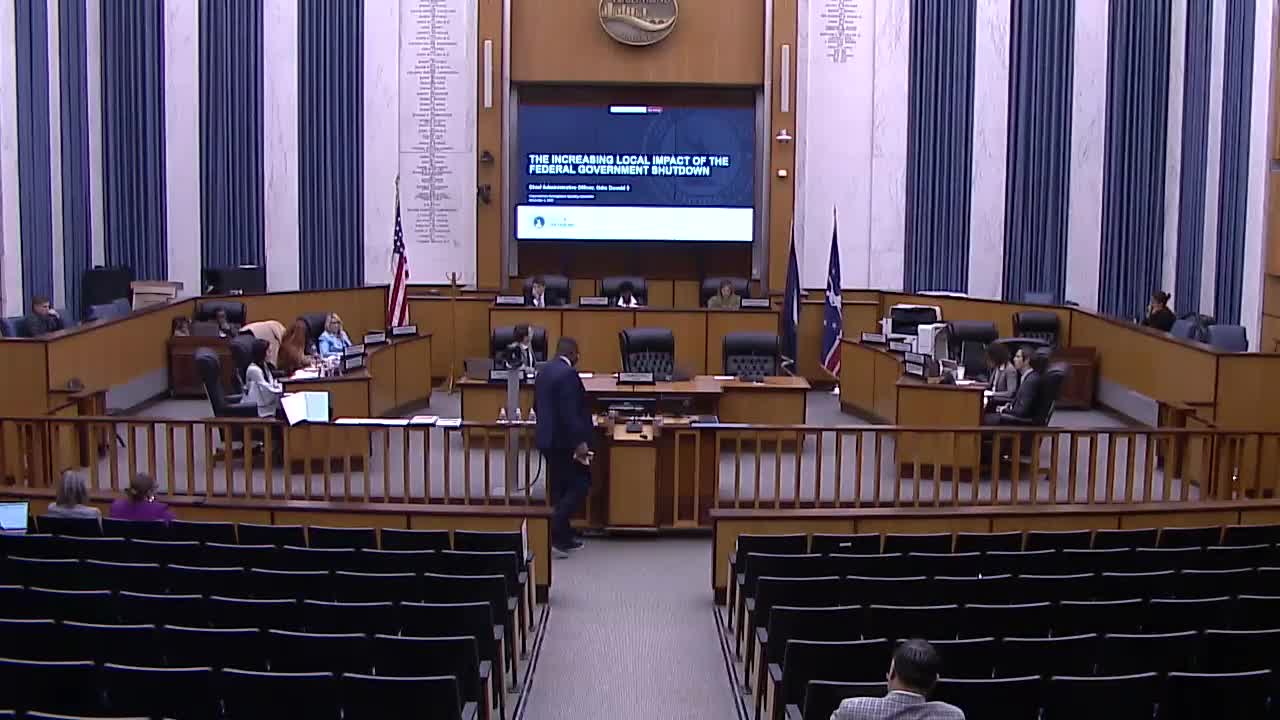
City warns SNAP recipients and HUD programs at risk amid federal shutdown; city activates mitigation and outreach
Loading...
Summary
The city warned that an ongoing federal shutdown threatens roughly $1.1 billion in locally implemented, federally supported programs and described steps the city is taking to maintain SNAP benefits, protect housing supports and keep social‑service staff paid while reimbursements are delayed.
The city reported an estimated $1,100,000,000 in federally supported programs at risk if federal reimbursement delays continue, Chief Administrative Officer Donald told the committee. “There are about 130 programs that are funded, in some form or fashion,” he said, and the city prepared a public Resilient Richmond shutdown report to outline the local exposure.
Donald said program risk can be grouped: 13 programs have already received full funding that is not affected; about 98 programs would face partial or eventual suspension if the impasse continues; and 19 programs could terminate immediately without further federal funds. He singled out the Department of Social Services (DSS) and the Department of Housing and Community Development (HCD) as having some of the most immediate operational risk.
On housing, Donald said HUD reimbursements have continued for now but the city is preparing worst‑case scenarios. He said CDBG, HOME, HOPWA and ESG programs collectively support dozens of subrecipient agencies and roughly 102 households through HOPWA; the city estimated roughly $500,000 in average monthly agency reimbursements and underscored that delays would increase city front‑funding obligations and could put ongoing home‑repair and rental assistance projects at risk.
On nutrition assistance, Donald said roughly 22,000 households — about 38,000 Richmond residents, or nearly 20% of the city's population — receive SNAP benefits. The CAO described two simultaneous developments: (1) the federal government announced it would cover 50% of November SNAP benefits using contingency funds, and (2) the Commonwealth is launching the Virginia Emergency Nutrition Assistance (VENA) weekly payments starting Nov. 3 to temporarily replace full monthly benefits while the shutdown persists.
The CAO also explained changes to SNAP work and exemption rules that took effect Nov. 1: the automatic exemption age moved from 55 to 65 and family exemptions shifted, which reduces the number of households automatically exempt from new work requirements. The city said those work requirements apply when a case comes up for review or renewal and that the state and city are coordinating to provide targeted outreach to affected residents.
City mitigation measures include activating bridge funding sources where possible, deferring discretionary purchases, prioritizing critical DSS and HCD services, implementing a hiring freeze on vacant grant‑funded positions, and coordinating with state partners and nonprofits (including Feed More and Richmond Public Schools) to expand food distribution and weekly payments. Donald said the city is also preparing targeted communications — multilingual postcards, text messages in coordination with the state, and coupon‑style handouts at food distributions — to reach residents with limited technology access.
Sean DeJos, director of social services, told the committee Medicaid recipients should not expect coverage interruption because Medicaid is federally required to continue through a shutdown, though he cautioned prolonged disruption would pose additional administrative complexity.
Council members asked for rapid follow‑up on housing provider insolvency risk, eviction and foreclosure exposure, and whether the city can take temporary measures to prevent homelessness. Donald told members staff are working on interim steps and intended to present additional operational options later in the week.
The CAO urged residents to use official city channels for up‑to‑date guidance (the city posted SNAP resources at go.rva.gov/snap) and asked elected officials and community groups to help mobilize donations and volunteers to supplement short‑term food distributions while federal and state actions evolve.