Dallas committees weigh $152M–$345M City Hall repair bill versus leasing and redevelopment
Loading...
Summary
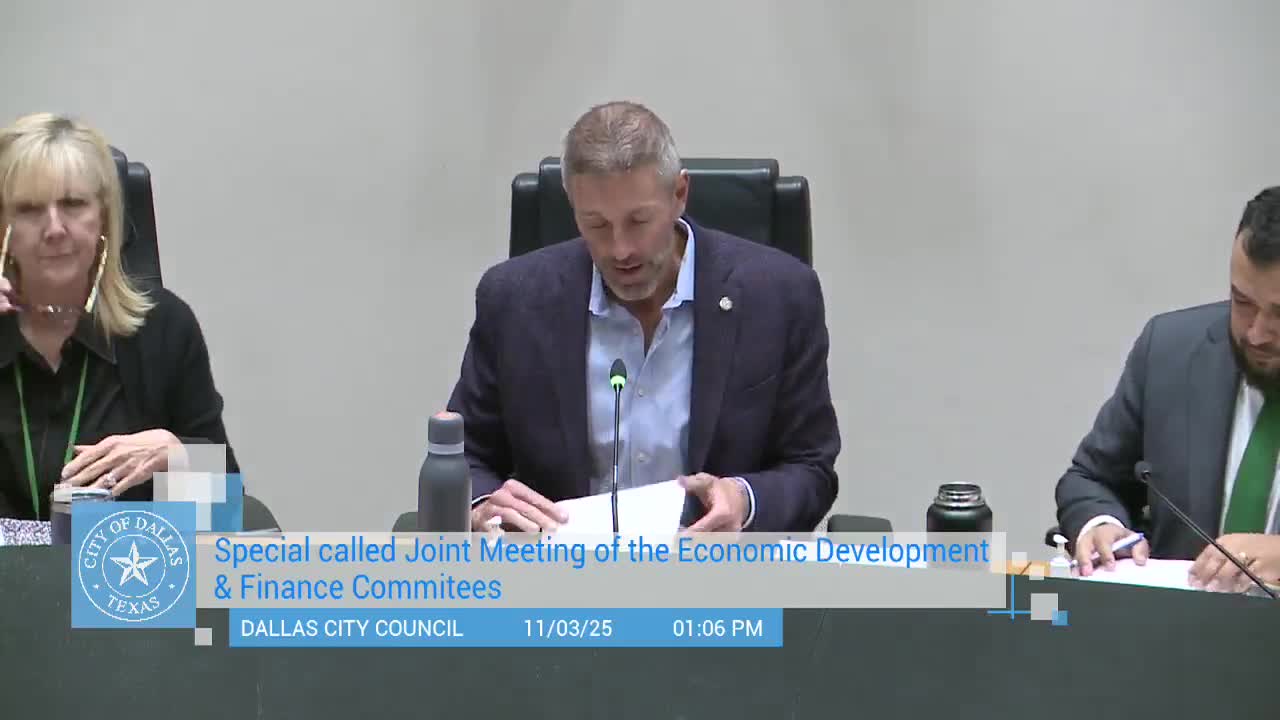
At a Nov. 3 joint meeting of the City of Dallas Economic Development and Finance committees, staff presented a range of options to address long‑running deferred maintenance at Dallas City Hall, saying full repairs could cost roughly $152 million to $345 million.
At a Nov. 3 joint meeting of the City of Dallas Economic Development and Finance committees, staff presented a range of options to address long‑running deferred maintenance at Dallas City Hall, telling council members the estimated cost to bring the building up to standard could be roughly $152 million to $345 million.
Staff framed three broad choices: maintain the status quo and accept continued failures, plan and fund phased capital repairs for City Hall, or relocate municipal operations to leased space (about 400,000 square feet in the central business district) and redevelop the 15‑acre City Hall site near the Kay Bailey Hutchison Convention Center.
Donzel Gibson, city manager’s office, said the estimates came from three sources: recent vendor quotes for shovel‑ready projects, prior estimates updated to current dollars, and staff projections based on historical experience managing city facilities. "The city is at an inflection point," Gibson said, summarizing the tradeoffs between substantial capital investment and the risk and disruption of continued deferred maintenance.
Staff told the committees that City Hall’s total footprint, including the garage, is about 1,000,000 square feet, with roughly 400,000 square feet occupiable for offices. The presentation cited an assigned staff population of about 2,200 employees (if fully on site), and described roughly 600,000 square feet of mechanical, garage and other non‑office space.
The briefing emphasized major unknowns. Vendor and third‑party estimates underpin about 29–30 percent of the overall cost estimate, staff said; additional uncertainty remains for items such as garage structural repairs and potential environmental hazards behind walls. Two structural engineers, representing Hunt & Joyner and Berkey Management Solutions, provided pro bono, rough orders of magnitude and said the staff estimates were "in the range of what we would expect," but staff and council members repeatedly asked for a sealed structural report and a comprehensive facilities condition assessment before any final policy decision.
Bond history and funding constraints figured prominently. Gibson recounted that the 2012 bond program included no city facilities funding, the 2017 bond program had a $7 million allocation for City Hall major maintenance, and the 2024 bond task force had advanced about $28 million for City Hall that the council later reallocated. Jack Ireland, chief financial officer, told the committees that the city is implementing the 2024 bond program through 2029 and that, unless council reprioritizes projects, meaningful new bonding capacity would be limited until about 2030. "We have the capacity right now to do everything in the 2024 bond program through 2029," Ireland said; adding a new, large City Hall proposition now would require delaying or substituting other projects.
Rosa Fleming, director of convention and event services, connected the discussion to downtown redevelopment and the convention center master plan. She noted that a redeveloped City Hall site could add taxable property to the roll and support continuity with the convention center project. "We are a top five U.S. city for meetings and conventions," Fleming said, and any non‑governmental redevelopment of the City Hall site would likely generate property, sales and hotel‑occupancy taxes currently foregone because the site is not on the tax roll.
Council members pressed staff for specific technical next steps. Multiple members asked for: (1) a sealed structural analysis and a full facilities condition assessment for City Hall, prioritized in the procurement schedule; (2) estimates of asbestos and other environmental remediation risks if interior work proceeds; (3) a side‑by‑side comparison that includes modernization and space planning for a renovated City Hall versus realistic lease or purchase options in downtown buildings (including the public spaces the city needs, such as chambers, public lobbies and parking); and (4) an economic‑impact/tax‑revenue study to quantify potential upsides from redeveloping the 15‑acre site adjacent to the convention center.
Council members expressed a mix of views without a formal vote on a final course of action at the meeting. Some members said they favored an approach that invests in the existing building if structural and cost data support it; others said the redevelopment opportunity and the potential to grow the tax base made leasing and redeveloping the site an attractive option. Mayor Pro Tem Moreno stated she was ready to pursue option 3 (leasing and redeveloping) and asked for an economic study; at least one council member said they strongly favored option 2 (plan and fund repairs) pending a full condition assessment.
Next steps identified at the meeting included: accelerating procurement of a thorough facilities condition assessment with a sealed structural report; preparing a space‑planning scenario that includes modernization and operating‑cost assumptions; commissioning an economic/tax‑impact analysis (which staff said could be done either by the city, the Economic Development Corporation, or a contracted consultant); and returning to the committees with timelines and cost‑detail for each option. The committees then recessed into executive session under Texas Gov. Code sections 551.071 and 551.072 to discuss property and legal matters and returned to adjourn at 4:27 p.m.
What remained unresolved at the meeting was who would pay for a major repair program if council chose to stay (staff assumed bond financing for the 10‑year comparison), how to sequence or reprioritize projects within current bond capacity, and how large a contingency is appropriate given the building’s age and documented unknowns. Council direction emphasized that staff should return with sealed technical analyses and more detailed financial and economic tradeoffs before any recommendation to the voters or formal council action.