Get Full Government Meeting Transcripts, Videos, & Alerts Forever!
Get email alerts on the Economic Development topic
No spam. Unsubscribe anytime.
Committee backs resolution to let Ozarks Electric pursue tax‑abatement conduit financing; judge will move next steps to full court
Summary
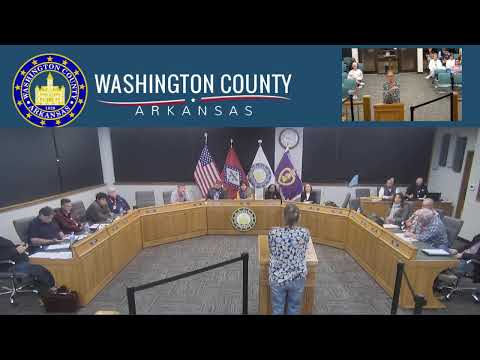
Washington County27s Services Committee voted Oct. 28 to send a resolution to the full quorum court supporting Ozarks Electric and Ozarks Go27s request to use a county conduit sale‑leaseback/tax‑abatement process to accelerate transmission, substation and fiber projects.
Washington County27s Services Committee on Oct. 28 voted to send to the full quorum court a resolution supporting Ozarks Electric and Ozarks Go as they pursue a county conduit sale‑leaseback and tax‑abatement process for specified infrastructure projects.
The committee27s action does not itself authorize tax abatement or issue bonds; it instructs the county judge to proceed with the legal steps required under state law if he chooses to do so. Michelle Allgood, attorney for Ozarks, described the process as a statutory conduit sale‑leaseback: the cooperative would finance and construct specified assets, the county would technically hold title for property‑tax reporting, and the cooperative would repay the financing; the county would not guarantee the bonds. Allgood said, "that is what you see and, a couple of things to make sure, we will build it, finance it. We technically own it.22
Azimuth and scope of the proposal: Ozarks representatives said the program would apply only to detailed, listed projects, not to all utility assets. Barrett Breeding, a company representative, said the planned work includes a major transmission rebuild to increase line capacity, a new operations/office location in Springdale, and additional fiber buildout for Ozarks Go. The presenters said the cooperative27s plan contemplates up to roughly $400 million of investment over about 10 years and that assets added early in the program could carry longer abatements (up to the statutory maximum), while assets added late in the build period would have proportionally shorter abatement periods.
Why the county was asked to act: Allgood said Arkansas law requires county authorization for the particular bond/leaseback structure and that the county serves as a conduit only; she told the committee the arrangement is "not a financial obligation" of the county and that the bonds are revenue bonds backed by lease revenue from the cooperative. "If Ozark Electric fall bankruptcy tomorrow, we had no ties to that," Allgood said when asked whether county taxpayers would be on the hook.
Questions and local concerns: Justices and members of the public pressed presenters about lost tax revenue to schools, whether the county assessor would be involved in valuing assets, how the abatement would be timed as assets are erected, potential impacts on utility rates, and whether the plan could be used by data centers. Allgood and Breeding said the company would file detailed renditions with the assessor, the school districts would be notified and given an opportunity to be heard although their formal approval is not required under the law, and that the pilot does not assume new generation or data‑center uses; it is targeted to distribution, transmission and fiber infrastructure. Breeding estimated a rough annual additional tax revenue to the county once projects are in service but said the program accelerates revenue realization relative to a slower, pay‑as‑you‑go timetable.
Committee vote and next steps: The committee passed the resolution in committee and sent it to the full court with a due‑pass recommendation. Committee members who supported the resolution cited accelerated infrastructure, improved reliability and earlier net revenue to the county; those opposed asked for more fiscal detail and cautioned about foregone near‑term tax receipts for some local taxing entities. The resolution itself does not enact abatement; if the county judge proceeds, statutory notices, a public hearing and filings with the assessor will follow.
Action recorded: Committee forwarded the resolution (11.1) to the full quorum court with a due‑pass recommendation; the county judge will have the authority to execute the steps required by Arkansas law to pursue the conduit sale‑leaseback process.