Get Full Government Meeting Transcripts, Videos, & Alerts Forever!
Get email alerts on the Wildfire Preparedness topic
No spam. Unsubscribe anytime.
Firewise volunteers present preparedness work as public debate grows over large‑scale forest thinning
Summary
Local Firewise groups described community preparedness, reflective address sign drives, chipping and prescribed burns; public commenters and Feather River Action criticized large-scale forest thinning farther from structures and a recent Plumas Sun article, calling for greater emphasis on home hardening and defensible space.
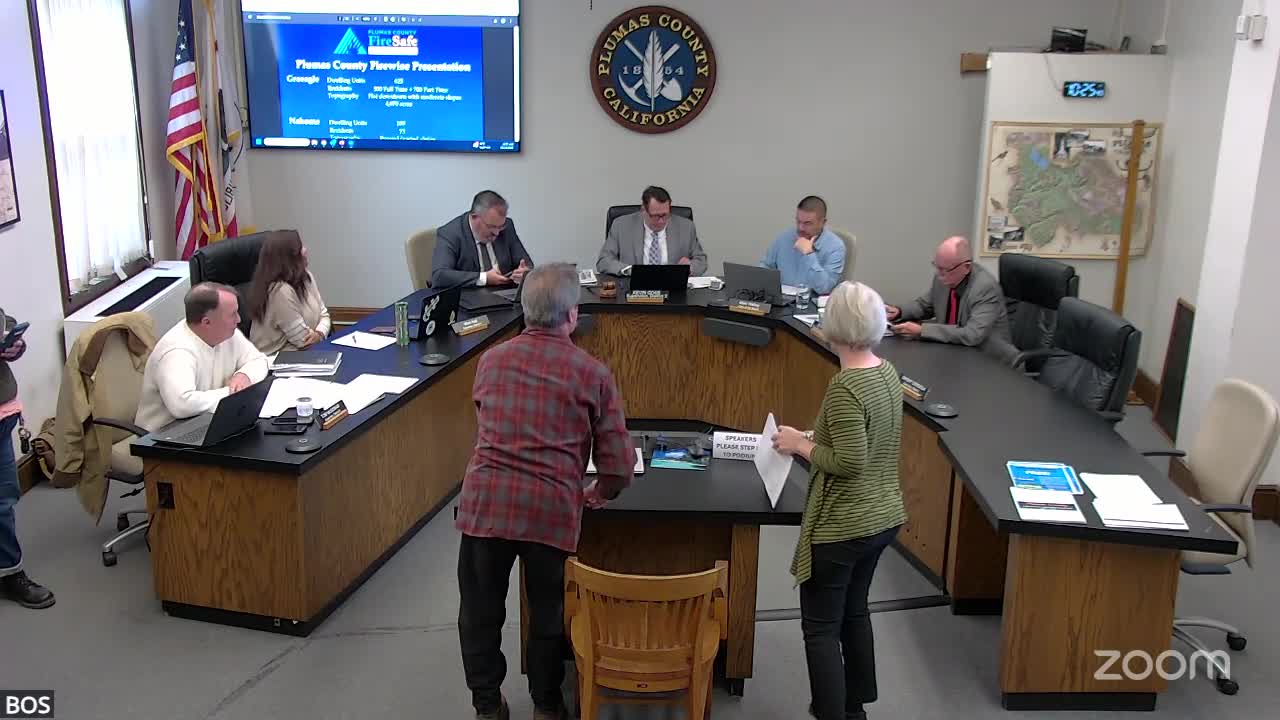
Representatives from Plumas County's Firewise communities presented an hourlong update Oct. 14 on volunteer-driven wildfire preparedness efforts across the county's east side, while public commenters pressed the board to weigh in on broader forest treatments and local media coverage of U.S. Forest Service projects.
Diane Gomez and other Firewise leads described activities in Graeagle, Nakoma, Valley Ranch and Smith Creek Ranch: evacuation drills, home‑hardening workshops, community work days, go‑bag distribution, a reflective address sign program (20 signs completed after a pancake breakfast outreach) and volunteer brigades with basic firefighting certifications and a T3 off‑road engine. Speakers said Graeagle has an estimated 700 part‑time residences and challenges contacting part‑time owners; Nakoma was reported as having approximately 369 vacant lots and 109 homes with roughly 1,356 acres identified for thinning across eight prioritized zones.
During public comment, Josh Hart of FeatherRiverAction.org criticized the U.S. Forest Service's proposed 400‑square‑mile Community Protection Project and a recent Plumas Sun article he said misrepresented scientific literature. Hart argued that large‑scale thinning and mastication beyond the immediate zone around homes can dry forests and increase wind penetration, letting fires move faster; he urged focus on home hardening and defensible space. Another commenter reiterated the point that structure loss is often driven by ember intrusion and said money should prioritize home protection.
Fire Safe Council representatives asked the board for county support for volunteer efforts and said a countywide wildland protection assessment will be completed in the spring; they requested the chance to present that plan and seek board involvement in strategic planning and a council resolution in coming months.
Board members and staff thanked the volunteers and acknowledged persistent outreach challenges to part‑time residents; no formal action was taken on fuel‑reduction policy or the Forest Service project during the meeting.