Get Full Government Meeting Transcripts, Videos, & Alerts Forever!
Get email alerts on the Food Permit Fees topic
No spam. Unsubscribe anytime.
City of Fishers health department proposes new food-permit fees tied to FDA risk levels
Summary
The City of Fishers Health Department presented a proposal to realign food establishment permit fees with FDA model food code risk levels; the department said the change would tie fees to inspection frequency, add reinspection fees and use prior-year grades to adjust permitted risk level by one step.
The City of Fishers Health Department presented a proposal to realign food establishment permit fees with the FDA model food code risk levels in a recorded webinar intended for public posting. Monica Helts, speaking for the health department, said the proposal would be presented to the City Council for adoption for the 2026 permitting year that opens Dec. 1.
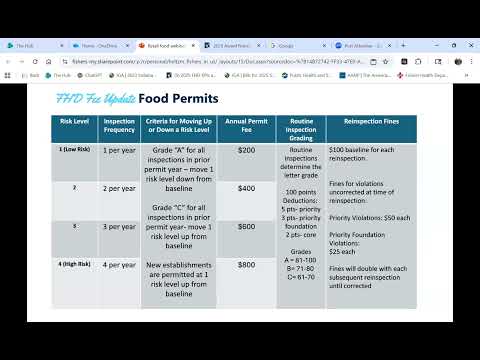
Under the proposal, fees would be tied directly to the FDA risk-level categories the Indiana State Department of Health has adopted and recent state-level changes Helts referenced. Risk levels 1 through 4 would determine inspection frequency — roughly annual for lowest-risk facilities up to quarterly for highest-risk facilities — and the annual permit fee would reflect the number of full inspections required for each level. "We are changing our fee structure to more align it with the FDA risk levels," Helts said.
Helts described the risk categories: risk level 1 covers convenience stores and coffee shops; level 2 covers retail food, schools and quick-service operations; level 3 covers most full-service restaurants that handle raw ingredients and require cooking, cooling and hot holding; and level 4 covers facilities serving highly vulnerable populations (for example, nursing homes and hospitals), which are normally permitted by the Indiana Department of Health. "Risk level 3 is most restaurants, basically," Helts said.
The proposal would use prior-year inspection grades to adjust an establishment's permitted risk level by one step. Establishments with a history of A grades would be permitted one risk level lower than their food-type baseline, reducing inspection frequency and the fee. Conversely, establishments with only C grades in the prior permitting year would be moved one risk level higher until their performance improves. New establishments would be permitted one risk level higher during their first year. "If you show a history of strong controls and strong practices, then you would be, really classified as 1 risk level down," Helts said.
Helts said the proposal represents about a 30% average increase across all establishments but that many current risk-level-3 establishments that have A grades would see little or no change. She provided examples: an established 21-employee restaurant currently paying $400 would remain at $400 under the proposal because a risk-level-3 baseline ($600) would be reduced one level for an A-grade history; a 13-employee restaurant with a baseline risk level of 2 that had repeated C grades would move up and be charged $600 under the proposal (compared with a current fee of $300); a coffee shop with a baseline risk level of 1 and mixed A/B grades would remain at risk level 1 and see no reduction below level 1.
The Health Department also proposed enforcement-related fees: a $100 fee for a reinspection visit, assessed each time staff must return to verify corrections; and the department would assess fines for uncorrected priority and priority foundation violations found during reinspections, with those fines doubling if violations remained uncorrected after a second reinspection. "If we have to come back and do a second reinspection, then, we will fine you a $100 for that reinspection," Helts said.
Helts said the grading categories (priority violations = 5 points; priority foundation = 3 points; core = 2 points) and the underlying point totals are not changing, but the city is updating the grading language to match Indiana code. She emphasized that routine (unannounced) inspections determine the grade used for any fee adjustment. "That routine inspection is what determines the grade level that you're getting," Helts said.
The proposal is intended to be introduced to City Council for adoption for the 2026 permitting year, which opens Dec. 1; the webinar did not record any City Council vote or final decision. For more information, Helts directed listeners to the City of Fishers website and to email the health department at healthdept@fishersin.gov.