
Cache County holds public hearing on potential CDBG application; residents propose fire stations, generators and replacement vehicles
Get AI-powered insights, summaries, and transcripts
Sign Up Free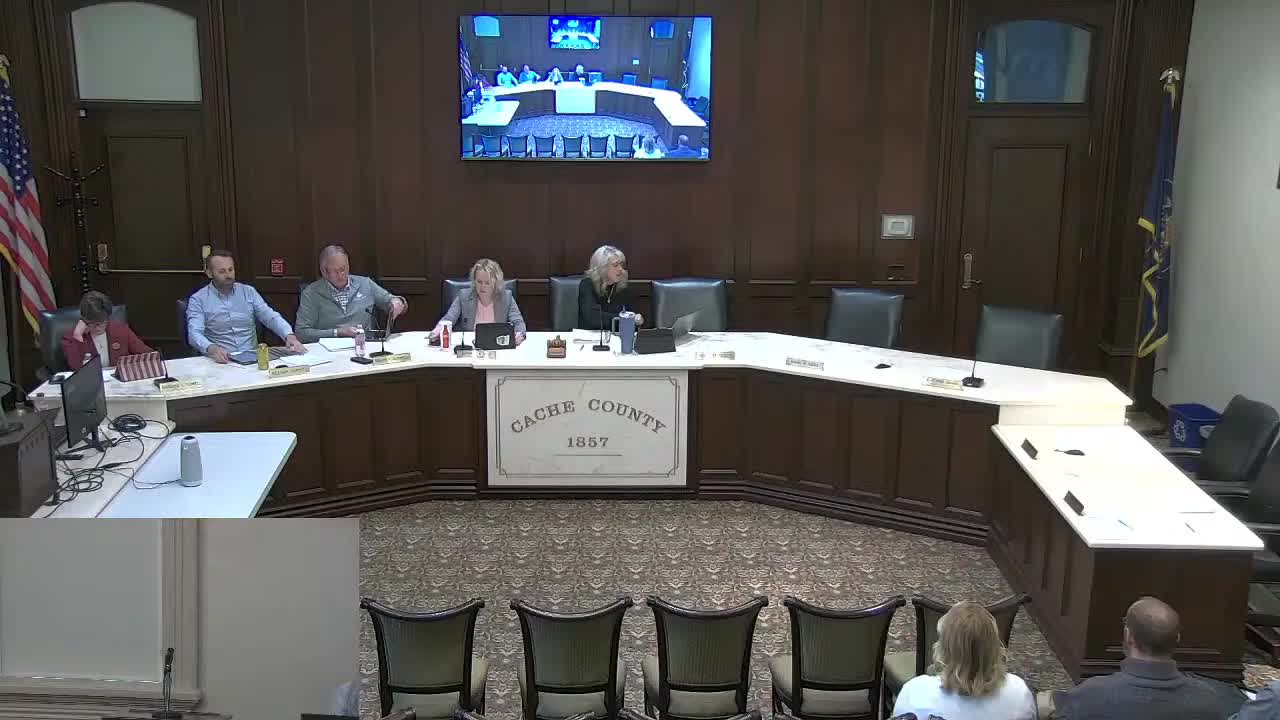
Summary
Cache County held a public hearing Oct. 28, 2025, at 199 North Main Street in Logan to gather public input on whether the county should apply for Community Development Block Grant (CDBG) Small Cities funding administered by the state.
Cache County held a public hearing Oct. 28, 2025, at 199 North Main Street in Logan to gather public input on whether the county should apply for Community Development Block Grant (CDBG) Small Cities funding administered by the state. County officials and a regional planner described program rules, income‑survey requirements and application deadlines; several local agencies and residents suggested projects the county could sponsor if it moves forward.
The hearing, opened by a county official, began with a public-notice reading that said Cache County is eligible to apply to the Utah Department of Workforce Services for CDBG funds administered through the state housing and community development division. Lucas Martin of the Bear River Association of Governments said the CDBG program can fund a broad range of activities "including, but not limited to, construction of public works and facilities such as water and sewer lines, fire stations, acquisition of real property, and provision of public services such as food banks or homeless shelters." He emphasized the program requires that projects principally benefit low- and moderate‑income (LMI) persons and that nonprofit organizations may ask the county to sponsor applications on their behalf.
Why it matters: CDBG funds are federal dollars distributed through the state and are typically reserved for projects that demonstrably serve LMI households. If the county chooses to sponsor an application, it will need to ensure proposed projects meet program eligibility and documentation requirements, including any income surveys required to show an area meets the LMI threshold.
Proposed projects and comments Brady George of the Cache County Fire District asked the county to consider capital projects for the district, including a new station for the Providence/Nibley area and seismic upgrades or replacements for existing stations in Paradise, Newton and Trenton. "The current age of our apparatus is right at the threshold for the national standard, which is 25 years of total service," George said, and he requested consideration of replacing frontline apparatus that will surpass the 25‑year threshold in coming months.
Lucas Martin explained eligibility mechanics for rural or unincorporated service areas: the county would perform an income survey of households in the service area for each proposed project; at least 51% of surveyed households must qualify as low‑to‑moderate income for the project to meet CDBG LMI requirements. Martin said strong survey results can remain valid for multiple future projects in that area.
Giselle Madrid of the Cache County Senior Center requested funding to replace two Meals‑on‑Wheels vehicles, noting the current vehicles are nearing substantial repair costs (she said the center is "hitting close to $200,000 on the vehicles"). Madrid also asked the county to consider a backup generator for the senior center to protect food and refrigerated items during power outages and to consider capital funding or land acquisition for a new senior center; she said a feasibility study is in progress.
Speaking on behalf of the Cache Community Food Pantry, Lucas Martin requested climate‑control improvements for an adjacent storage warehouse ("swamp coolers") and backup generators for the pantry’s freezers to prevent spoilage of perishable food during outages.
Alma Burgess, Cache County’s CDBG administrator, relayed additional ideas that have been raised, including accessibility upgrades to restrooms at the county election center (at the airport/fairgrounds site) and installing a backup generator there. "Generators seem to be a theme tonight," she said.
Process and deadlines Martin said the Bear River region currently lists Dec. 1, 2025, as the deadline to submit a materially complete application from the county; final applications are submitted in January. He noted that because of a federal government shutdown affecting HUD availability, the state had indicated it might allow an internal extension to accommodate questions that require HUD guidance. The county chair instructed members of the public who wish their projects considered to submit proposals through Alma Burgess, who will present specific applications at a subsequent public meeting where the council will decide which projects, if any, to sponsor.
Outcome and next steps No formal funding decisions were made at the hearing. The meeting concluded after public comment; the council moved and seconded adjournment and approved the motion by voice vote. After adjournment, the chair introduced Stephanie Giddens, a new Bragg staff member who will work on CDBG matters with the county.
What the record shows: attendees discussed project ideas for public‑safety infrastructure (fire stations and apparatus), senior services (vehicle replacement and a generator), food‑security infrastructure (cooling and generators), and election‑center accessibility. Eligibility for any of these projects will depend on meeting CDBG LMI requirements and submitting a materially complete application by the stated deadline.