Central Utah Water highlights Olmsted power plant's historic architecture while defending new plant built to protect water rights
Loading...
Summary
Jansen Cook, Preservation Architect with the Utah State Historic Preservation Office, led a recorded tour of the Olmsted Power Plant campus and described the plant's early-20th-century construction, its machinery, and why Central Utah Water built a modern replacement to maintain generation and protect stored water.
Jansen Cook, Preservation Architect with the Utah State Historic Preservation Office, led a recorded tour of the Olmsted Power Plant campus and described the plant's early-20th-century construction, its machinery, and the reasons Central Utah Water Conservancy District built a modern replacement plant.
Cook said the historic plant was built of ashlar masonry, a fired-clay masonry chosen in part for fire resistance, and that large windows historically provided daylight for workers before electric lighting was commonplace. "It was built of Ashlar Masonry," Cook said, "and the reason for that is that it was fire resistant." He described the site as a run-of-river plant that diverts water about 4.5 miles up Provo Canyon rather than siting at a dam base.
The tour traced the plant's water routing: water stored at Bridal Lake (around 10,000 feet) supplies spring runoff that Central Utah Water and other regional users rely on; water is conveyed through Jordanelle and coordinated with diversions at Deer Creek and the Pearl River before being diverted at the Olmsted intake. Speakers said the combined full water right for the historic plant was 429 cubic feet per second (CFS). Cook provided operational context: "For the non-water guys out there, 1 cfs is roughly 450 gallons a minute," and noted that sustained flows are commonly expressed as acre-feet.
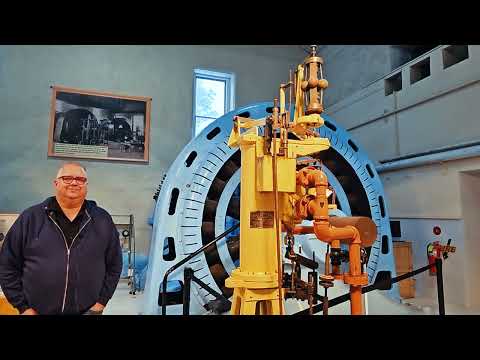
Cook and Central Utah Water staff showed original equipment and manufacturing provenance; turbines and generators were brought in by rail from General Electric in New York and original nameplates remain. The tour included machine elements (wicket gates, governors, Pelton and Francis turbines), a former control room with older "Christmas tree" dials, and visible cavitation damage that staff said helped justify building a new plant. "When we started evaluating the condition of this plant... it was cheaper for us to build new ones," Cook said.
Speakers described the historic campus as largely self-sufficient, with a Telluride Institute used to train workers, a blacksmith shop, labs and housing for workers. Cook noted that the Telluride Institute lineage still exists though not at the same building, saying it is now at Cornell (as stated on the tour).
Central Utah Water staff outlined the project chronology as discussed on the tour: Cook recalled involvement beginning around 2012 and coordination with the State Historic Preservation Office for clearances; participants described upgrades in the 1980s, a 2015 evaluation of the historic plant, and subsequent design and construction work for the replacement plant across the parking lot. Speakers stated the replacement plant generates roughly 10'13 megawatts in exchanges during the tour and emphasized the replacement was built to preserve generation and protect Jordanelle-stored water that supports about 1.6 million water users, as one speaker stated.
Preservation work during redevelopment included efforts to retain architectural features (masonry detailing, insulators, some historic finishes) while managing modern requirements such as groundwater collection and accessibility. Tour presenters described compromises and mitigation measures to protect historic fabric without jeopardizing operation.
The recorded tour closed with Central Utah Water staff reiterating their ownership and stewardship role: much of the campus is owned by Central Utah Water Conservancy District, and the agency said it planned ongoing maintenance and updates "for the foreseeable future."