Get Full Government Meeting Transcripts, Videos, & Alerts Forever!
Get email alerts on the Infrastructure Finance topic
No spam. Unsubscribe anytime.
Commission discusses civility code and mayor outlines multi‑part plan to raise $200M for infrastructure without raising homeowner taxes
Summary
Commissioners discussed a proposed civility code for elected/appointed bodies and a seven‑part mayoral proposal to generate revenue for roughly $200 million in infrastructure needs without raising homeowner taxes.
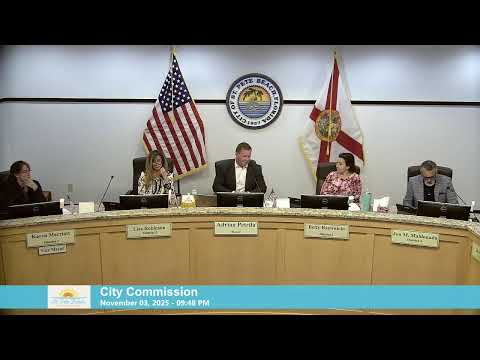
Commissioners discussed two separate items in the Nov. 3 meeting’s discussion section: a draft standards‑of‑conduct (civility) framework and a mayoral outline of a multi‑part strategy to address an estimated $200 million infrastructure backlog.
Commissioner Maldonado introduced a draft standards‑of‑conduct document modeled after recent actions in other municipalities and said the goal is to foster respectful, civil public meetings and interactions among elected and appointed officials. Commissioners expressed general support for further study and suggested staff (and the city attorney) bring back examples and potential language for adoption in early 2026.
Mayor Petrillo presented a seven‑part financing concept he said could fund a roughly $200 million infrastructure need including sewers, reclaimed water, pump stations and roads, and could be implemented without raising the homeowner tax rate. Elements he described were: (1) exploring access or vehicle‑entry fees (tolling or access charges) for nonresident vehicles combined with resident/business exemptions; (2) leveraging additional parking revenue and enforcement (including permit reforms and higher fines); (3) partnering with the University of Florida for planning and ordinance models; (4) creating a community redevelopment area (CRA) to capture incremental property tax revenue; (5) pursuing federal and state grants and private grants; (6) seeking a larger share of county tourist development tax (TDT) dollars for local capital projects; and (7) updating fees and impact fees.
The mayor said, by way of example, a $1 per‑vehicle island access charge applied to the county’s estimated 60,000 daily trips could yield approximately $11 million annually, which combined with other measures and bonding could finance major projects. Commissioners requested legal analyses, equity and traffic‑management studies and more detailed fiscal modeling before taking policy steps; staff was asked to return with options and constraints, including FDOT ownership of Gulf Boulevard and the legal steps necessary to change road ownership or add access charges.