Wausau panel recommends April referendum after fire chief warns of staffing, safety and insurance risks
Loading...
Summary
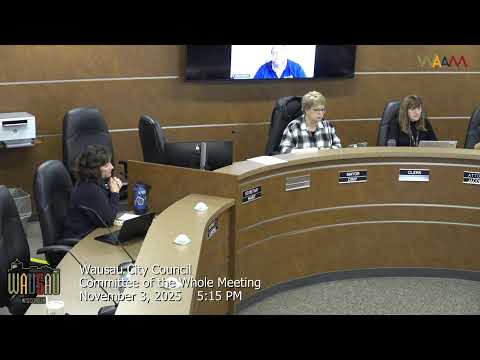
Wausau Committee of the Whole members on Nov. 3 recommended that the Common Council put a funding question for firefighters on the April 7, 2026 ballot after Fire Chief Jeremy Kopp presented evidence of chronic understaffing, rising call volume and operational risks.
Wausau Committee of the Whole members on Nov. 3 recommended that the full Common Council place a referendum on the April 7, 2026 ballot asking voters to fund firefighter positions, after Fire Chief Jeremy Kopp detailed years of stagnant staffing, growing call volumes and operational risks.
Chief Kopp told the committee the department has relied on a hybrid cross-staffing model for decades that leaves engines and ambulances frequently under-crewed. “This isn't a job. This isn't a career. It's a calling,” Kopp said, describing how crews now perform more advanced medical care and entry operations than in past decades. He said the city is counting 68 positions toward daily staffing, and six apprentices are expected to become certified paramedics soon, bringing the target to 74 by Jan. 1, 2026.
The nut graf: council members said they needed voters’ direction because grant funding and federal SAFER grant timelines complicate long-term budgeting. The committee debated whether to ask residents to fund a portion or all of the recurring costs and discussed parallel contingency and revenue options if voters reject a levy increase.
Supporting details: Kopp said the department’s call volume has increased almost every year and that the city could exceed 7,000 calls this year, pulling personnel away from fire engines and increasing reliance on mutual aid. He described a recent house fire captured on a ride-along video in which the first-arriving lieutenant deployed a 2 1/2-inch hose line alone until additional crews arrived. Kopp said that level of strain increases the risk of lost property, delayed rescues and firefighter injuries. He cited NFPA guidelines, ISO (Insurance Service Office) ratings and NIOSH research as benchmarks the department uses in planning and evaluation.
Kopp and staff reviewed the SAFER grant timeline and recruitment work: the SAFER award began in 2022 and expires in early February 2026; the chief said about $600,000 may remain in the grant and staff intend to seek an extension if the federal office reopens applications. The finance director and mayor warned that state “maintenance of effort” rules for shared revenue and the timing of grant expiration could affect how positions are counted in future certifications to the state.
The committee also examined costs and alternatives. Kopp said the city has spent approximately $177,000 to outfit and train apprentices. Staff presented overtime figures and payroll data discussed in the meeting (year-to-date overtime through September cited in the session), and members suggested revenue options including charging for fire-run responses (a fee other communities use and insurance companies often cover), increases to ambulance contract rates, and internal cuts. Mayor and staff outlined one scenario that would permanently fund four firefighter positions by reallocating about $1.41 million from specified contracts and administrative positions as a partial contingency.
Public comment and neighborhood feedback were mixed. Kathy Strawser, president of the Police and Fire Commission, urged the council to prioritize public safety and urged elected leaders to make “the hard choices that keep Wausau safe, strong, and financially stable.” At least one alder reported district-level opposition to a referendum, and council members said they had heard both support and resistance during neighborhood outreach.
After about two hours of presentations and discussion, Alder Larson moved, and Alder Watson seconded, a recommendation that the Common Council place a referendum on the April 7, 2026 ballot; the motion passed on a voice vote. The committee then considered a revised, lower-cost proposal from Miller Communications to provide neutral education materials and outreach. Miller presented a reduced scope that removed survey components and reduced the number of mailers; the committee amended the proposal to one mailed piece and approved recommending Miller’s retention on a roll-call vote, 5–4.
Votes at a glance: • Recommendation to place a referendum on the April 7, 2026 ballot — Mover: Alder Larson; Second: Alder Watson; Outcome: motion carried by voice vote (no roll call recorded). • Recommendation to retain Miller Communications for voter-education with a reduced single-mailer scope — Mover: Alder Larson; Second: Alder Watson; Outcome: approved on roll call, 5–4. Roll call (as recorded): Lukens Aye; Neal No; Kreiner No; McElhinney No; Rasmussen Aye; Watson Aye; Tierney No; Larson Aye; Henke Aye.
Why it matters: committee members and city staff said the SAFER grant expiration, persistent overtime and a potential ISO downgrade could have financial and public-safety consequences if the city does not secure stable funding. Several alderpersons urged continuing parallel work on contingency planning, revenue options and more-granular cost estimates before the council finalizes ballot language.
What’s next: the Committee of the Whole made nonbinding recommendations to the Common Council. The council will consider the recommendations at its next meeting; if the council approves a referendum question it must finalize ballot language and filing details in the coming weeks ahead of the January deadline for an April question. Staff will continue contingency planning and follow up on open items including the SAFER-grant-extension request and additional revenue analyses.